Xiaomi 18 Pro and Xiaomi 18 Pro Max Launch: Xiaomi’s new flagships combine 2nm Snapdragon chips, 200MP Leica-branded cameras, rear displays and batteries as large as 8,500mAh. The more unusual story, though, is a privacy feature designed to deal with people peeking at your screen.
Xiaomi has taken the wraps off the Xiaomi 18 Pro and Xiaomi 18 Pro Max in China, and unlike the previous Pro generation, these two phones are also headed outside the company’s home market.
The Xiaomi 18 Pro series was launched in China on September 23, with Xiaomi confirming that a global release will follow later in 2026. An exact international launch date, list of countries and global pricing have not yet been announced.
That global push matters, but it is not the only reason the 18 Pro series stands out. Xiaomi has packed the phones with the kind of hardware expected from an aggressive flagship launch, including Qualcomm’s latest 2nm processors, large batteries, dual displays and a 200MP-led camera setup. It has also added something less conventional: a display privacy system built to make shoulder-surfing harder.
The Xiaomi 18 Pro can react when someone looks over your shoulder
Both the Xiaomi 18 Pro and 18 Pro Max introduce what Xiaomi calls a Privacy Display. In ordinary use, the feature reduces the screen’s usable viewing angle so people sitting or standing nearby have a harder time seeing what is on the display.
There is another layer to it. Launch coverage cited by AndroidPure says the system can use the front camera to detect an onlooker and automatically activate privacy mode. It can also use location information to trigger the feature in crowded places.
That makes the feature more interesting than a conventional privacy filter because the phone is not simply making the display harder to read from the side. It is designed to respond to the situation around the user.
There is, however, an unanswered technical question. The available launch coverage does not clarify whether the onlooker-detection process happens entirely on the device.
Two Pro phones, but Xiaomi has given them different silicon
The Xiaomi 18 Pro gets a Snapdragon 8 Elite Gen 6, while the larger Xiaomi 18 Pro Max steps up to the Snapdragon 8 Elite Extreme Gen 6. The chipsets are manufactured on a 2nm process, with the phones offering up to 16GB of LPDDR5X RAM and 1TB of UFS 4.1 storage.
Size is another clear dividing line.
The Xiaomi 18 Pro uses a 6.4-inch AMOLED display with a 2,436 × 1,120 resolution, while the Pro Max moves to a 6.9-inch panel with a 2,624 × 1,208 resolution. Both support refresh rates up to 120Hz and peak brightness of up to 4,000 nits.
Xiaomi has also kept the secondary rear screen. The 18 Pro carries a 2.7-inch AMOLED panel on the back, while the 18 Pro Max gets a slightly larger 2.9-inch version.
So the rear display is no longer just a one-off visual experiment. Xiaomi is retaining it as part of the Pro series design.
Xiaomi is betting heavily on 200MP cameras
The two models share the same Leica-branded triple-camera arrangement.
There is a 200MP main camera, a 200MP periscope telephoto camera with 3.2x optical zoom, and a 50MP ultrawide camera. The phones also carry a 50MP front camera, while video recording goes up to 8K at 30fps.
That means Xiaomi is not using the Pro Max name to reserve the higher-resolution camera system for the larger phone. The main camera hardware is shared across both models, while the bigger differences come down to display size, processor and battery capacity.
The Pro Max stretches battery capacity to 8,500mAh
Battery size is one of the most striking specifications in the new lineup.
The Xiaomi 18 Pro packs a 7,000mAh silicon-carbon battery, while the Xiaomi 18 Pro Max increases that to 8,500mAh. Both support 100W wired charging.
The supplied launch reports differ on the stated wireless-charging figure, so a single wireless charging rate is not being treated here as confirmed.
Both phones run HyperOS 4, with one report specifying Android 17 as the underlying software version.
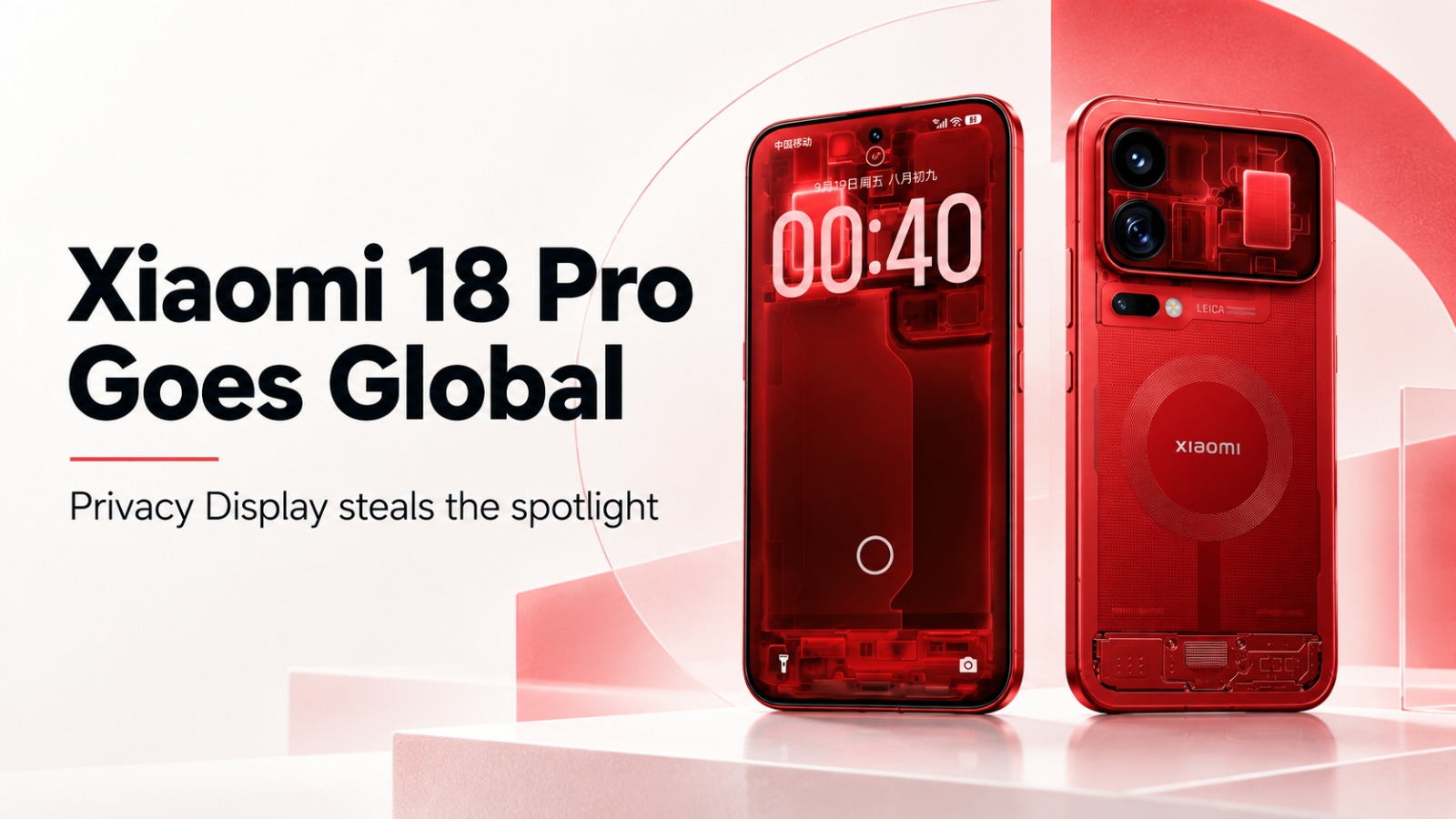
The red Transparent Edition goes further than a different back panel
Xiaomi is also selling Transparent Special Editions of both phones, and this is where the launch gets considerably more playful.
The special models come in red and are available only with 16GB of RAM and 1TB of storage. Xiaomi says the textured rear finish uses a micron-level film process to create a three-dimensional embossed effect.
The visual theme continues into the software. Xiaomi has created wallpapers for both the main screen and the rear display that mimic the phone’s internal components.
Even the contents of the box follow the theme: the Transparent Edition includes a colour-matched transparent red charging brick and data cable.
It is a small detail, but one that gives the special edition more character than simply swapping the colour of the rear glass.
Importantly, the special editions do not receive different core hardware. Their internal specifications are otherwise the same as the corresponding standard 18 Pro and 18 Pro Max models.
Xiaomi 18 Pro and 18 Pro Max price in China
The Xiaomi 18 Pro starts at CNY 5,999 for the 12GB RAM and 256GB storage model. Higher configurations rise through CNY 6,999, CNY 7,999 and CNY 8,999, while the 16GB + 1TB Transparent Edition costs CNY 9,999.
The Xiaomi 18 Pro Max starts at CNY 6,999, with its regular 16GB + 1TB version reaching CNY 9,999. The Transparent Edition sits at the top of the range at CNY 10,999.
For buyers outside China, those prices are only a reference point for now. Xiaomi has confirmed that the 18 Pro series will be released globally later this year, but there is still no confirmed international price or market-by-market launch schedule.
The global version of the story will therefore depend on more than specifications. Xiaomi still has to reveal where the phones will be sold, how much of this hardware will carry over unchanged and what premium it plans to charge outside China.
For now, though, the Xiaomi 18 Pro series is shaping up around three ideas that are unusually easy to distinguish: very large batteries, unusually high-resolution cameras and a phone screen that is designed to notice when someone else may be trying to read it.
Also Read: Xiaomi 18 Pro and Pro Max: Battery, Camera, Display, Launch Date and Everything We Know