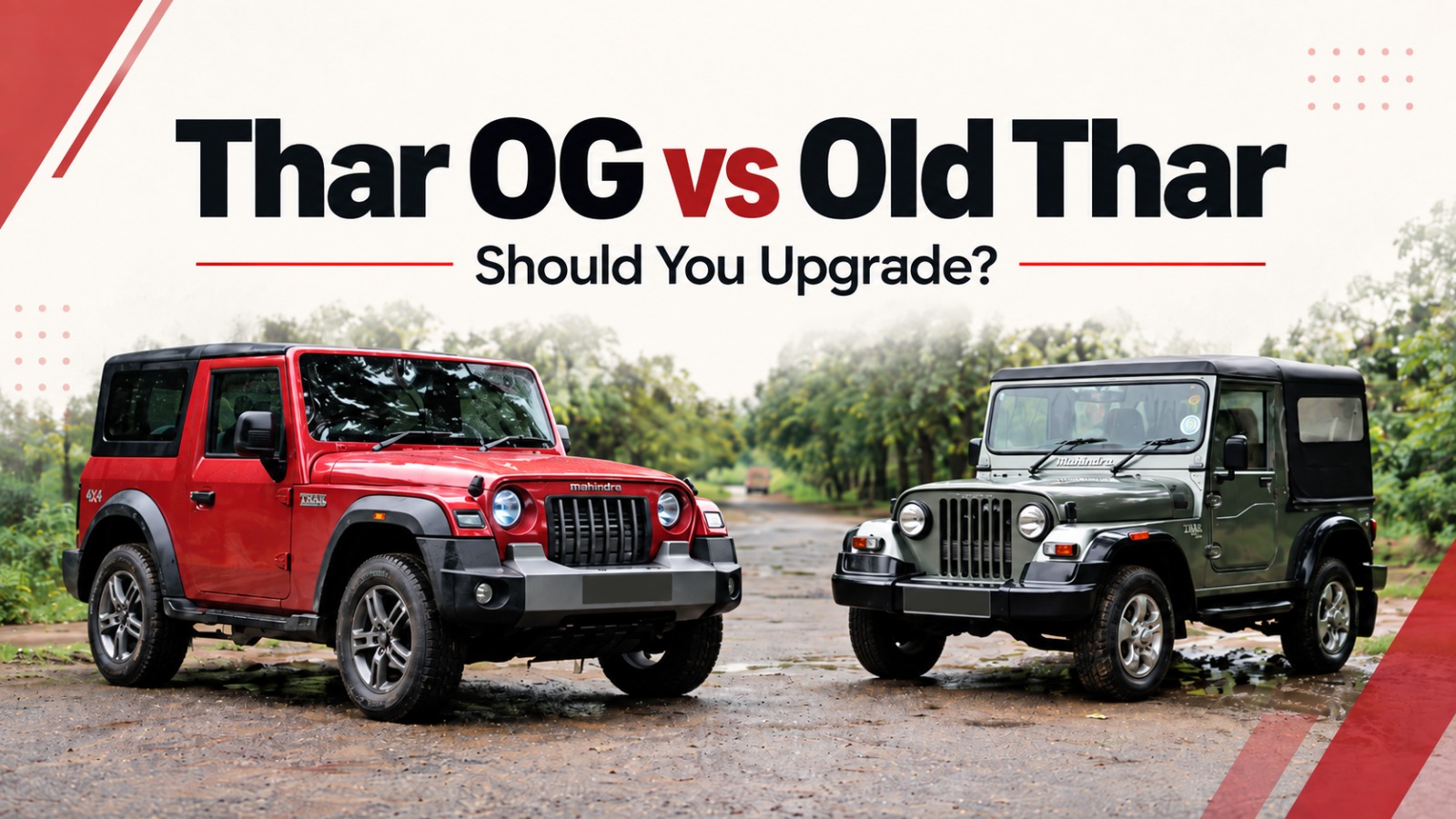
Mahindra has changed more than the face of the three-door Thar with the new Mahindra Thar OG. But for someone who already owns the outgoing model, the bigger question is whether there is enough here to justify buying another one.
Buying a new Mahindra Thar OG is one decision. Replacing an existing three-door Thar with one is a very different one.
That distinction matters because Mahindra has not completely reinvented the SUV. The familiar Thar silhouette remains, but underneath it sits a series of mechanical revisions, along with a reorganised range built around three trims, three engine choices and both rear-wheel-drive and all-wheel-drive configurations.
The new Thar OG has been launched at introductory ex-showroom prices ranging from Rs 10.32 lakh to Rs 17.75 lakh, a difference of Rs 7.43 lakh from the bottom to the top of the range.
For first-time Thar buyers, that gives plenty of choice. For existing owners, however, the upgrade calculation is more complicated.
Why upgrading to the Mahindra Thar OG could make sense
The strongest argument for moving to the Thar OG is that Mahindra has gone beyond a cosmetic facelift.
The company has retained the recognisable three-door shape while making what are described as significant mechanical revisions beneath the skin. That immediately makes the OG more relevant to an existing owner than an update limited to bumpers, lights or cabin trim would have been.
There is also considerably more choice within the new range.
Mahindra is offering the Thar OG in LXT, AXT and ZXT trims, with three engine options and a choice between RWD and AWD, depending on the variant.
That could matter particularly to an owner whose requirements have changed since buying the older Thar.
Someone who previously bought one configuration but now wants a different drivetrain has a reason to look again. The availability of both RWD and AWD means the OG is not being offered with a one-size-fits-all mechanical setup.
Similarly, three engine choices give buyers more room to choose a version around their current needs instead of simply replacing an older Thar with a near-identical specification.
In other words, the case for upgrading is strongest when an owner wants to change the kind of Thar they drive, not simply replace an old one with a newer registration number.
But this is not an automatic upgrade for every Thar owner
There is an equally important reason not to rush.
Visually, Mahindra has deliberately retained the Thar’s familiar silhouette. The OG receives visual and equipment updates, but it is not presented as a ground-up design departure from the outgoing three-door model.
For an existing owner who still likes their Thar and has no particular need to switch engine or drivetrain configuration, that familiarity cuts both ways.
It preserves what people recognise about the Thar, but it also means an owner should not expect the upgrade decision to be justified simply by dramatically different styling.
More importantly, the information available does not establish enough verified detail to claim that every existing Thar owner will receive a measurable improvement in performance, fuel economy, ride quality or any other specific area by moving to the OG.
Those claims would require specifications or comparative data that are not included in the material available here.
That makes the sensible comparison less about whether the Thar OG is “better” in the abstract and more about whether its particular changes solve something an existing owner actually wants changed.
The three-engine, RWD and AWD mix may be the real upgrade story
This is where the OG becomes more interesting.
Mahindra could have treated the three-door Thar update largely as a styling exercise. Instead, the new model arrives with three trims, three engine choices and two drivetrain layouts.
That makes the range itself an important part of the update.
An owner of the previous Thar who wishes they had selected a different powertrain or drivetrain has a clearer reason to consider moving up. Someone who is already happy with their current combination has a weaker one.
It is a small distinction, but an important one for buyers looking beyond launch-day excitement.
Price also changes the conversation
The Thar OG starts at Rs 10.32 lakh ex-showroom and stretches all the way to Rs 17.75 lakh.
That Rs 7.43 lakh gap between the entry and upper ends of the range shows how differently two Thar OG purchases can be configured.
It also means there is no single answer to the upgrade question.
Moving from an older Thar into a comparatively accessible OG variant is a different financial decision from stepping into a version near the top of the Rs 17.75 lakh range.
For existing owners, the relevant number is therefore not simply the Thar OG’s headline starting price. It is the price of the engine, drivetrain and trim combination that would genuinely represent an upgrade over the Thar already sitting in their garage.
So, should an old Thar owner upgrade?
On the information currently available, the Thar OG looks more compelling as a considered upgrade than an essential one.
The case becomes stronger if you want a different engine or drivetrain configuration, were already planning to replace your existing vehicle, or specifically value the mechanical revisions Mahindra has made beneath the familiar body.
The case becomes weaker if your current three-door Thar already meets your requirements and you were expecting a substantially different-looking vehicle to justify changing it.
That is ultimately what makes the Thar OG interesting.
Mahindra has not discarded the formula that made the three-door Thar recognisable. It has instead worked underneath that formula, while broadening the combinations buyers can choose from.
For a new buyer, that means more options.
For an existing owner, it means the right question is no longer simply “What has changed?”
It is “Has the part of the Thar I wanted to change actually changed enough for me?”
And that answer will depend far more on the engine, drivetrain and trim being considered than on the familiar shape parked outside.
Also Read: Xiaomi 18 Pro and Pro Max: Battery, Camera, Display, Launch Date and Everything We Know