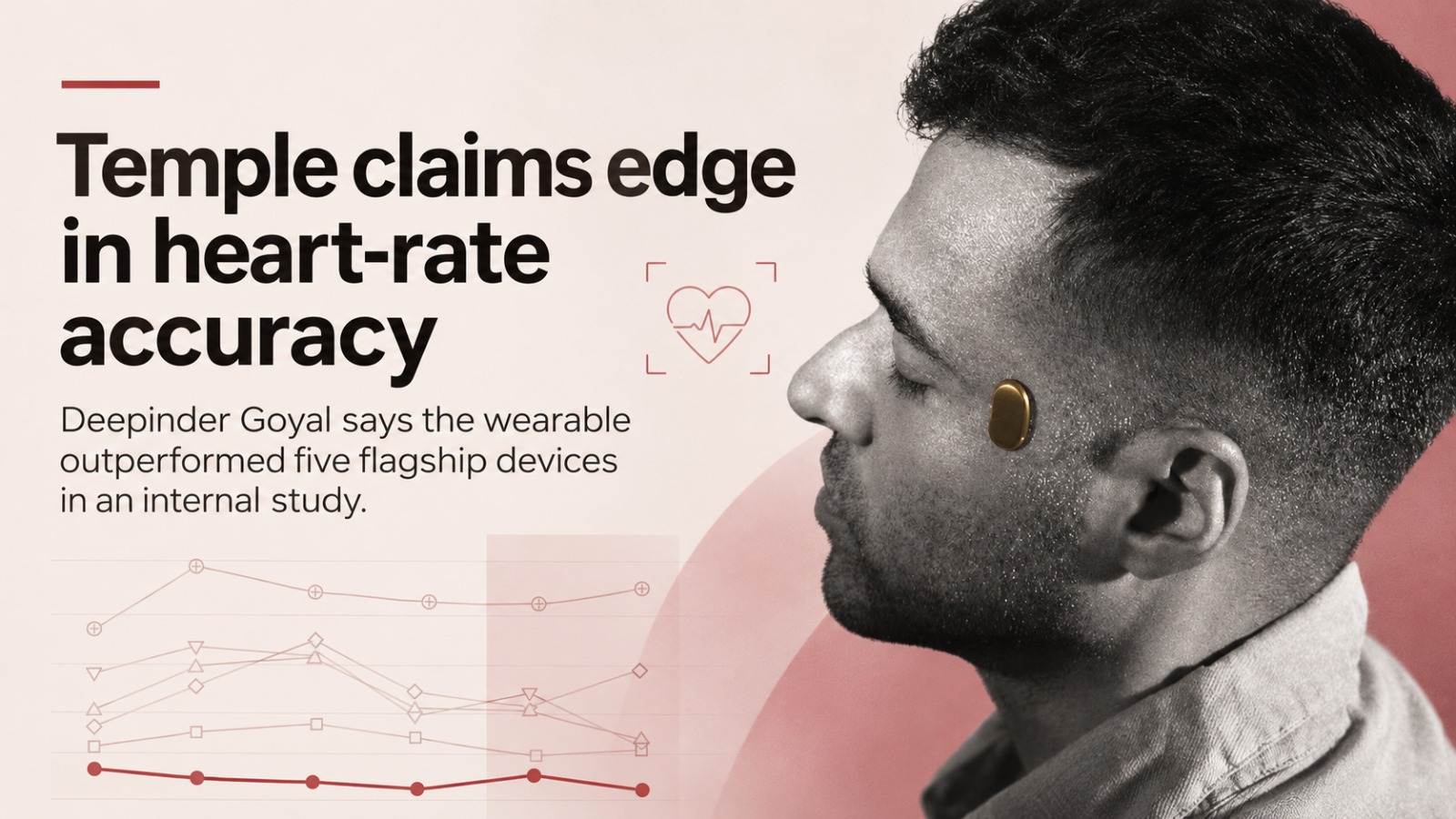
Deepinder Goyal, founder of wearable technology company Temple, has shared findings from an internal study claiming that the company’s device delivers more accurate heart rate measurements than five leading wearables, including the Apple Watch, WHOOP and Oura Ring.
The experiment involved comparing Temple with five flagship devices for various exercise intensities, ranging from the resting state to the peak level. As per Goyal, Temple was able to measure the heart rate inaccuracies in the least number of times, especially at high-intensity exercises.
In a post on X, Goyal said heart rate monitoring remains an unresolved challenge for wearable technology, especially in heart rate Zones 4 and 5, which are particularly relevant to professional athletes.
Accuracy assessment was performed using the Polar H10 chest strap as a reference system. In contrast to standard measurements, the researchers attached the chest strap to the participants’ chest using tape to avoid contact loss during physical activity.
Goyal explained that chest straps can lose contact with the skin during sprints, potentially causing missed heartbeats and affecting measurements.
The comparison included the Apple Watch Series 12, Oura Ring 5, Garmin FR970, Fitbit Air and WHOOP MG.
The company’s published chart measures mean absolute error (MAE), expressed in beats per minute, across resting conditions and five heart rate zones. Lower error values indicate greater accuracy against the reference measurement.
Temple recorded the lowest mean error across all six conditions shown in the chart. Goyal identified the Apple Watch Series 12 as the closest competitor overall.
He also claimed that Temple outperformed the Polar H10 when the chest strap was worn without tape during high-intensity Zones 4 and 5. This was a separate comparison from the study’s taped chest-strap reference.
Explaining the reported advantage, Goyal highlighted two design choices: the device’s adhesive attachment and its placement on the temple.
He feels that the adhesice ensures consistent contact of the device with the skin in practice, minimizing the difference between practical application and laboratory tests.
The second aspect is the position where measurements take place. Goyal stated that the temple is above the main artery in the body and maintains the blood flow even during intense physical exertion.
He added that Temple tested the same sensor at four locations on the body, with the temple producing the most accurate results.
The company believes improvements in heart rate accuracy could also strengthen other performance-related measurements that depend on reliable heart rate data.
However, the findings are based on Temple’s own research and should not yet be treated as independently established evidence of superiority over competing devices. Broader testing across different users, activities and conditions will be important in assessing whether the reported advantage holds up.
Goyal said Temple has made its full white paper and supporting data available through its website. An expanded study involving independent researchers is also underway, according to his post.
The company has invited further independent replication under additional testing conditions and offered to fund such research.
The announcement reflects Temple’s ambition to develop a wearable aimed at elite performance athletes, with precise heart rate tracking positioned as one of its core priorities.
Also Read: Two Point O Capital Raises $10 Million to Expand into Battery Storage and Clean Energy Solutions