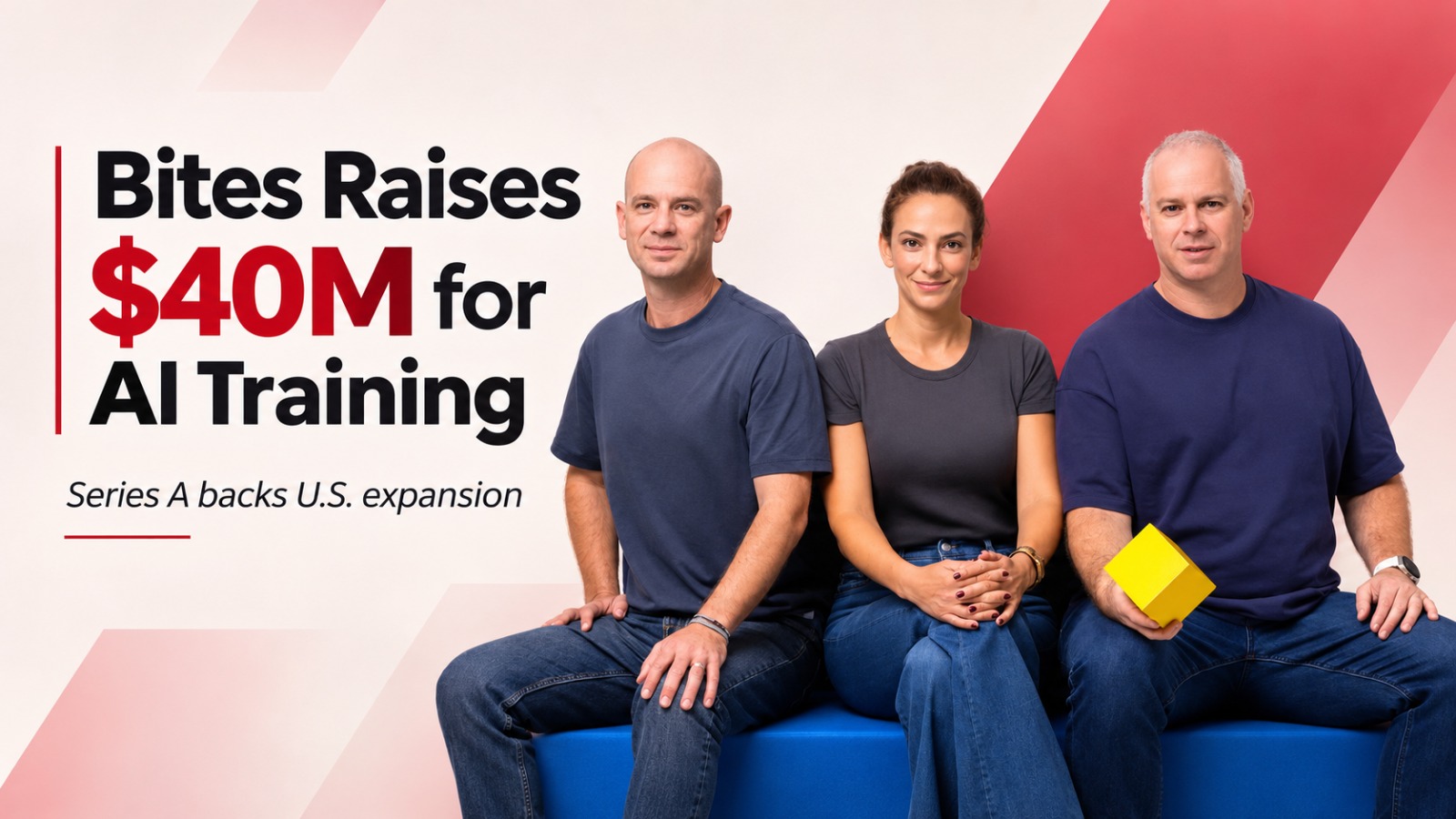
Israeli-founded artificial intelligence startup Bites founded Eran Heffetz (Co-Founder & CEO), Tal Nagler Almog (COO), and Hagai Horovitz (CIO).has secured $40 million in Series A funding to expand its employee training platform in the United States and develop technology that connects workplace learning with measurable business performance.
The investment round was led by PeakSpan Capital, with participation from existing investors Vertex Ventures, Horizon Capital, Rittenhouse Ventures and Lyra Ventures. The latest financing brings Bites’ total funding to $55 million.
Operating from New York and Tel Aviv, Bites focuses on training frontline employees in industries where workers often lack convenient access to conventional corporate learning systems. Its customers include major international businesses such as Coca-Cola, Unilever, Shake Shack, Wynn Resorts and Compass Group.
Unlike traditional employee training platforms that require dedicated applications or learning management system accounts, Bites delivers short, AI-generated training videos through familiar communication channels, including WhatsApp, SMS, Microsoft Teams and Slack.
Training modules are designed based on short lessons which do not last more than 90 seconds in duration. These lessons are referred to as “Bites” and can be developed from any company materials and processes, hence providing businesses with an opportunity to develop brandable videos within minutes.
With support for more than 150 languages, the platform is designed to help employers train workers across geographically dispersed and multilingual teams.
Bites is targeting a substantial segment of the global workforce. An estimated 2.8 billion people worldwide work in deskless roles, many of whom are not easily reached through conventional corporate training infrastructure.
Bites says that clients reach employee engagement levels above 90% in just three weeks after implementing their platform. Also, the firm has net revenue retention of 161% owing to increased spending by existing clients.
These figures are company-reported and do not independently establish how much the training improves employee productivity or business results.
That distinction is central to Bites’ next phase of development.
The startup plans to move beyond delivering training material by connecting its platform with business systems that monitor operational performance. These include sales platforms, customer management tools, enterprise resource planning software and human resources systems.
The proposed integration would allow Bites to identify areas where employees may need additional guidance, automatically produce relevant training content and assess whether the intervention leads to improved results.
For instance, in case there are low sales during a specific promotional period, the retailer will be able to analyze where the shortfall is coming from and deliver coaching videos in different languages of choice.
The objective is to make training more responsive to operational requirements rather than relying exclusively on scheduled courses or standardised learning programmes.
“Every company already knows training matters. What they’ve never had is proof, or speed,” said Eran Heffetz, co-founder and CEO of Bites.
“Bites’ next generation is about what happens next: finding the gap, closing it automatically and showing the business what it was worth.”
Founded in 2020 by Heffetz, Tal Nagler Almog and Hagai Horovitz, Bites is now preparing to strengthen its commercial presence in the American market.
The company intends to use the new capital to expand its US sales operations from New York, establish additional reseller partnerships and enter industries beyond its existing customer base.
Banking and insurance are among the sectors identified for future expansion.
The financing will also bring changes to the company’s board. PeakSpan Capital representatives Phil Dur and Charlie Reinkemeyer are set to join as directors.
For Bites, the investment supports a shift from making workplace training more accessible to demonstrating its commercial impact. Its planned AI-powered integrations are intended to give employers a clearer connection between employee learning, day-to-day operational challenges and business outcomes.
The company’s next challenge will be demonstrating whether that approach can consistently translate short training sessions into measurable improvements across different workplaces and industries.
Also Read: Phinity Labs Raises $5.2 Million to Build AI Agents That Design Computer Chips From Text Prompts