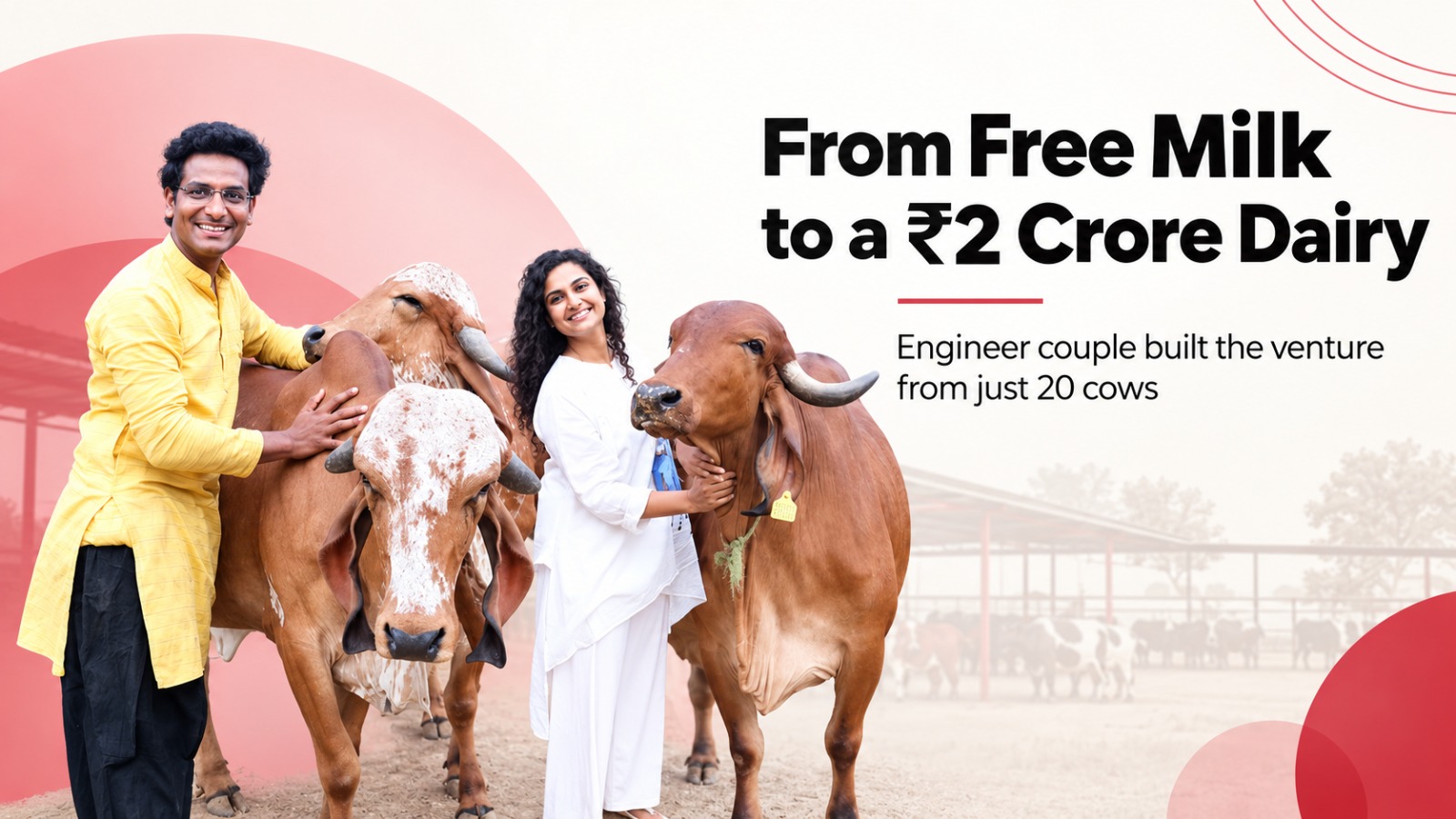
What began as a small dairy experiment near Jaipur has grown into an annual ₹2 crore business. Vibhor Jain and Ishita Jain now run a 100-cow operation producing milk, bilona ghee, buttermilk, freeze-dried milk powder and other products, while preparing the farm for its next phase in agro-tourism.
The first challenge Vibhor Jain faced was not raising cattle or producing milk. It was finding people willing to buy what he was producing.
In 2018, after studying dairy farming and animal husbandry and travelling to Gujarat to learn from livestock farmers, Vibhor leased seven bighas of land in Bhankrota near Jaipur. He brought 20 cows and a bull from Rajkot and treated the farm as an experiment rather than making a large investment immediately.
There was one problem. The milk did not yet have a market.
So Vibhor took an unconventional route. He began giving milk away.
No customers, so the milk went out for free
The farm initially priced its milk at ₹91 a litre. To convince potential customers about its quality, Vibhor distributed free milk, handed out pamphlets and set up stalls at exhibitions.
It was a slow exercise in building trust rather than chasing quick sales. According to Vibhor, it took about a year before the farm was able to establish a local customer base.
That early experience shaped what came next.
Instead of treating dairy farming simply as the sale of fresh milk, Vibhor gradually began looking at the operation as a business that would need several products, tighter control over cattle feed and direct relationships with customers.
Today, the venture has reached an annual turnover of around ₹2 crore, with its products finding customers in India as well as overseas.
Engineering to agriculture was a deliberate switch
Vibhor, 31, completed a BTech in Computer Science from Bengaluru in 2017. His connection with cattle, however, began much earlier with two cows kept at his family home.
During his engineering years, he became increasingly interested in agriculture and eventually decided against taking the conventional corporate route. He then spent time studying dairy farming, animal husbandry, fodder management and milk production before starting his first farm.
His wife, Ishita Jain, followed a different academic path before joining the venture. She studied IT engineering in Nagpur and later completed an MBA in Pune. The couple married in January 2022, after which Ishita became closely involved in running the farm.
Rather than managing the operation remotely from Jaipur, the two live at the farm and oversee its day-to-day work.
Ishita says around 15 people work there, but she considers the couple’s own involvement essential to the business.
From 20 cows to a 100-cow dairy
By 2021, Vibhor had decided to develop the dairy on a larger scale. He bought six-and-a-half bighas of land in Tibaria village in the Hingonia area and shifted to a new setup.
At that point, the farm had around 80 cows. About 35 were producing milk, with daily output at roughly 150 litres.
The operation has since grown to around 100 cows, with about 60 currently producing milk.
Daily production is now around 300 litres.
Of that, roughly 100 litres are supplied directly to customers at ₹150 a litre. Instead of selling the entire output as fresh milk, the farm uses the remainder to produce higher-value dairy products.
That shift is central to the economics of the business.
Eight litres of ghee a day, using up to 30 litres of milk for each litre
One of the farm’s main products is ghee made using the traditional bilona method.
Ishita says producing one litre of ghee requires around 28 to 30 litres of milk. The ghee is prepared on a traditional stove, with around eight litres produced each day. The couple says the product also receives demand from customers overseas.
The farm also produces about 200 litres of buttermilk daily, supplying it to hotels, roadside eateries and regular customers.
But one of the more unusual investments in the business sits beyond conventional dairy processing.
The ₹30 lakh bet on freeze-dried milk
The couple invested around ₹30 lakh in a freeze-dryer, allowing them to turn milk into powder without using heat during the drying process.
According to the figures shared by the couple, one batch uses around 24 litres of milk and produces approximately four kilograms of powder over 24 hours.
A 500-gram pack is priced at ₹2,090. The couple says the product is particularly sought after by travellers and people living abroad.
The same machine is being used for other products too.
The farm makes colostrum powder from milk produced by a cow during the first 12 hours after giving birth. A 100-gram pack is priced at ₹1,880. The couple also uses the freeze-dryer to dehydrate ripe vegetables, which they say can remain stable for about a year when protected from moisture.
The business goes back to what the cows eat
For Vibhor, improving the final product starts much earlier than milk processing.
The couple has invested ₹6 lakh in two machines brought from Tamil Nadu to establish an oil-processing unit at the farm. A traditional wooden oil press is used for peanuts, mustard, coconut, almonds and sesame.
The process produces oil for use or sale while leaving behind oilcake that can be fed to the cattle.
Their landholding has also expanded to a total of 18 bighas.
Two bighas are reserved for the cows, while around 10 bighas are used to grow green fodder including Napier, Super Napier, moringa, rajgira, pearl millet and oats. Jowar chaff is used as dry fodder.
Another six bighas have been developed for agroforestry, with around 2,000 trees planted. These include approximately 300 sandalwood trees and 600 mango trees.
Dairy is no longer the only plan
The farm’s revenue model now stretches beyond fresh milk.
Alongside milk, ghee, buttermilk and powdered products, the couple is involved in breeding Gir cows and says good-quality animals can sell for as much as around ₹2.50 lakh.
The next step is to develop the property as an agro-tourism destination.
For Vibhor and Ishita, that would add another layer to a business that has repeatedly changed shape since its modest beginning with 20 cows.
The more revealing part of their journey is not simply that annual turnover has reached ₹2 crore. It is how the business evolved when selling milk alone was no longer enough.
Free samples helped create the first customers. Value-added products improved the product mix. A ₹30 lakh freeze-dryer opened another category. Fodder cultivation and oil processing gave the farm greater control over what its cattle consume.
Eight years after the experiment began, the dairy looks very different from the operation Vibhor started in 2018. The original idea, however, remains visible: learn on a small scale, build the market first, and expand only after understanding what customers are willing to pay for.
Also Read: GTA 6 Will Not Launch on Xbox Game Pass