

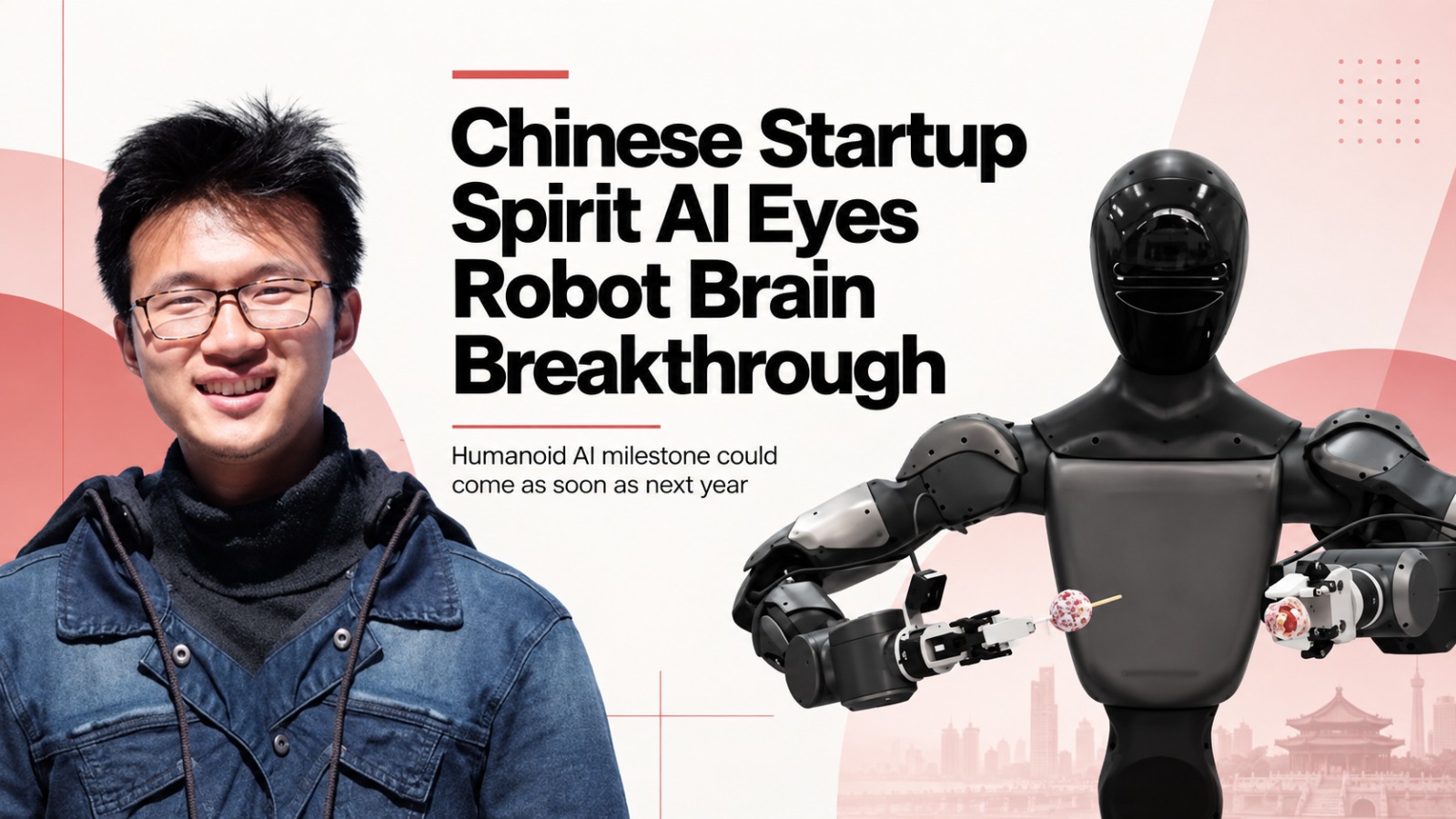
China’s race to build capable humanoid robots is increasingly shifting from impressive hardware demonstrations to a harder challenge: teaching machines how to understand instructions, adapt to their surroundings and complete useful physical work. Spirit AI, a Chinese startup developing what it calls robot “brains”, expects a major step forward by the middle of 2027. The company believes robots could by then take natural-language instructions and translate them into a sequence of physical actions needed to attempt a task.
“We anticipate reaching the GPT-3.0 milestone by mid-2027,” Spirit AI co-founder and chief scientist Gao Yang said. “You will be able to speak to a robot in natural language, and it will execute a series of reasonable physical actions to attempt the task.”
The comparison with GPT-3 is Spirit AI’s own way of describing the level of capability it is targeting. The broader ambition is to give robots something closer to general-purpose intelligence for physical environments, rather than programming them for one narrowly defined movement at a time.
Robot hardware has advanced. The ‘brain’ is now the problem
Humanoid robots have become increasingly capable of running, dancing and even performing backflips. Spirit AI sees the software controlling those machines as the bigger constraint on what they can actually accomplish in factories, businesses and eventually homes.
“The brain is indeed the weakest link in the complete robotics stack,” Gao said.
That challenge sits at the centre of “embodied AI”, a field focused on AI systems that do not simply generate text or images, but perceive and act in the physical world.
The robotics industry is looking for the kind of software leap that could expand robots from demonstrations and highly controlled tasks into machines capable of handling a wider variety of commercially useful jobs.
Spirit AI says its own capabilities have already changed significantly since the company was founded in 2024. Gao said robots at the time could perform individual tasks such as pouring water or folding clothing, while current systems can operate across larger spaces and complete continuous workflows.
Important limitations remain. Fine movements, including something as seemingly straightforward as unscrewing a bottle cap, are still difficult. Robots can also struggle when confronted with tasks they have not previously encountered.
1,000 contractors are collecting real-world movement data
Spirit AI is taking a heavily real-world approach to training its systems.
Around 1,000 contractors across China wear data-collection equipment in homes and factories, recording how people move and interact with their surroundings. That information is then used to train the company’s robot models.
At a training centre in Spirit AI’s Beijing office, workers wearing sensors were repeatedly carrying out everyday actions such as opening refrigerators, unlocking safes and cutting vegetables with knives.
In structured living-room environments, Spirit AI says its robots have reached a 90% success rate on simple tasks.
The company prefers physical-world data to relying overwhelmingly on simulated environments.
Gao said simulation works well for rigid objects but becomes more difficult when robots need to manipulate flexible materials. Electric cables, for example, can deform in ways that are difficult for simulators to reproduce accurately.
Spirit AI has also taken an unusual approach to the quality of its training data. Gao said some robotics training operations may repeat the same movement more than 50 times to produce one sufficiently precise example. Spirit AI has found that using a broader collection of less-perfect or “dirty” movements can help its models improve more quickly.
Factory deployment is already under way
Spirit AI is not limiting its development work to research facilities.
The company has tens of its Moz1 wheeled humanoid robots operating on production lines at battery manufacturer CATL and retailer JD.com. JD.com is also an investor in the startup.
Gao expects industrial settings to provide the first major window for broader deployment over the next one to two years.
Commercial service environments could follow. His expectation is that robots may begin handling simpler jobs in those settings around two years from now.
Homes, however, represent a substantially harder challenge.
A factory can be designed around predictable workflows and controlled surroundings. Household environments expose robots to a far wider range of objects, movements and unexpected situations. Gao said entering homes will therefore take considerably longer than industrial or commercial deployment.
Spirit AI has raised more than $670 million
The scale of investment behind the company shows how much capital is moving into embodied AI.
Spirit AI has about 300 employees and has raised more than $670 million since its founding in 2024. It is currently valued at 20 billion yuan, or about $2.9 billion.
Gao did not comment on whether the company has plans for an initial public offering.
For now, its focus remains on improving the intelligence controlling the machines.
The company’s timeline is also important for understanding what the expected breakthrough does, and does not, mean. Spirit AI is not saying fully autonomous household humanoids will suddenly become commonplace in 2027. Its mid-2027 target is about robots becoming better at interpreting spoken instructions and assembling multiple physical actions into a sensible attempt at completing a task.
That still leaves reliability, dexterity, unfamiliar environments and safety as major problems to solve.
Safety will become harder as robots move closer to people
Physical AI introduces a different set of safety questions from software that operates entirely on a screen.
Spirit AI currently uses whole-body force control in its robots. Gao said excessive physical interaction with the surrounding environment can automatically trigger emergency braking as a baseline protection mechanism.
He also argued that highly autonomous physical AI remains immature enough that more advanced concerns are not yet the most immediate problem. That could change as foundation models become more capable and robots begin operating in crowded commercial spaces and homes.
“Once foundation models reach a mature, autonomous ‘GPT-4.0’ era, researching advanced AI safety and alignment will become much more actionable,” Gao said.
For Spirit AI, the next milestone is therefore less about making a robot perform another eye-catching physical stunt and more about whether a person can simply tell it what needs to be done and have the machine work out the sequence for itself.
If the company reaches that mid-2027 target, it would mark a significant test of whether embodied AI can move from carefully programmed demonstrations toward robots capable of handling a broader range of practical work.
Also Read: West Nile Virus Explained: What It Is, How It Spreads, Symptoms and Prevention