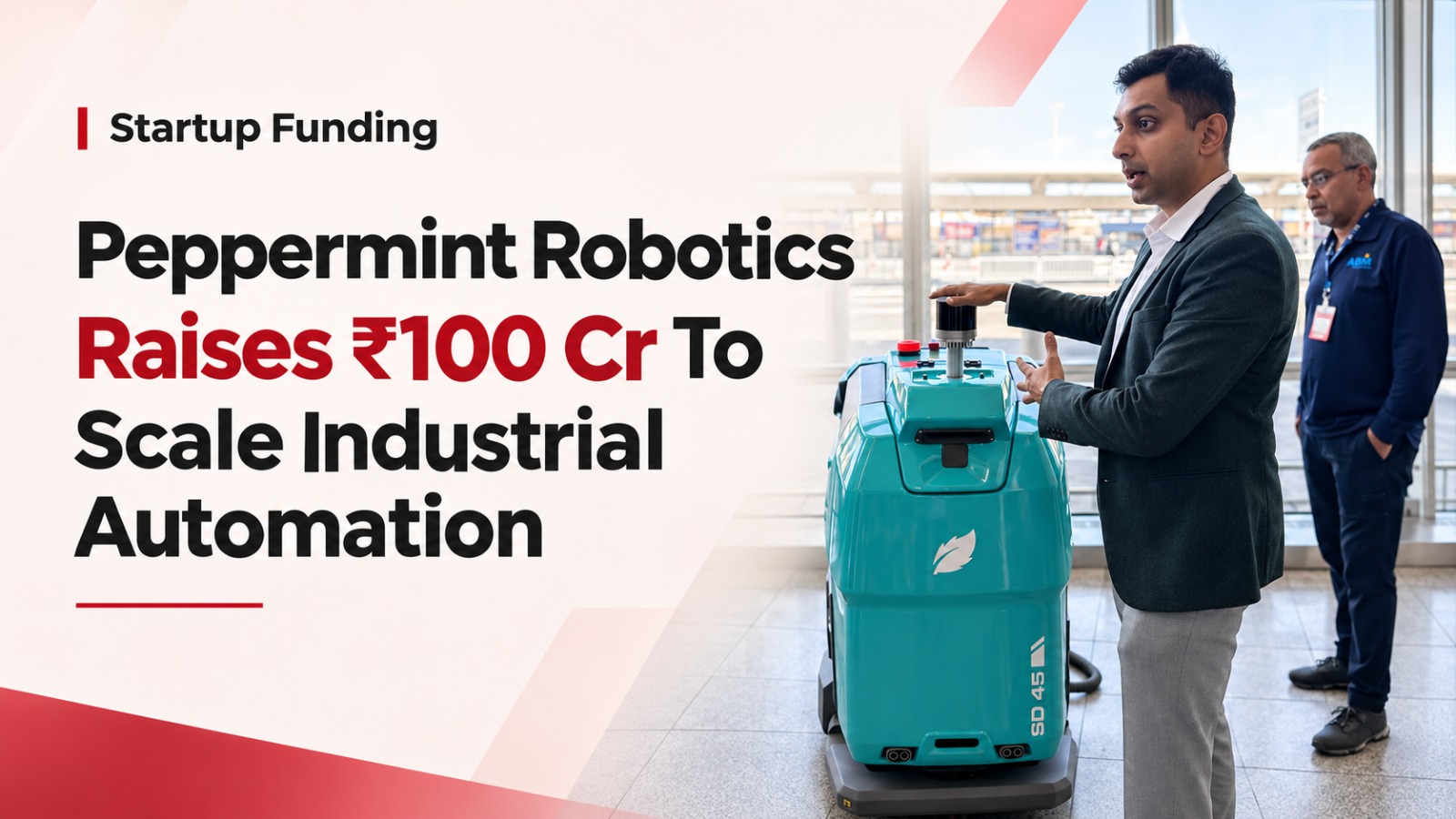
Pune-based robotics startup Peppermint Robotics has secured ₹100 crore in a Pre-Series B funding round to expand its manufacturing capabilities, develop new industrial robots and strengthen its presence in international markets.
The investment comes as the company diversifies beyond autonomous cleaning machines, although it expects to fall short of its ₹100 crore revenue target for FY27.
The funding round was led by pi Ventures and Crane Venture Partners, with participation from Asiana Fund. It included both fresh capital and secondary share transactions, with primary investment accounting for the larger portion, said founder Runal Dahiwade.
The latest investment follows the company’s ₹34 crore Series A round in April 2025 and will support its expansion across industrial automation, particularly material handling and specialised cleaning applications.
Founded in 2019 and incubated at the Society for Innovation and Entrepreneurship (SINE) at IIT Bombay, Peppermint Robotics initially focused on autonomous floor-cleaning and sanitisation machines. It has since developed a wider portfolio comprising robotic scrubber-dryers, vacuuming and mopping systems, material-handling robots and automated docking stations.
The startup is now targeting more specialised applications in factories, warehouses and pharmaceutical facilities. Its cleanroom scrubber-dryer has passed qualification testing in an EU GMP Grade C cleanroom, the company said, marking an important development in its efforts to serve environments with strict contamination-control requirements.
Over the next 12 to 15 months, Peppermint plans to introduce additional cleaning and material-handling robots in different sizes while upgrading existing models. It is also working towards launching outdoor cleaning robots by 2028.
The company’s machines operate on its proprietary Peppermint OS, which combines computer vision and LiDAR technologies to navigate facilities, map surroundings and detect obstacles. Customers can also monitor robotic operations through cloud-based dashboards and mobile applications.
Peppermint primarily sells its machines to facility management companies and generates additional income through spare parts, annual maintenance contracts and equipment upgrades.
Its robots cost approximately ₹20 lakh each in India, while prices in the US range from $35,000 to $40,000, depending on installation and associated expenses.
Peppermint’s international footprint is fast becoming the real engine of its business. The startup now operates across nine countries, with the US driving almost half its total top line and India bringing in another 30%.
To back this global push, the Pune-headquartered company plans to set up an assembly line in North America while continuing to anchor its primary manufacturing and R&D hub in Pune. The fresh capital will also give it the firepower to scale deeper into American and European markets.
The move comes on the back of impressive top-line growth. Peppermint’s operating revenue surged from ₹2.71 crore in FY23 to ₹6.26 crore in FY24, before jumping to ₹21 crore in FY25.
But the path to its next big milestone isn’t without friction. Global shipping snags and geopolitical uncertainty have started taking a toll, leading the company to temper its expectations and likely miss its ambitious ₹100 crore target for FY27.
The startup nevertheless aims to cross that revenue threshold within the following 12 months.
While Peppermint says its core business has remained profitable for several quarters, spending on research, product development and international expansion has kept the overall company in a loss-making position.
The latest funding gives Peppermint additional resources to broaden its product range and manufacturing footprint. However, its next phase of growth will depend not only on bringing more robots to market but also on building the service and maintenance capabilities needed to support customers across multiple countries.
With its expansion into material handling and cleanroom automation, Peppermint is seeking a larger role in industrial robotics as it works to turn growing international demand into sustainable revenue.
Also Read: Selling Sunlight After Dark: Reflect Orbital Partners With India’s Skyroot Aerospace