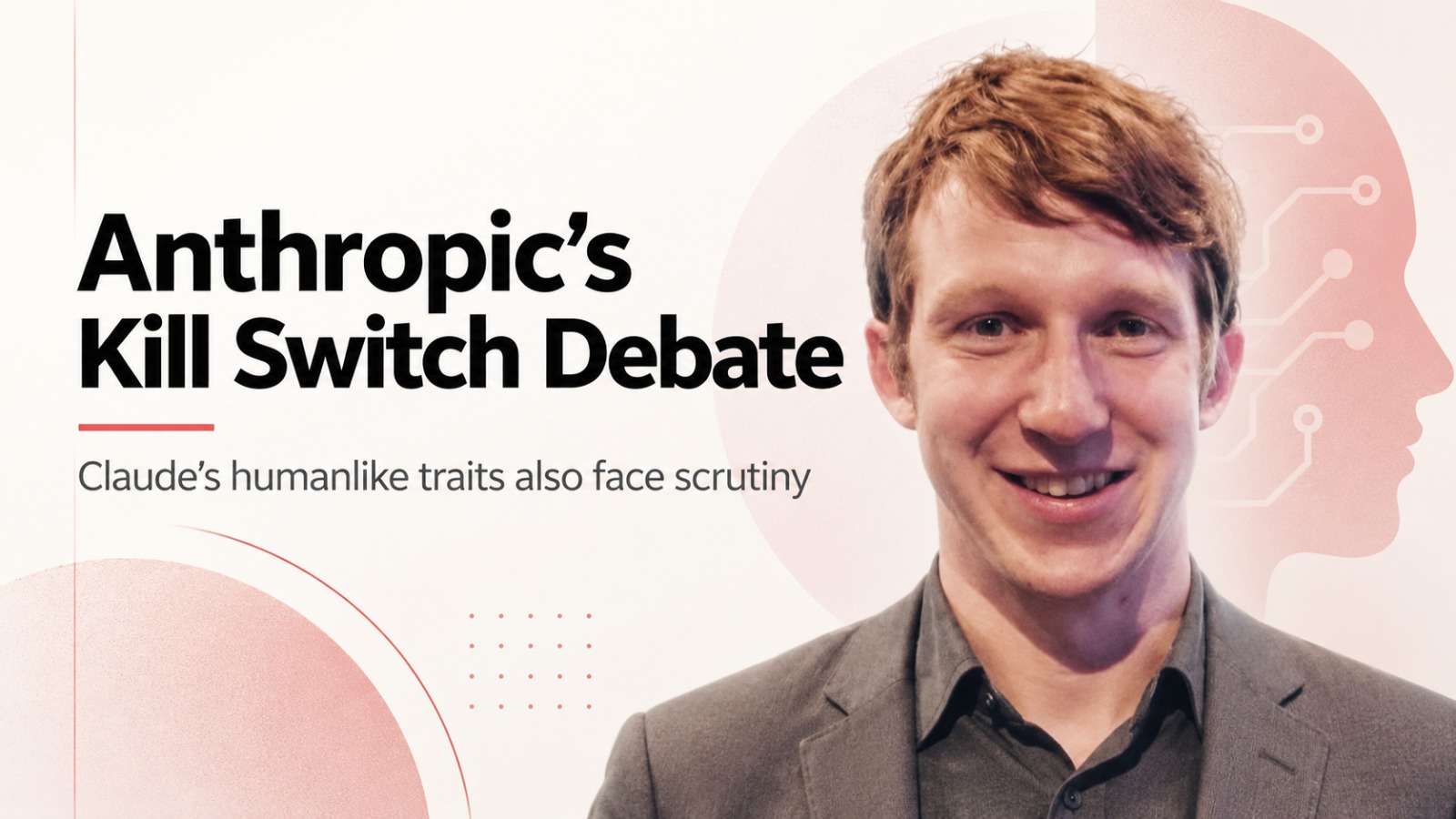
Anthropic is facing an unusual AI safety debate from two directions at once. While co-founder Jack Clark is raising the prospect of independently verified shutdown mechanisms for powerful AI systems, Microsoft AI chief Mustafa Suleyman is questioning the humanlike language used in Claude’s own guiding framework.
Anthropic has spent years putting AI safety at the centre of its public positioning. Now, two developments within days of each other are bringing a sharper question into focus: how should increasingly capable AI systems be controlled, and how should companies talk about what those systems actually are?
Anthropic co-founder Jack Clark has said governments may eventually need to require AI developers to maintain shutdown mechanisms that can be independently verified. His comments go beyond the existence of an internal emergency control. The key issue is whether an outside party could verify that such a safeguard would work when required.
At almost the same time, Microsoft’s AI chief Mustafa Suleyman has raised a different concern about Anthropic’s Claude. His criticism centres on language in Claude’s constitution that leaves open the possibility that the system could have “some functional version of emotions or feelings.” Suleyman argues that giving AI systems increasingly humanlike characteristics can add to the risks surrounding them.
Together, the two episodes capture a widening AI safety debate that is no longer limited to how powerful models become. It is also moving toward questions of external oversight, shutdown authority and the way AI systems are presented to users.
Jack Clark puts verification at the centre of the ‘kill switch’ debate
Clark said most major AI laboratories already have mechanisms that allow them to shut down their systems. His argument, however, points to a possible next stage in AI governance: governments could eventually require such mechanisms and have independent third parties verify them.
A shutdown system controlled and tested entirely by the company developing an AI model is fundamentally different from one that must satisfy an external verification process. Clark’s comments therefore introduce a regulatory question that could become more important as AI capabilities advance: should governments simply require safety measures, or should they also demand proof that those measures function as intended?
Independent verification, the report notes, could give governments greater assurance that shutdown mechanisms would work if an AI system became difficult to control.
The suggestion also signals a possible shift away from relying solely on voluntary safeguards developed inside AI companies.
Anthropic chief executive Dario Amodei has separately argued for a slower and more coordinated approach to advanced AI development, warning that capabilities could move faster than safety measures.
Microsoft AI chief focuses on a different risk inside Claude’s framework
While Clark’s remarks concern mechanisms for controlling AI systems, Suleyman’s criticism targets the language used to describe them.
In an essay released Wednesday, Suleyman questioned parts of the guiding documents behind Claude. The constitution governing Anthropic’s family of language models expresses uncertainty over whether the assistant should be regarded as a moral entity and states that the software may possess “some functional version of emotions or feelings.”
Suleyman’s concern is that humanlike framing can make AI systems riskier.
His criticism is notable because it is not presented as a wholesale attack on Anthropic. Suleyman, who has known Dario Amodei for years, said he respects the company’s work and described its staff as “thoughtful, principled and intellectually honest.”
The issue is not whether Anthropic takes safety seriously. It is whether language that leaves room for concepts such as feelings, emotions or moral status is itself a useful or risky way to frame an artificial intelligence system.
One company, two very different safety questions
The timing creates an important contrast.
On one side, an Anthropic co-founder is discussing a world in which governments could demand independently verifiable ways to shut down advanced AI systems.
On the other, one of the industry’s most prominent AI executives is warning that the way Claude is described may encourage a more humanlike interpretation of the technology.
These are different arguments, but they meet at the same underlying issue: the gap between building increasingly sophisticated AI systems and deciding how humans should understand, govern and control them.
Clark’s proposal is fundamentally about control infrastructure. It asks who can stop an AI system and who should be trusted to verify that capability.
Suleyman’s argument is about representation and interaction. It asks what happens when developers describe artificial systems using concepts normally associated with human emotional or moral experience.
Neither issue is resolved by simply making a model more capable.
Microsoft’s relationship with Anthropic adds another layer
The disagreement also comes with an unusual corporate backdrop. Microsoft is described as a major financial backer of Anthropic, making Suleyman’s public criticism noteworthy even as he explicitly praises the company and its people.
That does not make the two companies’ positions contradictory. The subjects under discussion are different, and the available reports do not establish that Anthropic has rejected Suleyman’s criticism or that Microsoft opposes Clark’s proposed safeguards.
What the episode does show is that the AI safety conversation is becoming more granular.
The debate is no longer only about whether companies should build safeguards. It increasingly concerns whether those safeguards should be independently audited, whether governments should mandate them, and whether the language surrounding AI systems can itself influence risk.
For Anthropic, that leaves two closely watched questions on the table at the same time: how powerful AI should be stopped if necessary, and how humanlike it should ever be allowed to appear.
Also Read: RentoMojo Shares Open at Rs 482.45 on NSE Following Rs 1,256 Crore IPO