

The shape of the US startups are changing, and one of the clearest signs is showing up before many young companies even begin building large teams.
Solo-founded businesses accounted for 36.3% of new US companies in the first half of 2025, compared with 23.7% in 2019. That works out to a 12.6 percentage point increase over the period, according to findings from AI company MyUser.
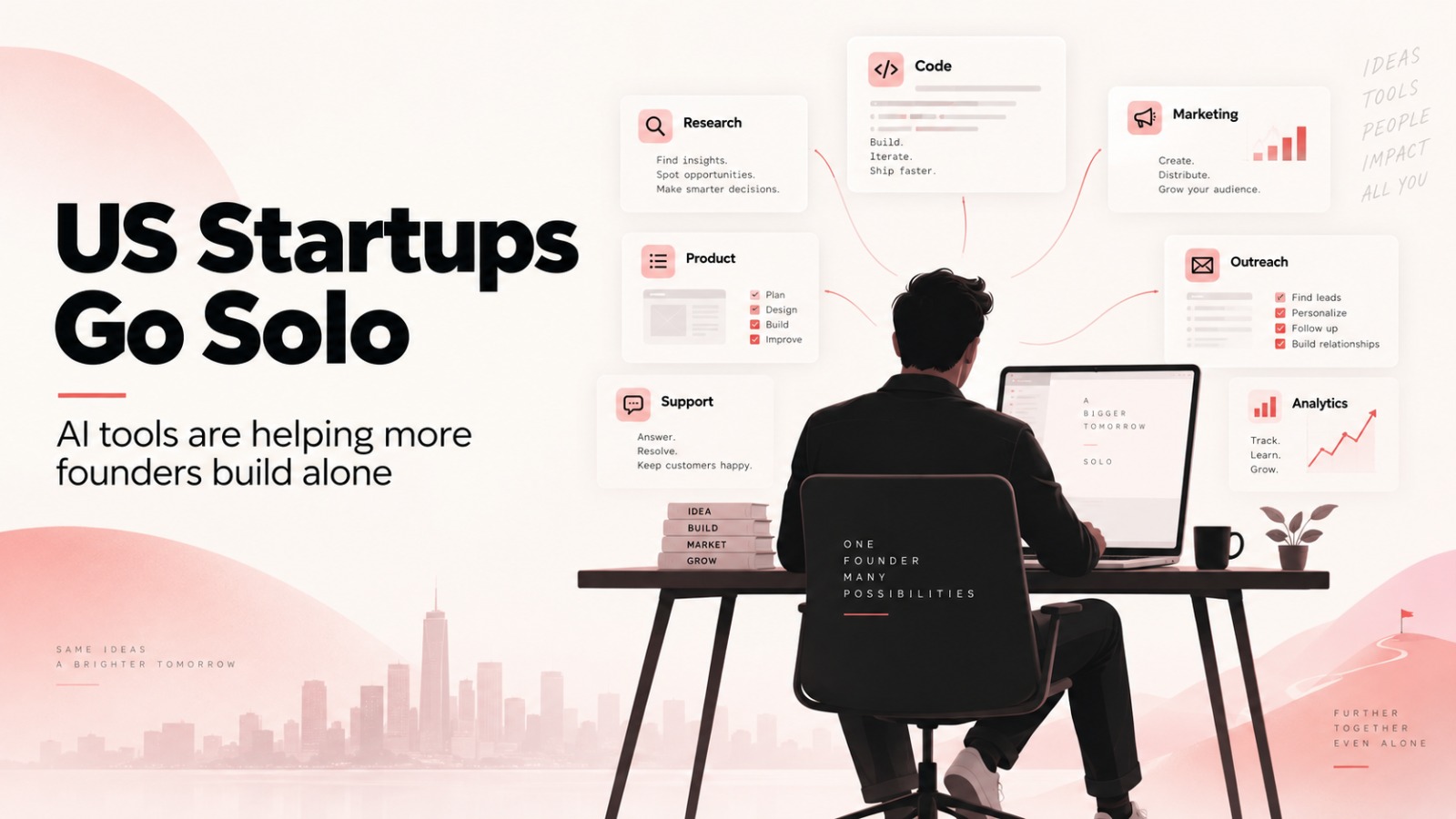
Behind that rise is a shift in the amount of work a single founder can realistically manage. Tasks that once pushed early-stage businesses towards hiring are increasingly being handled with the help of artificial intelligence tools.
The change is not limited to one part of running a company. AI is being used across coding, customer support, sales outreach and marketing, giving founders ways to manage several functions without immediately adding employees.
For solo founders, that matters because the traditional constraint was often time rather than ambition.
Ibrahim Hasanov, founder of MyUser, described the problem in practical terms: one person has only a fixed number of hours, while a business may simultaneously need somebody selling, another person supporting customers and someone else writing code.
“For most of startup history, that math simply didn’t work past a certain size. You hired, or you stalled,” Hasanov said.
AI is changing what happens before the first hires
The impact appears particularly significant in the operational work that surrounds a startup’s core idea.
Sales and marketing can be demanding for a one-person company because they depend on repeated outreach, follow-ups and continuous customer engagement. AI tools can now assist with drafting messages, personalising follow-ups and maintaining sales pipelines, reducing the immediate need for a dedicated salesperson.
That gives solo founders another option during the earliest stages of a business. Instead of building a team simply to keep routine processes moving, they can use software to handle parts of the workload while concentrating their own time elsewhere.
The same shift is also affecting how quickly founders can move from an idea to testing whether it can work.
Activities that previously consumed months without directly answering that question can now be completed faster with AI tools, allowing founders to spend more time on product development and business decisions.
The bigger change is how many roles one person can cover
What stands out in the findings is not simply the growing availability of AI software. It is the widening range of responsibilities that one founder can take on before a larger organisation becomes necessary.
The report describes the change as a question of how many “hats” a founder must physically wear. AI does not remove the work entirely, but it can absorb parts of multiple functions that would otherwise compete for the founder’s limited time.
This goes some way towards explaining why the growth of one-person founded enterprises is significant. The shift from 23.7 percent in 2019 to 36.3 percent between January-June 2025 is not just a marginal shift in startup creation. It is a significant shift in the frequency of startups created by one person.
In case of start-ups, the typical order of events would be that a founder hit the point where he could not do everything alone anymore and thus needed additional people to drive the business forward.
AI is about to change that order of events. Now a founder has the opportunity to utilize technology in order to do things that would have required separate hands before.
The result is a startup model in which one person can remain operationally capable for longer, even while managing work across product, customer service, sales and marketing.
Whether that changes how companies build teams over the longer term is not addressed in the available findings.
What the data does show is that solo founding has become considerably more common among new US companies, while AI tools are expanding the amount and variety of work an individual founder can handle.
Also Read: RentoMojo Shares Open at Rs 482.45 on NSE Following Rs 1,256 Crore IPO