

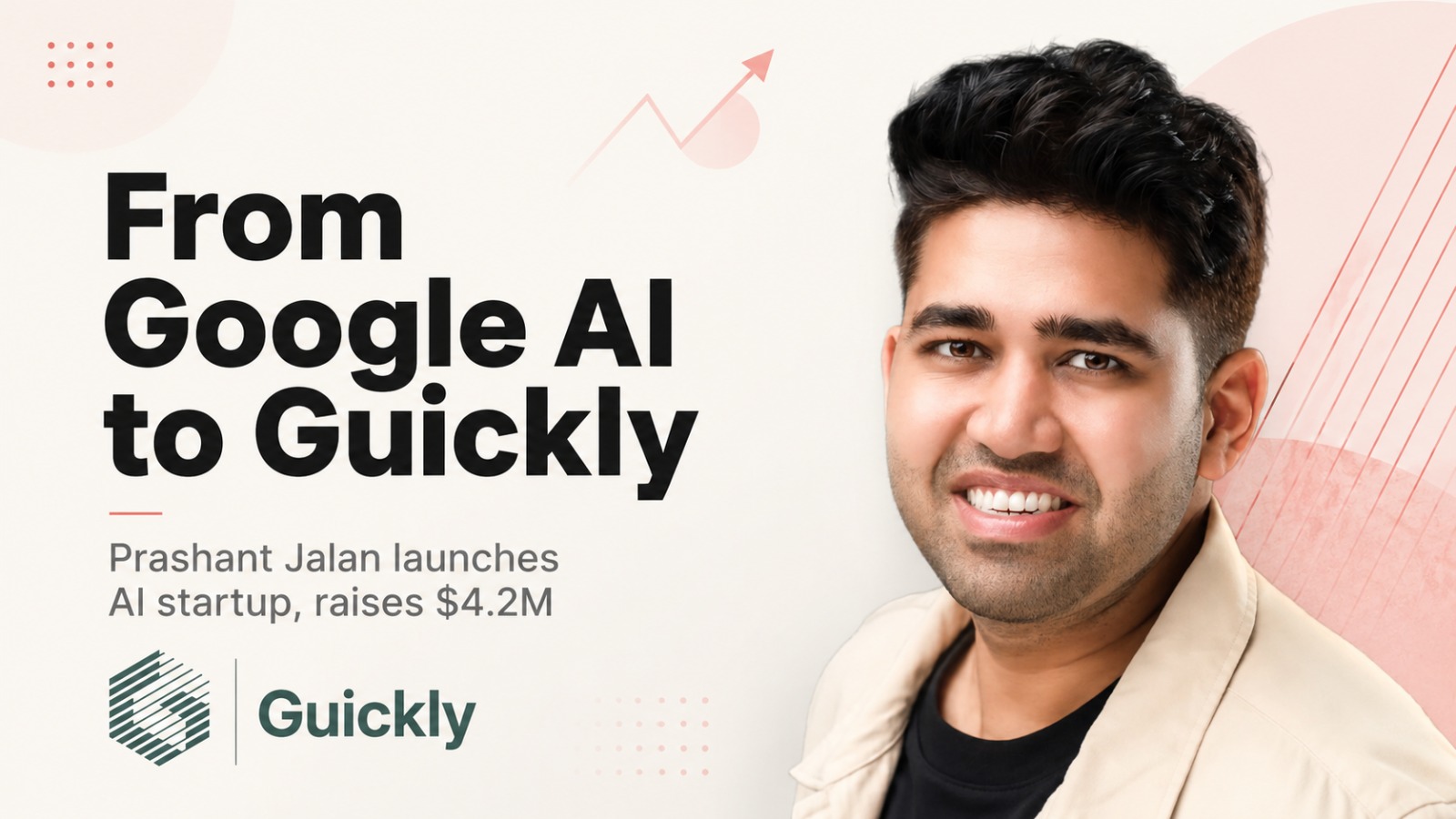
The former Google applied AI lead has launched San Jose-based Guickly to give companies a clearer view of where artificial intelligence is being used, what it is costing them, and where that spending may be going to waste. The startup has also raised $4.2 million in seed funding.
For Prashant Jalan, the move into entrepreneurship appears closely tied to the kind of technical problems he has spent his career working on.
Before founding Guickly, Jalan was a lead in applied AI at Google. His work included the speed-limit feature on Google Maps and the development of a profiler aimed at optimising TPU performance. Now, the Indian-origin entrepreneur is taking that experience into a problem that sits at the intersection of artificial intelligence, enterprise technology and spending visibility.
His new company, Guickly, is building what it describes as an independent measurement layer for enterprise AI.
The premise is straightforward. As businesses adopt more AI products, agents and models, knowing exactly where those tools are being used can become harder. The cost structure is also different from much of conventional enterprise software, where companies have typically dealt with more predictable per-user subscriptions.
Generative AI usage can instead generate variable costs depending on consumption. Guickly is being built around that shift.
Guickly By Prashant Jalan: Building visibility into the AI stack
Guickly’s product is designed to help organisations identify the AI tools and agents operating across their environment, including unauthorised or untracked tools that fall under what is often described as “shadow AI”.
The platform can attribute spending, set budgets at the employee or tool level and flag potential waste, including unused licences and costly model choices.
That makes Guickly less about giving employees another AI application and more about helping businesses understand the AI applications they already have.
It is an important distinction in the way Jalan is positioning the company.
Rather than competing to create another model or workplace assistant, Guickly is focused on the measurement and management layer surrounding enterprise AI. Its central question is not simply whether a company is using AI, but where it is being used, how much it is costing and whether that expenditure is delivering value.
The company also says prompts, source code and other sensitive material remain on-premises rather than being transmitted to Guickly’s servers.
A founder shaped by applied AI
Jalan’s background gives the Guickly story a more interesting dimension than the funding announcement alone.
His earlier work was rooted in applied technology rather than AI as an abstract research exercise. At Google, he worked on a feature encountered by everyday Maps users while also building tooling aimed at improving the performance of TPUs.
With Guickly, the underlying technical challenge has changed, but the focus on measurement and optimisation remains visible.
Enterprise adoption of AI is creating a different type of operational problem. A company can have employees experimenting with multiple products, teams using different models, licences that are not being fully utilised and AI services whose costs rise alongside usage.
Guickly is attempting to put those activities into one measurable view.
Jalan has framed the company’s approach around reducing the amount of effort leaders need to spend simply figuring out what is happening inside their own organisations.
“We believe time is sacred, and speed is respect,” Jalan said.
Why Guickly is looking beyond conventional software budgeting
Part of the problem Guickly is targeting comes from the economics of generative AI itself.
Traditional software subscriptions can often be budgeted around the number of users. With generative AI, expenditure can vary with actual consumption. Tokens, the units of text processed by AI models, mean heavier usage can translate into larger bills.
That can make an organisation’s AI bill harder to understand if products and models are being used across different departments without a common measurement layer.
For Guickly, this is where financial visibility meets AI governance.
The company’s proposition is built around giving businesses the ability to see both sanctioned and untracked usage while connecting that activity with budgets and expenditure. The objective is not merely to show that an AI tool exists inside the organisation, but to provide enough information for companies to make decisions about what should continue, what should be controlled and where money may be getting wasted.
$4.2 million to build the measurement layer
Guickly has raised $4.2 million in seed funding, led by Engineering Capital, with participation from Converge VC, Neon Fund and angel investors.
The capital will support the company’s work on measuring AI usage and spending, improving visibility across corporate systems and helping enterprises manage costs as adoption increases.
The funding is significant, but it is not the most distinctive part of the Guickly story.
What makes Jalan’s new venture worth watching is the problem he has chosen to tackle. Much of the enterprise AI conversation has centred on what companies can build or automate with artificial intelligence. Guickly is approaching the same transition from another direction: once AI spreads across an organisation, who is keeping track of it?
For Jalan, whose earlier work ranged from Google Maps’ speed-limit feature to tools for optimising specialised AI hardware, the next problem is one of visibility.
This time, the system he wants to measure is the enterprise’s expanding AI footprint itself.
Also Read: Inside Breedr: Ian Wheal’s $27M Push to Digitize Cattle















