

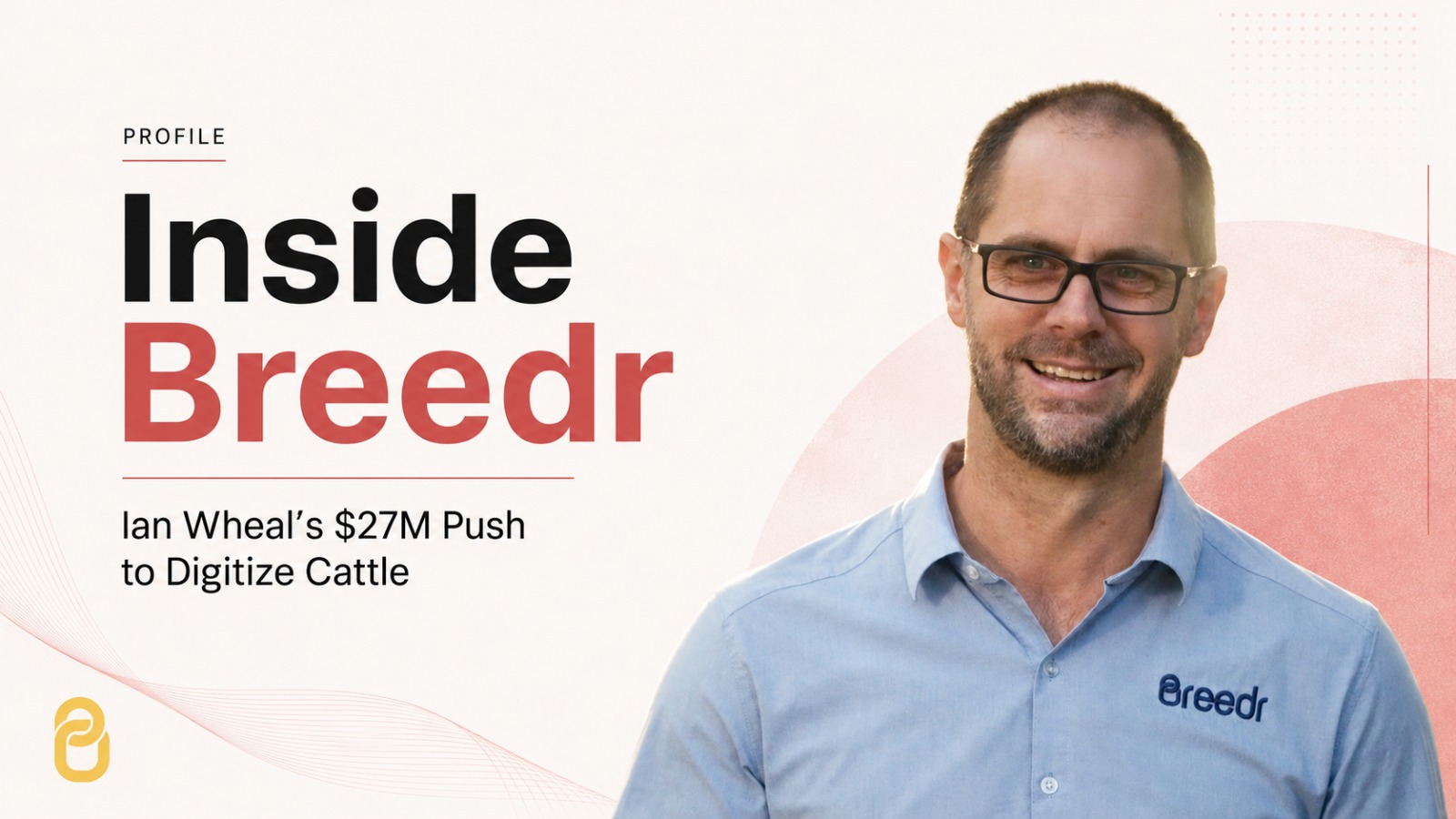
For Ian Wheal, Breedr’s attempt to modernise the cattle industry did not begin in a software lab. It traces back to a cattle farm in Australia.
Wheal grew up around livestock, and his father built one of Australia’s early cattle cooperatives. He later studied at London Business School and worked in consulting and technology before founding Breedr in the UK in 2018. That combination of agriculture and technology now sits at the centre of a company trying to give individual cattle a digital history that can follow them through a fragmented beef supply chain.
Eight years after its founding, Breedr says more than two million cattle are recorded on its platform. The company operates across ten supply chains and has ambitions that stretch much further, targeting an industry with more than 1.3 billion cattle worldwide.
Its latest expansion is being backed by fresh capital. Breedr announced a $27 million Series B funding round led by Partech through its impact fund, with participation from Latitude and Outsiders Fund. The investment takes Breedr’s disclosed funding to $46.6 million.
The funding makes Breedr a venture-backed agriculture technology story. The more interesting profile, however, is of a company trying to turn the history of an individual animal into a commercial asset.
From cattle farm to livestock technology founder
Breedr’s origins are closely tied to Wheal’s background.
Growing up on an Australian cattle farm meant he had first-hand exposure to an industry in which the physical animal can travel through several businesses before reaching the consumer. Breedr says a cow can typically pass through three or four farms or ranches during its life.
That movement creates a basic information problem.
An animal may have a history of weight gain, medication, breeding and movement, but those details are not automatically preserved in a consistent form each time ownership changes. Breedr’s response has been to create an individual digital record carrying information such as weight, health and family history.
The underlying idea is that an animal should arrive at its next buyer with more than a physical appearance and a broad description.
Breedr was founded in 2018 and later shifted its headquarters to Texas after Wheal relocated there in 2022. The business now operates across the United States, United Kingdom and Australia, while also building a presence in New Zealand and Europe.
That geographic footprint matters because Breedr is not trying to sell only a farm-management app. Its larger goal is to connect different parts of the cattle supply chain around a continuing data record.
The individual animal is Breedr’s unit of data
The most distinctive part of Breedr’s model is its focus on individual cattle.
Instead of keeping information only at herd or batch level, Breedr attaches records to individual animals. Weight, health and breeding history can then be updated as cattle move between producers.
Repeated weights can help a farmer track how quickly an animal is growing. Medicine and breeding records can add context to management decisions, while buyers can potentially review documented performance before completing a transaction.
For Breedr, this creates the possibility of transforming livestock data from an internal farm record into something that travels with the asset itself.
That distinction is central to the company’s broader strategy.
If the history survives each transfer, a rancher, feedlot or buyer further down the chain can potentially make decisions using information accumulated before the animal reached them.
The challenge is that the system only works if the underlying data remains trustworthy.
Animal identifiers have to stay connected to the correct cattle, measurements need to be entered consistently and successive businesses must continue maintaining the record. Adding more farms to the network expands Breedr’s reach, but scale alone does not guarantee that every data point will be complete or comparable.
Two million cattle, from family ranches to large operators
Breedr says more than two million cattle are now on its platform.
Its customer base ranges from family ranches to businesses handling more than 100,000 cattle annually. The company also says close to $500 million worth of livestock has been transacted through its platform during 2026.
That transaction figure requires an important distinction.
It represents the value of livestock bought and sold through the platform, not Breedr’s revenue. Breedr collects fees on transactions, meaning the total value of cattle moving through the marketplace should not be treated as money retained by the company.
This is one reason Breedr increasingly looks less like a conventional software company and more like a digital infrastructure business built around livestock.
The company has three connected commercial layers: management software, cattle trading and livestock finance.
Software is only the first layer
Breedr initially monetises part of its platform through subscriptions to livestock-management tools.
Its published plans include tiered monthly subscriptions, with higher levels adding capabilities such as performance insights, supply prediction, network monitoring and custom integrations.
But subscriptions are only one part of the model.
Breedr also operates a livestock marketplace where cattle can be sold with their digital records attached. The company says its growth-prediction model uses AI to help inform when an animal may be ready for sale.
This creates a relationship between data and commerce.
The more information Breedr accumulates about an animal, the more context it can potentially provide during a transaction. And as more transactions move through Breedr, the marketplace can generate additional records and activity for the wider platform.
That flywheel is strategically attractive, but it also means different parts of Breedr have different economics. Subscription income depends on producers continuing to use the software. Marketplace income depends on cattle actually being sold.
Breedr has also moved into cattle finance
The third part of Breedr’s model takes the company outside conventional agricultural software.
Breedr manages a cattle fund that can advance money against livestock still being raised. That allows participating producers to release some cash tied up in animals before the eventual sale.
For farmers and ranchers, timing can matter.
Access to capital could reduce pressure to sell an animal immediately simply because cash is needed elsewhere in the business. Breedr’s data and transaction histories may also offer additional information relating to cattle linked to an advance.
But finance brings a different set of risks.
A software subscription does not expose a company to the same questions around funding costs, animal performance, underwriting and the ultimate value realised when livestock is sold.
Breedr’s financing arm therefore has to be considered as a separate economic activity, not just another software feature. The available disclosures do not provide enough information to independently assess the performance or sustainability of that financing portfolio.
Breedr says better data can get cattle to market sooner
One of Breedr’s more ambitious arguments is that better animal-level information can improve productivity.
The company says producers using its approach can get cattle to market weight up to five months sooner than under what it describes as a more guesswork-driven process. Breedr also says that can generate more than $500 of additional value per animal.
Those figures should be treated as company-reported outcomes rather than independently established industry-wide results.
Breedr further estimates that reducing the amount of time cattle spend reaching market weight can cut methane emissions by 20% to 30% per animal.
That environmental argument helps explain why Partech invested through its impact fund.
Arnaud Minvielle, General Partner at Partech, described beef as a particularly difficult decarbonisation challenge and argued that Breedr’s model connects producer profitability with emissions reduction. He also characterised Breedr as building a transaction layer for a large market in which much activity has yet to be digitised.
A shrinking US cattle herd gives Breedr a timely pitch
Breedr’s funding comes at a moment when the US cattle industry is dealing with tight supply.
The company’s funding announcement states that the US cattle herd entered 2026 at its lowest level since 1951 and that the year’s calf crop was projected to be the smallest on record.
That backdrop strengthens Breedr’s argument that producers need to extract more value from each animal.
Wheal puts the problem in similarly direct terms. His position is that rising beef demand combined with a historically small herd means the industry cannot afford to rely on paper-based decision-making.
The company’s proposition, therefore, is not simply that digital records are more convenient. It is that better information could help producers make more precise choices about growth, timing, sale and finance.
Better farm economics do not guarantee cheaper beef
There is, however, a limit to how far Breedr’s technology can influence the consumer end of the market.
Better growth records could help producers identify underperforming cattle sooner, use feed more selectively or choose a more appropriate sale date. Better documentation may also reduce some uncertainty for buyers.
But supermarket beef prices are shaped by far more than farm-level information.
Cattle numbers, feed costs, drought, land, disease, labour, transport, processing capacity, trade policy, wholesale margins and consumer demand all affect what shoppers eventually pay.
The USDA’s August 2026 Food Price Outlook, cited in the material reviewed, forecast beef and veal prices to rise 9.8% during 2026, with a forecast interval of 7.0% to 12.6%, while expecting lower year-over-year beef production in the second half of the year.
Breedr can potentially influence efficiency within parts of that chain. It cannot rebuild the national herd, create additional processing capacity or decide how savings are distributed between ranchers, feedlots, processors and retailers.
That distinction is important when assessing what the company may ultimately change.
The $27 million round is about scaling the network
Breedr plans to use the Series B funding to grow its team, recruit more farmers and ranchers and increase the amount of information captured by the platform, including genomic data.
Partech’s Arnaud Minvielle and Latitude’s Remus Brett are also joining Breedr’s board following the round.
Genomic information could deepen the record Breedr maintains around an animal, but the larger task remains network expansion.
The value of an individual digital record rises if it can survive across the many businesses an animal encounters. Breedr therefore needs participation not just from isolated producers, but across connected supply chains.
The company says it already operates within ten such supply chains. Its ambition is to become a system of record across major livestock-producing regions.
That is a considerably larger objective than selling farm software.
Ian Wheal is betting that cattle data can become infrastructure
Breedr’s profile ultimately comes back to the problem Wheal chose to solve.
A founder raised around cattle has built a company around the proposition that the industry’s physical asset and its information should no longer travel separately.
Breedr now combines farm-management software, a data-backed marketplace and embedded cattle finance inside one system. The company describes that system as tracking individual animal data from birth through processing.
Its two million recorded cattle and $27 million Series B suggest that investors see commercial potential in that approach.
The next phase will require more than adding animals to a database.
Breedr will need to show that its records remain dependable as cattle move across businesses, that producers continue paying for its tools, that its marketplace produces durable economics and that its financing operation can scale responsibly.
It will also need to demonstrate that the efficiencies it promotes can be measured outside company claims and across increasingly complex supply chains.
For Wheal, the ambition is global. For Breedr, the practical challenge is more granular: proving that the history of one animal, properly captured and preserved, can become valuable enough to change how an old industry makes decisions.
Also Read: Rockstar Confirms GTA 6 Will Launch at 30 FPS on PS5 and Xbox Series X/S

















