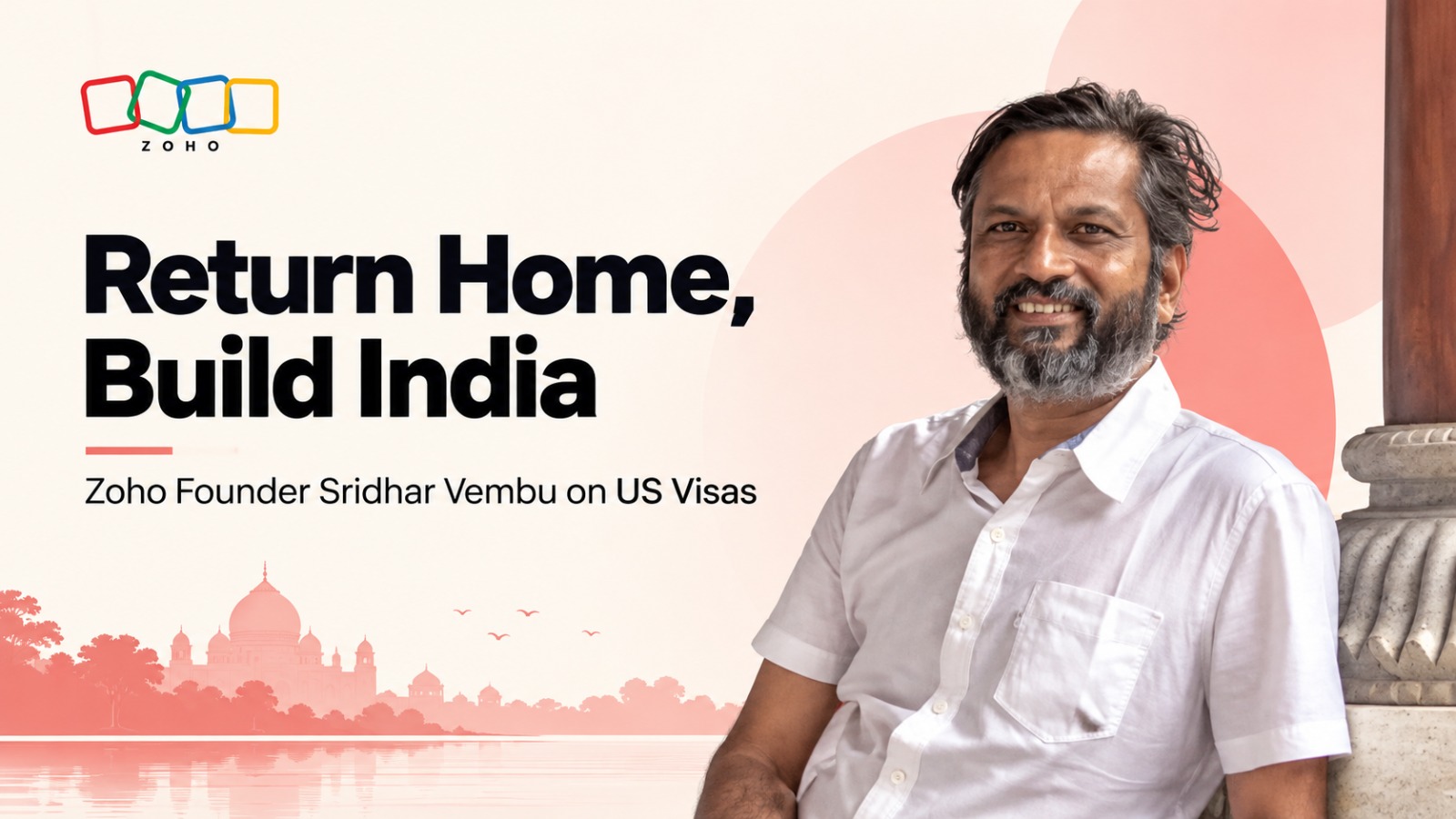
Zoho founder Sridhar Vembu has urged Indians living and working in the United States on visas to return to India and help build the country’s future, arguing that uncertainty around immigration has made it increasingly difficult for some Indian professionals to plan their lives in America.
In a post on X, formerly Twitter, Vembu said Indians had made significant contributions to America’s technological strength but were now facing an uncomfortable reality as attitudes towards them changed.
“Indians have made a major contribution to America’s technological prowess. Yet, a big part of America no longer wants us,” he wrote.
Vembu also highlighted the personal consequences of visa uncertainty for professionals who have spent years building careers, families and lives in the US.
“Indians who are on a visa in the US face the painful prospect of uprooting the life you have built with hard work,” he said.
His message ended with a call for Indians to redirect their efforts towards the domestic economy.
“Let this be the birth pains of a bold new future. Come back, let’s build India 🙏,” Vembu wrote.
Why Sridhar Vembu Is Asking Indians in America to Return
Vembu’s remarks come against the backdrop of concerns among Indian professionals about their ability to continue working and eventually settle in the United States.
Many Indian technology workers rely on employment-based immigration routes, including the H-1B visa, while others pursue permanent residency through the Green Card process. Uncertainty surrounding their long-term prospects can complicate decisions about careers, families and where to build a future.
For professionals who have spent years establishing themselves abroad, returning to India is not simply a matter of changing jobs or moving countries. It can also mean leaving behind the lives they have built through years of work.
Vembu’s appeal presents this uncertainty as an opportunity for India to attract skilled professionals back home. Rather than viewing their return only as a personal or professional setback, he wants Indians to consider how their experience and expertise could contribute to the country’s development.
Vembu Explains Why Talent Migration Can Continue as India Develops
Vembu’s comments also prompted a discussion about why talented Indians have helped build businesses and technology capabilities abroad while India has struggled to retain some of its brightest professionals.
Responding to a user who asked why Indians had built America’s technology sector instead of achieving similar results in India, Vembu pointed to the experiences of other Asian economies.
“The Chinese migrated in large numbers even as China developed.
Taiwanese migrated in large numbers as Taiwan developed. Same with South Korea and before that Japan,” he replied.
He added that the movement of skilled people abroad does not necessarily mean their home countries cannot develop.
“My point is that development at a national level accompanies out migration of talent seeking better opportunities faster,” Vembu wrote.
His response suggests that talent migration and domestic development can happen at the same time. People may move abroad to access opportunities that are available sooner, even as their home countries continue to grow economically.
For India, Vembu’s argument puts the focus on whether returning professionals can find opportunities to apply their experience, build companies and contribute to the country’s technological capabilities.
Sridhar Vembu Had Earlier Written an Open Letter to Indians in the US
This is not the first time Vembu has called on Indians living in America to consider returning home.
In April, he shared an open letter addressed to Indians in the United States, urging them to consider coming back to India and contributing to its growth. He referred to his own journey to America decades earlier and acknowledged the opportunities the country had offered him.
At the same time, Vembu expressed concern about changing attitudes towards immigration and employment, arguing that Indians abroad were increasingly caught up in wider political divisions in the United States.
In the letter, he questioned whether the country’s political choices would necessarily resolve the concerns facing Indians living there.
“You may think the next election will fix this, but your choice would be between people who hate our Bharatiya civilisation and people who hate civilisation itself. That is the “hard right” vs “woke left” battle. You are mere bystanders to that conflict,” Vembu wrote.
His latest message continues that appeal, placing greater emphasis on the prospect of returning to India and helping shape its future.
For Indian professionals weighing their options abroad, Vembu’s argument is that immigration uncertainty could also prompt a broader question: whether the experience and skills they have gained overseas could be put to use in building businesses and creating opportunities at home.
Also Read: GTA 6 May Let NPCs Track Your Behaviour as Rockstar Details New Systems