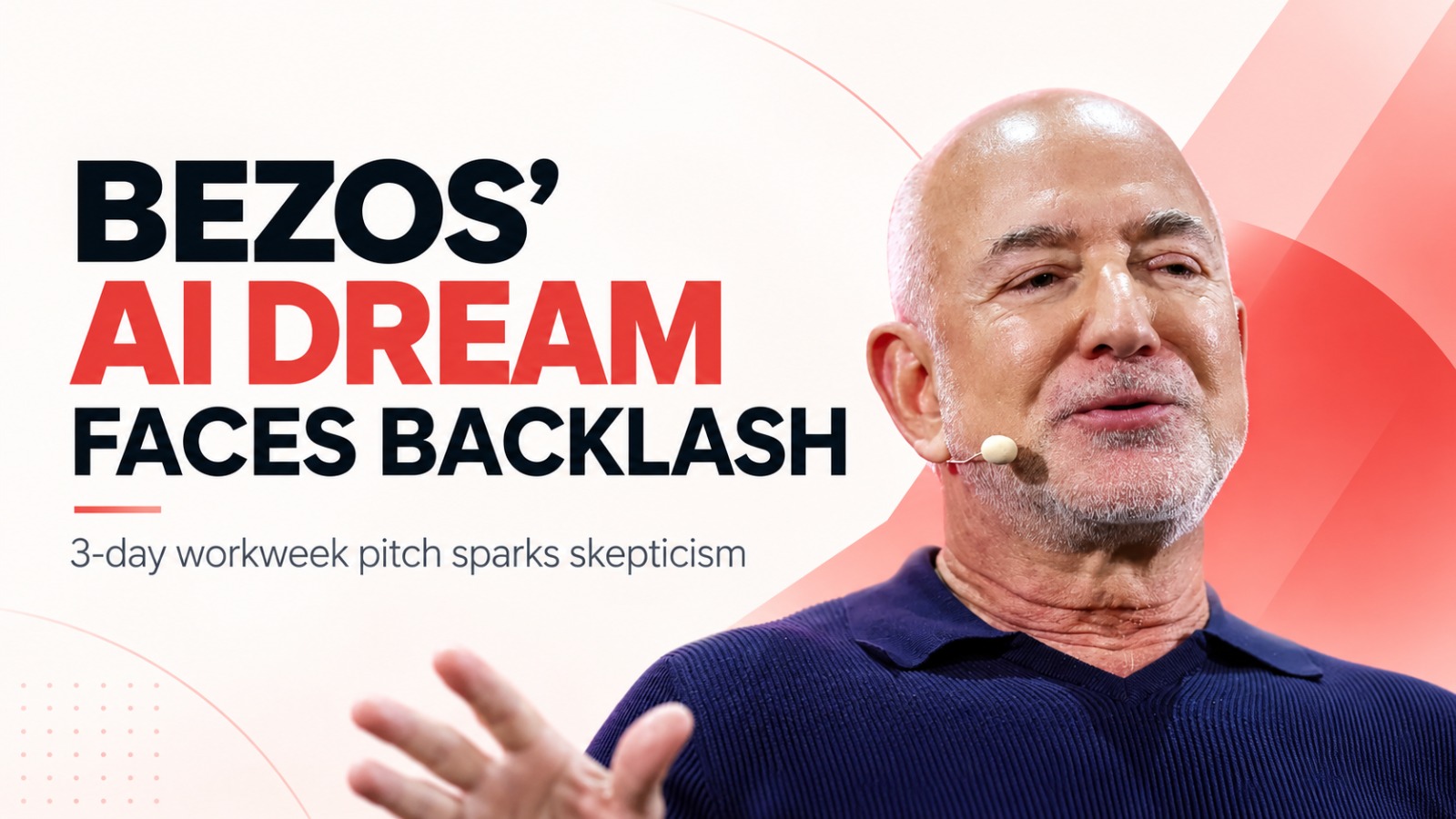
The Amazon founder Jeff Bezos believes artificial intelligence could make single-income households and shorter working weeks possible. But recent layoffs and concerns over employee wages have sparked a debate about who will actually benefit from AI-driven productivity.
Artificial intelligence could eventually help people earn enough to support their families while working just three days a week. That is the future Amazon founder Jeff Bezos believes is possible, although many workers are questioning whether companies will share the financial benefits of AI with their employees.
Speaking to Fox News, Bezos suggested that advances in AI could dramatically improve economic productivity, allowing households to maintain comfortable lifestyles without depending on two incomes.
His comments have attracted attention for an uncomfortable reason.
While Bezos is discussing a future in which people may not need to work as much, Amazon has been reducing its corporate workforce.
The contrast has sparked criticism online, with social media users questioning whether higher productivity will translate into shorter working hours and better wages or simply allow businesses to operate with fewer employees.
Jeff Bezos Sees AI Creating a Future With Less Work
Bezos believes artificial intelligence could change the relationship between employment, income and productivity.
Rather than predicting widespread unemployment, he suggested that AI-driven improvements could eventually make workers financially comfortable enough to reduce their working hours.
“Some people will also decide, you know what? I can support my family by working three days a week,” Bezos said during the Fox News interview.
He went further, predicting that these productivity gains could create an unexpected challenge for employers: a shortage of people willing to work.
“That’s what productivity in the economy means.
It’s going to actually be difficult to hire people because the productivity in the economy is going to make it so that if people don’t want to work two jobs, they won’t have to,” he explained.
His argument rests on the possibility that AI could help businesses produce more goods and services with less human effort.
If those improvements translate into stronger household incomes, some workers could choose shorter schedules without sacrificing their financial security.
Amazon’s Layoffs Complicate the Three-Day Workweek Prediction
The timing of Bezos’ remarks has brought renewed attention to employment decisions at Amazon, the company he founded.
According to Reuters figures, Amazon eliminated approximately 1,000 white-collar positions during the week of Bezos’ comments.
Those reductions were described as part of a broader restructuring that has affected around 30,000 employees since the previous year.
The job cuts have raised an important question about the future Bezos is describing.
If artificial intelligence allows companies to accomplish more work with fewer resources, will the benefits appear in employees’ paychecks and schedules, or will businesses primarily use those improvements to reduce operating costs?
Bezos has previously attributed workforce reductions to over-hiring during the pandemic rather than explicitly linking them to artificial intelligence.
Amazon CEO Andy Jassy’s $40.1 Million Compensation Adds to the Debate
The discussion has also brought executive compensation into focus.
Amazon CEO Andy Jassy received $40.1 million in total compensation in 2024, representing a reported 37% increase compared with the previous year.
For critics, the central issue is not whether AI can make businesses more productive. It is whether that additional productivity will translate into meaningful improvements for ordinary workers.
A company can become more efficient without automatically raising salaries, reducing working hours or expanding employee benefits.
That leaves an important part of Bezos’ prediction unresolved: how the economic gains generated by AI would reach the households expected to benefit from them.
Social Media Users Question Whether Companies Will Share AI Gains
Bezos’ comments prompted criticism on X, where users challenged the assumption that employers would voluntarily reduce working hours while maintaining employee incomes.
Melanie D’Arrigo questioned whether companies would offer three-day workweeks rather than expect employees to produce more during the traditional five-day schedule.
In a post on October 8, she wrote:
“If you think companies will give us a 3 day work week instead of forcing us to double our output over 5 days while suppressing wages, then you don’t understand capitalism, or the greed of the CEOs and billionaires who have built their wealth by exploiting the working class.”
Another user, posting under the name Chrisy | Homemade Hooplah, raised concerns about whether employers would increase compensation in the future when workers are already demanding better wages.
“The fact that they won’t pay us more NOW is all the proof you need to know that they’re not going to pay us more LATER,” the user wrote.
Other reactions drew attention to working conditions at Amazon, including criticism of how warehouse employees are monitored.
Workers may welcome technology that makes their jobs easier, but that enthusiasm does not necessarily extend to automation that threatens their income or job security.
AI-Related Job Losses Are Already a Growing Concern
The debate extends beyond Amazon.
Artificial intelligence has been referenced in more than 180,000 corporate layoffs across the United States since May 2023, including over 112,000 in 2026.
Businesses across industries are exploring ways to use artificial intelligence to improve efficiency, streamline processes and automate tasks previously performed by employees.
The potential impact is not limited to office-based roles.
AI systems designed to learn physical workflows could also affect workers performing repetitive tasks in industrial and operational settings.
For employees whose income depends on the number of hours or days worked, the consequences of automation could be particularly significant
A reduction in available work does not automatically translate into greater financial freedom, especially when earnings fall alongside working hours.
Amazon’s Workplace Safety Record Faces Renewed Scrutiny
Criticism of Bezos’ prediction has also revived discussion about working conditions at Amazon.
A US Senate investigation in 2024 examined workplace safety practices at the company over an 18-month period.
The investigation concluded that Amazon prioritised operational speed over worker safety and manipulated injury records in ways that made its warehouses appear safer than they were.
These findings add context to the criticism surrounding Bezos’ comments.
The Bigger Question Is Who Benefits From AI Productivity
Bezos’ prediction presents an optimistic possibility for the future of employment.
If AI allows businesses to generate more economic value with less labour, there may be opportunities to reduce working hours while maintaining or improving living standards.
However, higher productivity and higher household income are not necessarily the same thing.
Businesses could use AI-generated savings to increase profits, invest in further technology, reduce prices or improve employee compensation. The outcome would depend on decisions made by employers, competition, labour arrangements and broader economic conditions.
Bezos is describing what greater productivity could make possible. His critics are questioning whether businesses will distribute those gains in a way that makes such a future achievable for ordinary households.
Neither the technology itself nor the availability of AI tools guarantees a three-day working week.
For that to become a sustainable arrangement, employees would need to earn enough during fewer working days to maintain their standard of living.
Can AI Really Make Three-Day Workweeks a Reality?
A future in which people spend less time working is not impossible, but the transition could look very different across industries and income groups.
Some employees may benefit from technology that allows them to complete their responsibilities more efficiently.
Others could face reduced working hours, lower earnings or greater competition for available jobs.
The difference between those outcomes could shape public attitudes towards AI as its adoption continues.
For now, Bezos’ comments have exposed a gap between the promise of artificial intelligence and the employment concerns already surrounding its use.
The real test of his prediction will not simply be whether AI enables companies to produce more with fewer working hours.
It will be whether workers can afford to take those hours off.
And with Amazon’s recent job cuts still drawing attention, that question is unlikely to disappear anytime soon.
Also Read: Zoho Founder Sridhar Vembu Tells Indians on US Visas to Return Home and Build India