

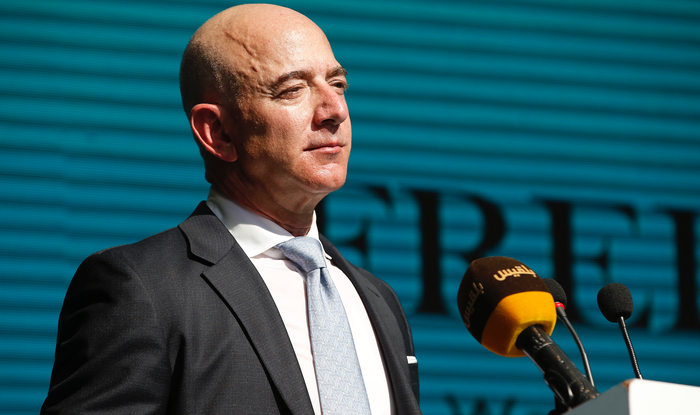
Amazon founder Jeff Bezos is stepping back into a hands-on leadership role, this time outside the e-commerce giant he built. The billionaire entrepreneur will serve as co-chief executive of Project Prometheus, a heavily funded artificial intelligence startup aiming to transform how physical products are designed and manufactured.
Project Prometheus has already raised $6.2 billion in funding, with a portion of that capital coming from Bezos himself. The move marks Bezos’s first operational role since he stepped down as Amazon’s chief executive in July 2021.
A High-Profile Comeback To Day-To-Day Leadership
Bezos formally left the Amazon CEO role in 2021, moving to the executive chairman position and devoting more time to his space company Blue Origin and other interests. The decision to co-lead Project Prometheus represents his return to an active corner-office job after a four-year gap.
Bezos is “back in a formal leadership role” as co-chief executive of Project Prometheus, describing the startup as a heavily funded AI company aimed at “revolutionizing manufacturing and engineering.”
This is Bezos’s “first significant executive role” since his Amazon exit, underlining the strategic importance of the move in the broader technology and AI landscape.
What Is Project Prometheus Trying To Do?
Public details about Project Prometheus are still limited. But the overlapping accounts from: AI for the “physical economy” rather than just the digital world.
According to the reporting, Project Prometheus will focus on artificial intelligence systems that assist engineering and manufacturing across several sectors, including:
- Computers
- Aerospace
- Automobiles
The company’s own LinkedIn presence is sparse for now, but Forbes notes that its profile page carries a blacked-out logo and a brief description: “AI for the physical economy.”
The company’s mission lines up with Bezos’s long-standing interest in space exploration, pointing out that Blue Origin recently achieved a successful booster landing. While there is no official link between the two companies, the choice of aerospace as one of Prometheus’s focus sectors naturally invites attention to that overlap.
One Of The Best-Funded Early-Stage AI Startups
With $6.2 billion already committed, Project Prometheus is being described as “one of the most well-financed early-stage startups in the world.”
The scale of the raise places Project Prometheus in a rarified category of AI ventures that begin life not as scrappy experiments, but as heavily capitalised bets on a very specific vision of the future.
The startup has already hired around 100 employees, including researchers “poached” from leading AI research organisations such as OpenAI, Google DeepMind and Meta, the Forbes report says, citing unnamed sources.
The Other CEO: Who Is Vik Bajaj?
Bezos will not be running Project Prometheus alone. Both reports identify scientist Vik Bajaj as co-founder and co-CEO of the startup.
Bajaj brings a deep scientific and innovation-led background to the role:
- He is a physicist and chemist
- He previously worked closely with Google co-founder Sergey Brin at Google X, the company’s experimental research division known internally as “The Moonshot Factory.”
- He also co-founded the health-tech venture Verily and later led Foresite Labs before joining Project Prometheus.
Bajaj has already updated his LinkedIn profile to list himself as Co-CEO and Co-Founder of Project Prometheus, mirroring the leadership structure that pairs him directly with Bezos at the top of the organisation.
An AI Bet Rooted In The “Physical Economy”
Unlike many consumer-facing generative AI products, Project Prometheus is being framed from the outset as a platform for heavy industries and complex engineering work.
By targeting computers, aerospace and automotive manufacturing, the company is positioning its AI tools as part of the underlying infrastructure that designs, simulates and builds physical products. That emphasis on the “physical economy” is further reinforced by its own sparse public description and by the sectors highlighted in the early reporting.
For Bezos, who has long championed ambitious, capital-intensive projects, from global logistics networks at Amazon to orbital launches at Blue Origin, the choice of focus areas fits squarely within his established interest in large-scale engineering challenges.
Silence From Jeff Bezos, Signals From His Feed
Interestingly, Bezos himself has not yet publicly commented on Project Prometheus. His recent social media posts have instead been centred on Blue Origin’s launches, suggesting that the AI venture is still in a deliberately low-key phase as far as public messaging is concerned.
For now, Project Prometheus stands out for three reasons that are firmly established by the available, verified information:
- Bezos’s return to an operational CEO role after stepping away from Amazon’s day-to-day leadership in 2021.
- The unprecedented scale of its early funding, with $6.2 billion already committed, partly from Bezos, making it one of the world’s best-funded early-stage AI startups.
- A clear thematic focus on AI for engineering and manufacturing in sectors such as computers, aerospace and automobiles, encapsulated in the phrase “AI for the physical economy.”
It is not clear how its technology will be deployed, how it might engage with manufacturers, or whether it will intersect with Amazon’s own AI ambitions.
Also Read: Japan’s AI Bet Deepens as Sakana AI, Turing Raise Over ¥35 Billion in a Week
















