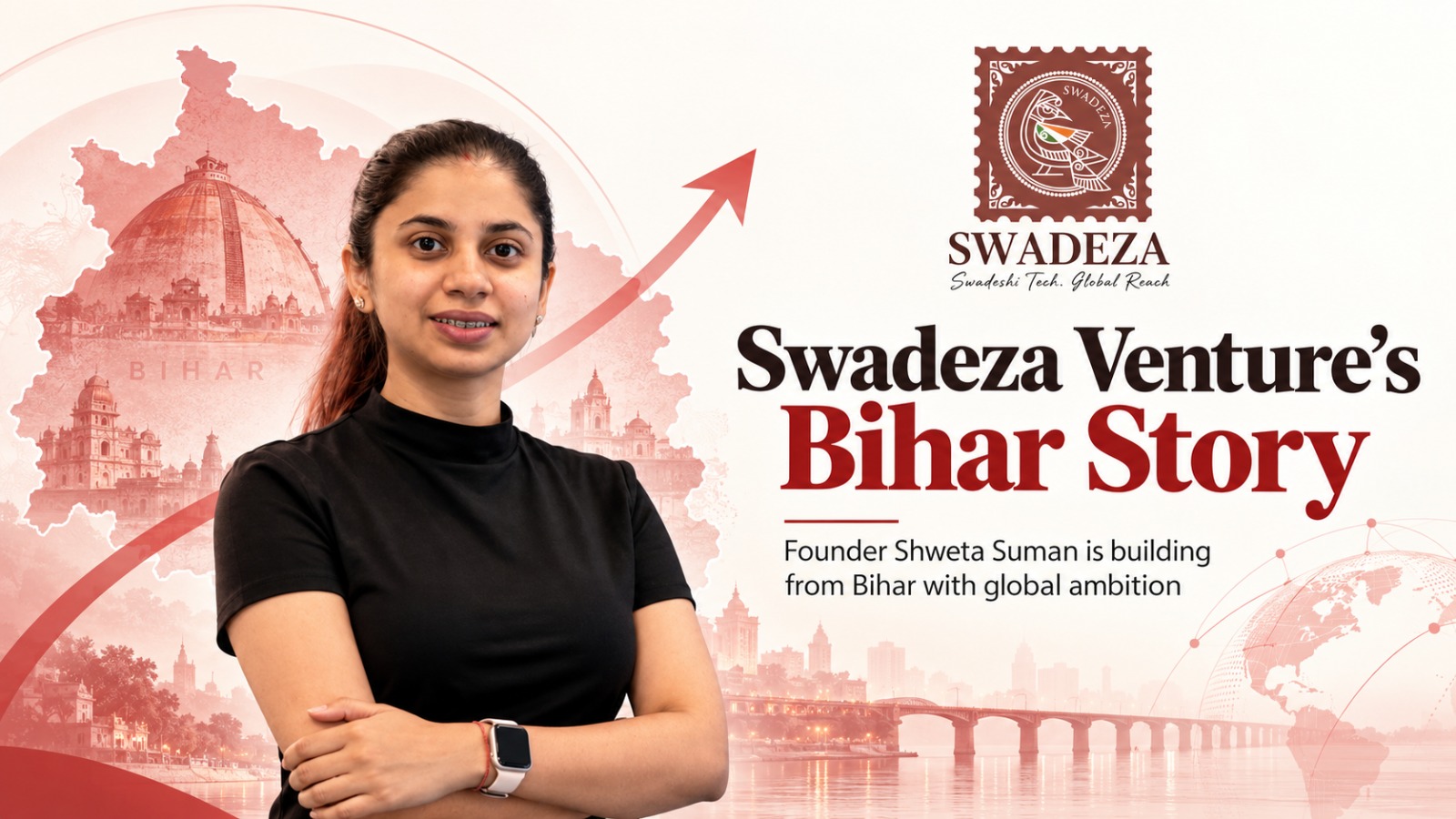
Following the exhibition of their artificial intelligence-enabled chip-designing technology at SEMICON India 2026, the Bihar-based startup firm, Swadeza, has come into prominence due to its innovative chip-designing strategy, while the startup’s founder, Shweta Suman, aspires to demonstrate the fact that the next big tech firms in India may originate elsewhere than the usual startup hotspots.
For Shweta Suman, building a technology company from Bihar has never been just about starting a business. It has also meant challenging the idea that ambitious technology ventures must begin in India’s familiar startup destinations.
This belief was further amplified in September 2026 when Suman’s firm, Swadeza Venture, took part in the SEMICON India 2026 event. This conference gathered some of the most well-known personalities of the semiconductor industry.
Swadeza, which, according to Suman, is the only start-up from Bihar to participate in the event, exhibited its semiconductor technology in Startup Pod 6. It was the first public display of its AI-native semiconductor engineering software, FORGE.
For a founder who chose to build from Bihar despite the difficulties that came with the decision, the occasion represented more than an exhibition opportunity. It was a chance to show what a technology company from the state could bring to a highly specialised industry.
The company’s journey has since received attention from Forbes India and YourStory, bringing further visibility to a venture working to establish itself in India’s emerging semiconductor ecosystem.
Speaking to Ascendants about the ambition behind Swadeza, Suman said:
“With Swadeza, my vision is to build technology that creates meaningful impact, prove that innovation can emerge from anywhere, and put Bihar on India’s deep-tech map. As a founder, I want to turn bold ideas into lasting impact.”
A Founder Who Chose to Build in Bihar
Suman’s journey to entrepreneurship did not follow a conventional route.
She completed her schooling in Oman before pursuing engineering at BIT Mesra. Her journey later took her back to Oman, before she eventually returned to Bihar after marriage.
Instead of relocating to an established technology centre to pursue her ambitions, she decided to build her venture in Bihar.
It was a choice that came with its share of challenges. Building a specialised technology business requires access to engineering expertise, industry relationships, potential customers and opportunities to demonstrate technical capabilities.
For a company operating outside India’s conventional technology hubs, establishing that credibility becomes an important part of the journey.
Suman has acknowledged that building Swadeza from Bihar has not been easy. That is also why the recognition the company has received holds particular significance for her.
Her decision to build locally has become part of Swadeza’s identity, even as its ambitions extend well beyond the state.
Swadeza Venture: A Business with Ambitions Beyond One Sector
While Swadeza’s recent recognition has centred on its semiconductor work, the company has a broader technology portfolio.
Its operations span semiconductor technology, IT consulting and development, and 360-degree digital marketing.
The company has also worked on software solutions for government and public-sector applications.
One such project involved developing an automated AI-based verification system for recruitment processes for the Government of Bihar. Swadeza has reported that the system helped reduce processing timelines from several months to weeks.
The venture describes itself as women-led and says its engineering team brings experience across fabless semiconductors, consumer technology platforms and government technology deployments.
However, it is Swadeza’s work in AI-powered semiconductor engineering that has become central to its current growth ambitions.
Inside FORGE, Swadeza’s Semiconductor Engineering Platform
Semiconductor development involves multiple complicated stages before a chip can be manufactured and deployed.
One of the most demanding is design verification, where engineers test whether a chip behaves according to its specifications.
Errors discovered late in the process can be expensive, making verification an important part of semiconductor engineering.
Swadeza is developing FORGE, an AI-native platform intended to support engineers across different stages of the chip development lifecycle.
Rather than treating AI as a general-purpose coding assistant, the platform is designed to work with structured information about semiconductor designs, helping engineering teams manage and interpret complex technical data.
Its product portfolio includes four tools at different stages of development.
DV-FORGE focuses on design verification. It is designed to interpret chip specifications and generate verification plans, coverage models and UVM testbenches.
Swadeza has reported using the technology on OpenTitan-class system-on-chip designs. According to the company’s reported results, its verification work on OpenTitan Earlgrey was completed in 30 days and identified seven bugs across approximately 40 intellectual property blocks and 2,581 registers.
The company has also reported completing verification work on a derivative called Darjeeling in 21 days.
Another product, PD-FORGE, is being developed to assist with physical design by identifying and tracing issues that arise during different stages of chip implementation.
The company has been targeting a production release in the fourth quarter of 2026, following closed testing.
Two additional products, PS-FORGE and SC-FORGE, remain under development. They are intended to address post-silicon validation and standard-cell engineering, respectively.
An important part of Swadeza’s approach is its emphasis on on-premises deployment, allowing semiconductor companies to use its tools within their own computing environments.
That matters in an industry where chip designs and related engineering data can represent valuable intellectual property.
The technology is ambitious, but the next measure of its progress will be commercial adoption and how effectively its tools perform in real-world engineering environments.
The SEMICON India 2026 Moment
Held from September 17 to 19, 2026, SEMICON India brought together companies and stakeholders involved in semiconductor technology and its wider ecosystem.
The company presented its technology at Startup Pod 6, giving it a platform to demonstrate its work and engage with people across the semiconductor sector.
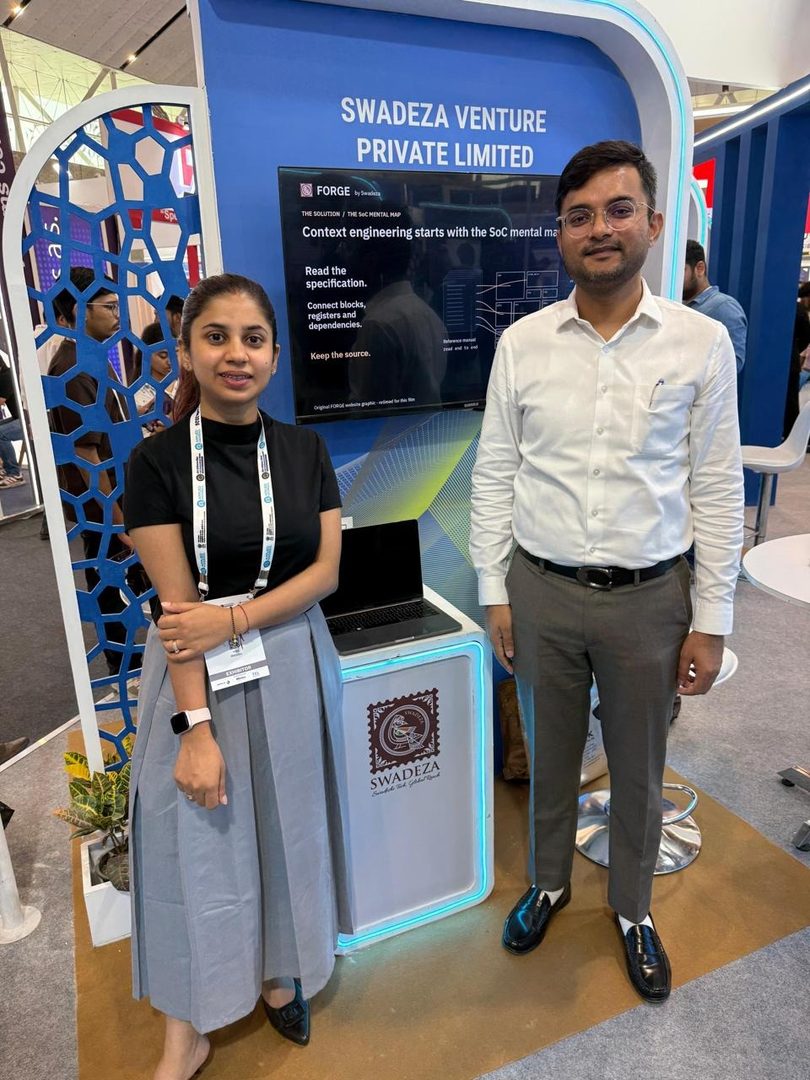
Its appearance gained further attention when Forbes India included Swadeza in its photographic coverage of the event, which also featured prominent names such as Tata Electronics and IBM.
For Suman, being represented in coverage alongside established companies was a meaningful moment in a journey that began far from India’s best-known technology centres.
The recognition did not place Swadeza on the same commercial scale as those companies, but it gave the young venture visibility in a sector where building credibility is particularly important.
The achievement was also notable for the story behind it: a founder building a semiconductor-focused technology venture from Bihar and taking that work to a national industry platform.
Why Bihar Matters to the Swadeza Story
Swadeza’s location is more than an address in its founder’s journey.
Bihar has long been part of conversations about talent moving to other states in search of education, employment and professional opportunities.
Suman’s decision to build a technology company in Bihar presents a different possibility.
It raises a question about whether specialised technology businesses can take shape in regions that have traditionally had less visibility in India’s startup ecosystem.
The timing is significant as Bihar pursues its own semiconductor ambitions.
The state approved its Semiconductor Policy 2026, aimed at encouraging investment in areas including semiconductor fabrication, display manufacturing and chip design. A Bihar Semiconductor Mission has also been established to oversee implementation.
Swadeza approaches the semiconductor opportunity from the engineering software side rather than chip fabrication.
Its efforts demonstrate one possible route for participation in the industry, where locally developed software tools could be used by semiconductor engineering teams beyond the state.
Whether that opportunity turns into a sustainable business will depend on product performance, customer adoption and the company’s ability to compete in a specialised global market.
Recognition Is One Milestone. Building a Lasting Company Is the Next.
Attention from industry events and national publications can open doors, but it does not eliminate the challenges of building a deep-tech company.
For Swadeza, the next stage will involve taking products further into development and production, strengthening industry relationships and converting interest into customer deployments.
Its ambitions are not limited to Bihar or even India.
The company is positioning its semiconductor engineering technology for a wider market, with the goal of building tools that chip development teams can use in demanding technical environments.
That ambition makes the company’s future an interesting one to follow.
Swadeza has gained visibility through SEMICON India 2026 and subsequent media recognition. The more difficult task now is turning that visibility into long-term commercial and technological progress.
For Suman, the larger motivation remains closely connected to where the company started.
She wants Swadeza to demonstrate that meaningful technology innovation does not have to be defined by geography.
Much More Than a Conference Appearance
There is a difference between being noticed at a major industry event and building a company that can make a lasting contribution to that industry.
Shweta Suman and Swadeza have achieved the first of those milestones. The second remains a work in progress.
What makes the story worth following is not simply that a Bihar-based startup appeared alongside recognised semiconductor companies.
It is the decision to build technically demanding products from a place that rarely dominates India’s deep-tech conversation, and the effort to take those products into a competitive industry.
Swadeza’s journey is still unfolding, with important questions around deployment, adoption and scale yet to be answered.
But for Suman, its progress already carries a purpose beyond the company itself.
She is trying to make Bihar part of a conversation about where India’s next generation of technology businesses can be built.
And for a founder who set out to prove that innovation can emerge from anywhere, that is a meaningful place to begin.
Also Read: What Is Atlas Atomics? Inside Vivek Ramaswamy’s Nuclear Startup