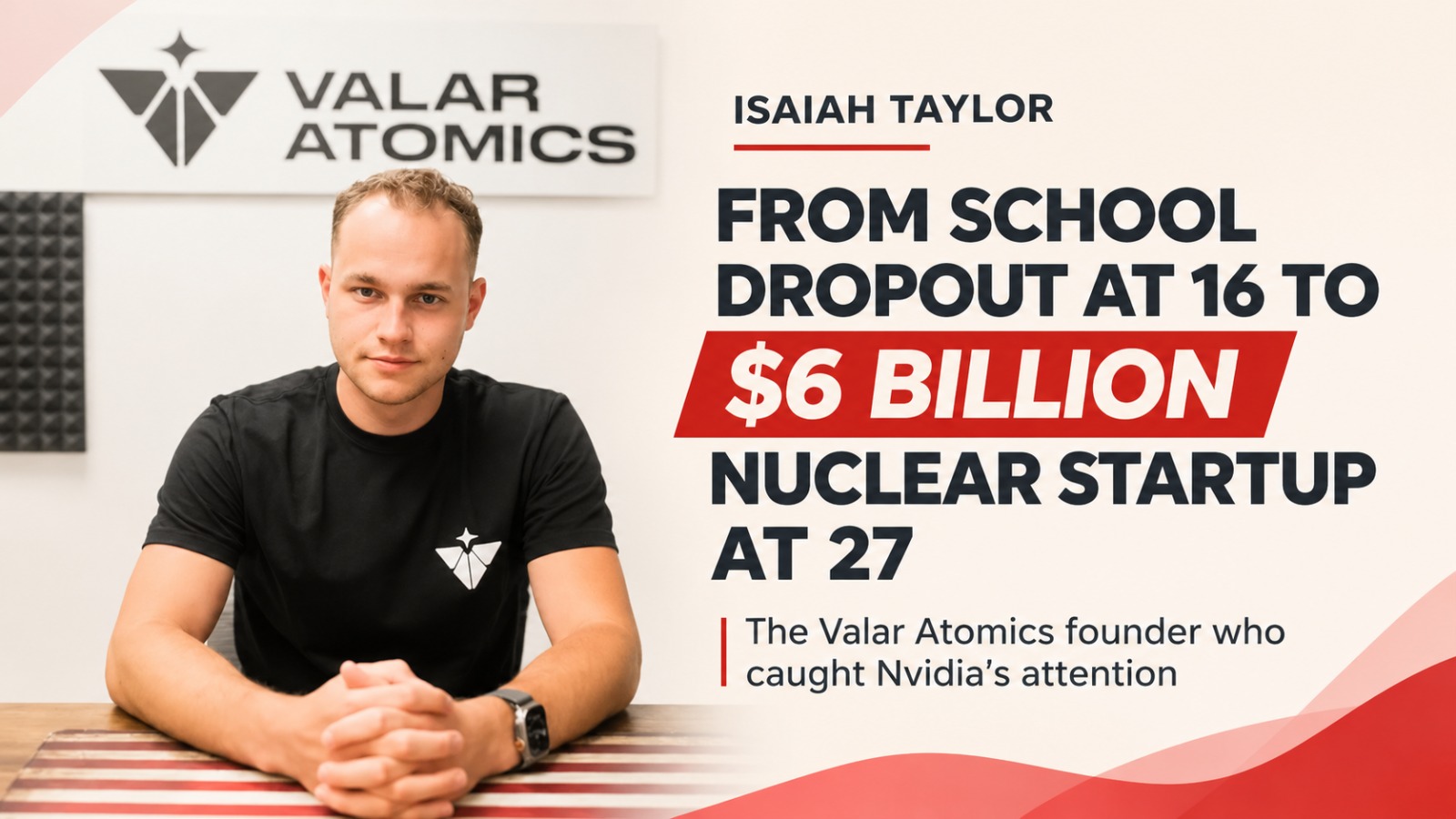
Isaiah Taylor left high school at 16. Eleven years later, he is leading a nuclear energy startup valued at approximately $6 billion, with plans to supply electricity to some of the world’s most power-hungry computing systems.
The 27-year-old American entrepreneur is the founder and CEO of Valar Atomics, a company developing small modular nuclear reactors. Founded in 2023, the startup has attracted major investment and drawn attention through a demonstration involving an Nvidia Blackwell-based artificial intelligence system.
The 27-year-old US entrepreneur is the founder and CEO of Valar Atomics, a firm specializing in the creation of small-scale nuclear reactors. The startup, established in 2023, has raised significant funds through a demonstration involving an artificial intelligence system based on the Nvidia Blackwell.
From leaving school at 16 to building technology businesses
Taylor’s interest in technology began long before Valar Atomics existed.
After leaving high school at 16, he taught himself programming and started taking on contract software development projects. The work gave him practical exposure to building technology and working with businesses without following a conventional university education.
He also founded two startups before establishing Valar Atomics, gaining experience that would later help him enter the nuclear energy industry.
His interest in nuclear science has a family connection. Taylor’s great-grandfather, Ward Schaap, was a nuclear physicist who worked on the Manhattan Project, the American-led programme responsible for developing the first atomic bombs during World War II.
Taylor eventually combined his interests in technology, entrepreneurship and nuclear energy into a business focused on electricity generation.
Why Valar Atomics is betting on nuclear power for AI
When Taylor founded Valar Atomics in 2023, his goal was to develop advanced reactors capable of supplying dependable electricity to businesses and industrial facilities.
The company is developing small modular reactors, or SMRs, which are designed to be smaller than conventional nuclear reactors and potentially easier to manufacture and install.
Their appeal lies partly in the possibility of producing reactor components in factories before deploying them at locations where electricity is needed.
That approach could be particularly relevant to data centres, which require substantial and continuous power to operate computing infrastructure.
As artificial intelligence systems become more demanding, electricity supply is emerging as a significant consideration for companies expanding their computing capacity.
Valar Atomics hopes nuclear energy can help meet that demand by providing electricity independently of weather conditions.
The Nvidia demonstration that put Valar Atomics in focus
A major technical milestone came on June 18, 2026, when Valar Atomics’ Ward 250 reactor achieved nuclear criticality.
In nuclear engineering, criticality means a reactor has reached a condition in which a self-sustaining nuclear chain reaction is possible.
The company followed this achievement with a demonstration in July 2026, generating electricity through its reactor technology and using it to operate an Nvidia Blackwell-based AI system.
The test provided a practical connection between nuclear power generation and AI computing, two industries that are increasingly linked by rising electricity requirements.
It involved a limited amount of electricity and did not establish that Valar Atomics could already power a large commercial data centre. That remains a considerably bigger engineering and commercial challenge.
The company and Nvidia also announced plans they were exploring for a proposed 30-megawatt AI data centre in Utah.
The project represents a much larger ambition than the initial demonstration, although its commercial operation has not been established.
A $1 billion investment puts Valar Atomics at a $6 billion valuation
Investor interest in Valar Atomics became particularly visible on August 4, 2026, when the company announced a $1 billion Series B funding round led by Sequoia Capital.
It also secured a $200 million credit facility to support its expansion plans.
Bloomberg reported that the funding round valued the startup at approximately $6 billion.
For a business established only three years earlier, the valuation marked a significant financial milestone.
The investment also reflects interest in technologies that could address the growing electricity needs of artificial intelligence, cloud computing and large-scale data infrastructure.
Still, the valuation should not be mistaken for evidence that Valar Atomics has established a commercial nuclear power business at scale. The company must turn its technical achievements and development plans into dependable electricity infrastructure.
The bigger challenge awaiting Isaiah Taylor
Taylor’s career has attracted attention partly because he entered one of the most technically demanding industries without completing a traditional academic education.
But nuclear energy is not a field where entrepreneurial ambition alone guarantees success.
Developing commercially viable reactors requires specialised engineering expertise, rigorous safety systems, regulatory compliance and substantial capital.
Valar Atomics has demonstrated progress in reactor operation and electricity generation. Its next challenge is proving that its technology can be deployed at a scale useful to commercial customers.
The proposed Utah AI data centre provides a clear example of the distance between a successful demonstration and a functioning large-scale energy project.
For Taylor, the challenge is now less about attracting attention and more about delivering on the expectations that come with a multibillion-dollar valuation.
His decision to leave school at 16 may be the most striking part of his personal story, but it does not fully explain his progress. Years of independent learning, software development and earlier business ventures preceded the creation of Valar Atomics.
At 27, Taylor has built a company positioned around an important question facing the AI industry: where will the electricity needed for increasingly powerful computing systems come from?
Whether Valar Atomics becomes a major supplier of that power remains uncertain. Its reactor demonstration, funding and proposed data centre have established its ambitions. Commercial-scale delivery will determine how far those ambitions can go.
Also Read: Mahindra Scorpio N Edition One First Look: What’s Different From Standard Model?