


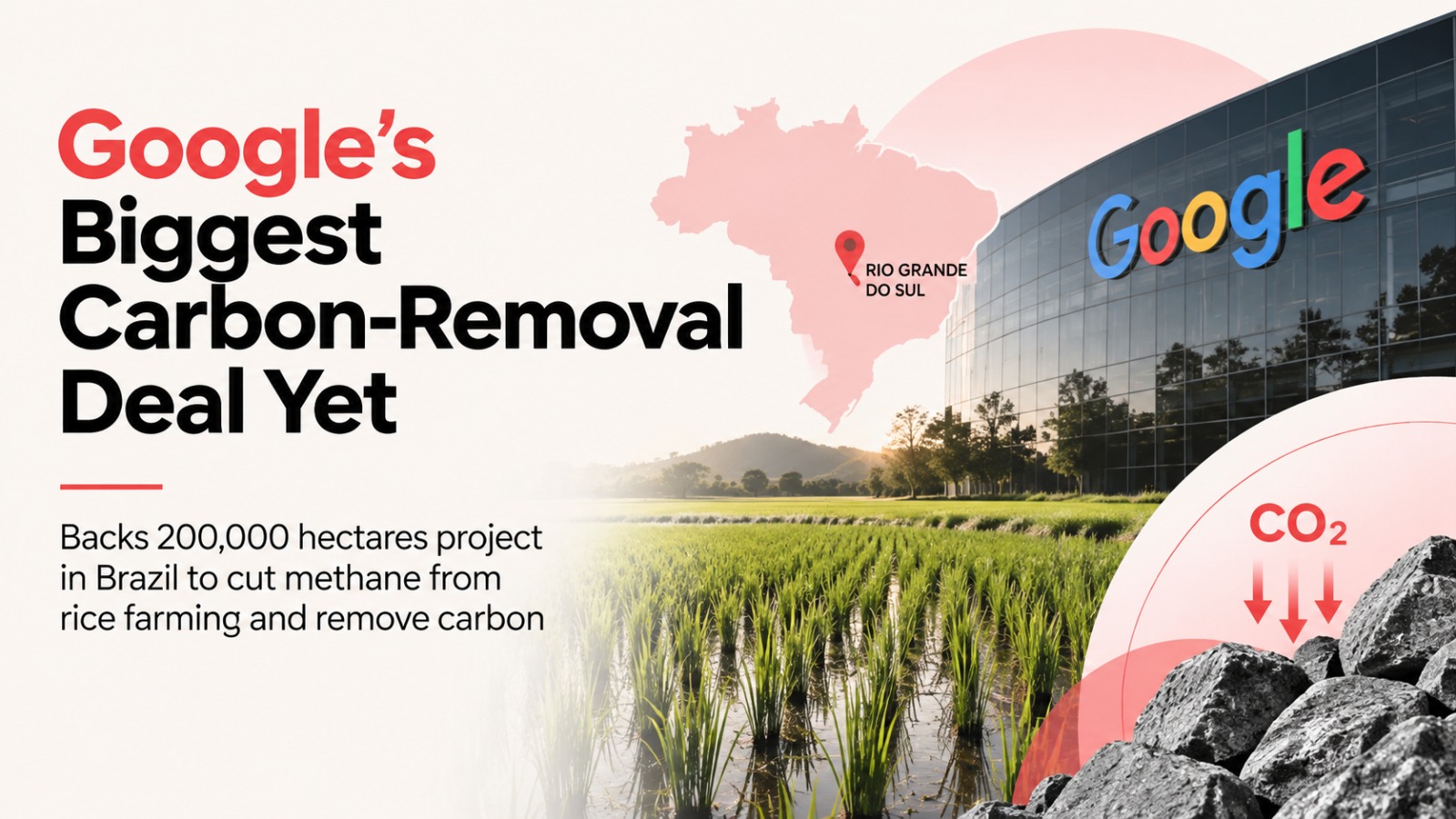
Google is backing a large-scale project in southern Brazil that combines methane cuts from rice farming with carbon removal, an approach the company hopes can become a template for projects in other major rice-growing markets.
Google has agreed to its largest carbon-removal deal to date, backing a Terradot project in Brazil that will attempt to tackle two climate problems on the same agricultural landscape: methane emissions from rice cultivation and carbon dioxide already present in the atmosphere.
The project will cover more than 200,000 hectares in Rio Grande do Sul, making it the largest enhanced rock-weathering project undertaken so far. The technique is designed to speed up a naturally occurring process in which certain types of rock absorb carbon dioxide from the atmosphere.
What makes the project different is not simply its size. Google and Terradot are pairing carbon removal with efforts to reduce methane from rice cultivation, creating two separate streams of climate credits from the same broader programme.
The project is expected to generate 1 million metric tons of methane-abatement credits by 2030 and another 1 million tons of carbon-removal credits by 2040. The two categories will be generated and verified separately. The carbon-removal component alone is 10 times larger than earlier enhanced rock-weathering projects, according to the companies.
Why rice fields are central to the project
Rice cultivation has emerged as an important target in efforts to cut methane emissions. A 2021 assessment by the United Nations Environment Programme estimated that rice paddies account for around 10% to 12% of global methane emissions.
Methane and carbon dioxide create different challenges. Methane has a stronger warming effect over shorter periods, while carbon dioxide can remain part of the climate system for far longer. Google’s carbon-removal head Randy Spock said the company sees a need to address both rather than concentrate resources exclusively on one category.
That thinking sits at the heart of the Brazil project. Rather than treating agricultural methane reduction and atmospheric carbon removal as unrelated markets, the model brings them together at commercial scale.
Google has said it hopes the arrangement can provide a framework for future projects.
The project could move well beyond 200,000 hectares
The initial footprint is significant, but the companies see a much larger potential market.
The model could eventually be expanded across roughly 1.5 million hectares of rice fields in Brazil. Terradot and Google also see scope for applying the approach in other major rice-producing regions, including India and Vietnam.
Terradot plans to begin pilots in several countries during 2026, followed by a planned move toward commercial scale in 2028.
That international expansion will matter because the economics of enhanced rock weathering remain one of the technology’s biggest hurdles.
The price of carbon removal remains the difficult part
Google and Terradot have not disclosed what Google will pay for credits generated under the new agreement.
There is, however, an earlier benchmark. A publicly disclosed Terradot transaction in 2024 covering 90,000 tons of carbon removal implied a price of roughly $300 per ton. That remains well above the approximately $100-per-ton level many developers are trying to reach in order to attract broader demand.
Terradot CEO James Kanoff said the new project will be cheaper than earlier deals. It has not yet reached the $100-per-ton level, but he described the new economics as a substantial move in that direction.
One less obvious expense is verification.
Terradot said verification itself can add more than $100 per ton to the cost of enhanced rock weathering. Under the new project, carbon removal may be allowed to accumulate for a longer period before undergoing third-party verification, a change intended to reduce that expense.
That detail could prove important to whether projects of this scale become commercially repeatable. Expanding carbon removal is not only a question of deploying the underlying technology. Measurement and verification costs can have a major effect on the final price of each credit.
Google deepens its relationship with Terradot
The transaction also extends an existing relationship between the two companies.
Google became an investor in Terradot after taking an equity stake in the company in 2024. The technology group is among several large companies facing pressure to increase spending on clean energy and carbon removal as emissions associated with AI-driven data centres grow.
The broader carbon-removal market is still developing. The Intergovernmental Panel on Climate Change has said carbon removal will be needed to help meet global climate objectives, while critics have argued that dependence on removal technologies can give companies more room to continue emitting in the near term.
For Google and Terradot, the Brazil project is therefore more than a large purchase agreement. It is an attempt to see whether a model combining agricultural methane reductions, rock-based carbon removal and lower verification costs can work across hundreds of thousands of hectares, and eventually beyond Brazil.
Also Read: YouTube Expands ‘Watch With’ Test, Letting Creators React Live From Mobile