Warren Buffett has spent decades talking about businesses, markets and the importance of thinking long term. But one of his most striking warnings was not about stocks at all. It was about the currency behind them.
Speaking to Berkshire Hathaway shareholders in May 2025, Buffett made clear that currency risk was something he took seriously.
“We wouldn’t want to be owning anything that we thought was in a currency that was really going to hell, and that’s the big thing we worry about with the United States currency.”
The remark has gained renewed attention following Buffett’s departure from the Berkshire Hathaway chairman’s seat, bringing fresh focus to what he identified as a deeper concern: the long-term consequences of persistent US government deficits and the gradual erosion of a currency’s purchasing power.
Buffett’s warning was about what happens over time
Buffett was not saying the US dollar had already collapsed. His concern was what could happen if government spending and borrowing remain on an unsustainable path for long enough.
“Fiscal policy is what scares me in the United States,” Buffett told shareholders.
He described the country’s fiscal deficit as unsustainable over a very long period and warned that such a situation can eventually become difficult to control.
“We are doing something that is unsustainable, and it has the aspect to it that it gets uncontrollable to a certain point,” he said.
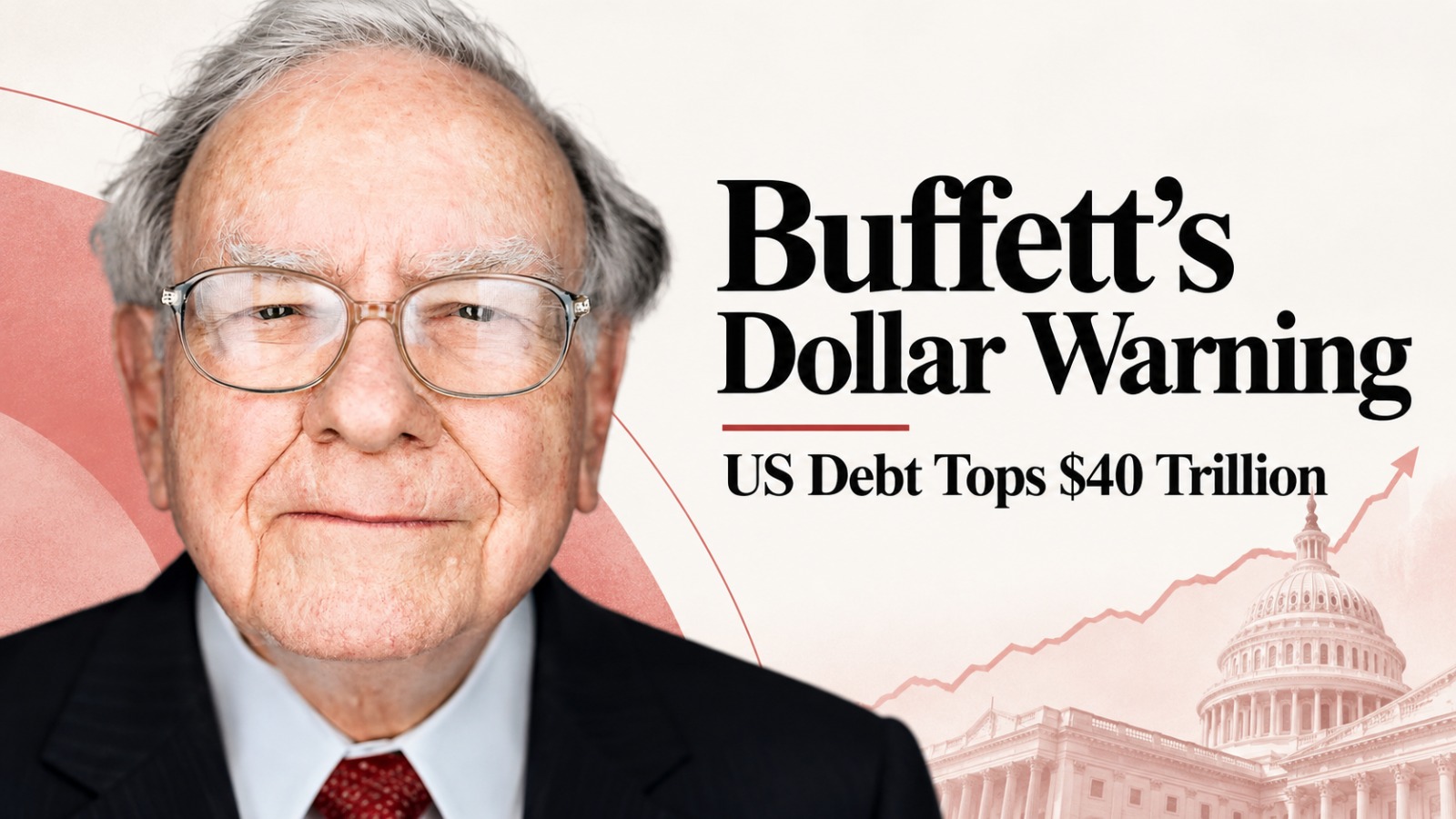
The numbers cited alongside those comments help explain the concern. Through the first 11 months of fiscal 2026, the US federal government had accumulated a deficit of $1.97 trillion, while national debt had moved past $40 trillion.
For Buffett, however, the issue was bigger than the headline debt number. It was about what continued borrowing and money creation can eventually mean for the value of money itself.
Governments, he noted, have the ability to issue paper money. But that ability also creates a risk.
“The natural course of government is to make the currency worth less over time,” Buffett said, adding that such a trend carries “important consequences.”
The dollar can remain a dollar while buying less
Currency depreciation does not necessarily arrive as one dramatic event.
For ordinary households, it can appear much more quietly. A bank balance may stay intact or even increase, while the amount of goods and services that money can purchase declines over time.
The long-term numbers cited in the report are striking. According to the Federal Reserve Bank of Minneapolis inflation calculator, $100 in 2026 has the same purchasing power as $11.61 did in 1970. Howard Marks sees the same risk from another direction
Buffett is not the only prominent investor raising questions about America’s fiscal trajectory.
Oaktree Capital co-founder Howard Marks has argued that investors worried about the United States’ fiscal position face a complicated problem. Selling US stocks does not necessarily eliminate exposure to the dollar.
If the proceeds simply move into bank deposits, money-market funds or dollar-denominated bonds, the investor still holds assets whose value is tied to the same currency.
Marks has described the dollar’s global role as a kind of “golden credit card,” reflecting the benefits the US has enjoyed from issuing the world’s dominant reserve currency.
For the first quarter of 2026, the dollar made up 57% of all allocated foreign exchange reserves, and it was used in 89% of all foreign exchange transactions in 2025, according to statistics given by Marks.
The second most prominent currency for all allocated foreign exchange reserves is the euro, whereas the Chinese yuan makes up only about 2%.
That suggests an important distinction. Concern about the dollar’s long-term purchasing power does not automatically mean another currency is ready to replace it.
A wider warning about debt and inflation
The same issue has also surfaced in comments from Federal Reserve officials and other major investors.
Fed Chair Kevin Warsh said on September 16 that inflation had been “too high” and had remained that way “for too long.”
Richmond Fed President Tom Barkin, speaking about US debt surpassing $40 trillion, offered another warning.
“There will be a reckoning on this as it goes forward. No one can tell you when,” Barkin said.
Investor Ray Dalio has approached the issue from yet another angle. Rather than expecting the US government to simply run out of dollars, Dalio has argued that a central bank can create money to meet obligations, with currency depreciation becoming the resulting risk.
“There won’t be a default,” Dalio said in comments cited in the report. “The central bank will come in and we’ll print the money and buy it. And that’s where there’s the depreciation of money.”
Buffett’s message was not a prediction of immediate dollar collapse
Warren Buffett’s “going to hell” remark makes for a dramatic headline, but his broader point was more measured. He was warning about the long-term consequences of fiscal choices, not declaring that the dollar was about to fail.
The US dollar continues to occupy a dominant position in global reserves and foreign-exchange markets. At the same time, Buffett’s comments highlight a different question: how much purchasing power a currency can lose even while remaining globally dominant.
The danger Buffett was pointing to was not necessarily a sudden disappearance of confidence in the dollar. It was the possibility that years of deficits, borrowing and inflation could slowly make each dollar worth less.
For investors and savers, that is a very different kind of risk. It does not always arrive with a crash. Sometimes, it happens one year at a time.
Also Read: What Is Casa Tupka? Yo Yo Honey Singh’s Tequila Brand