


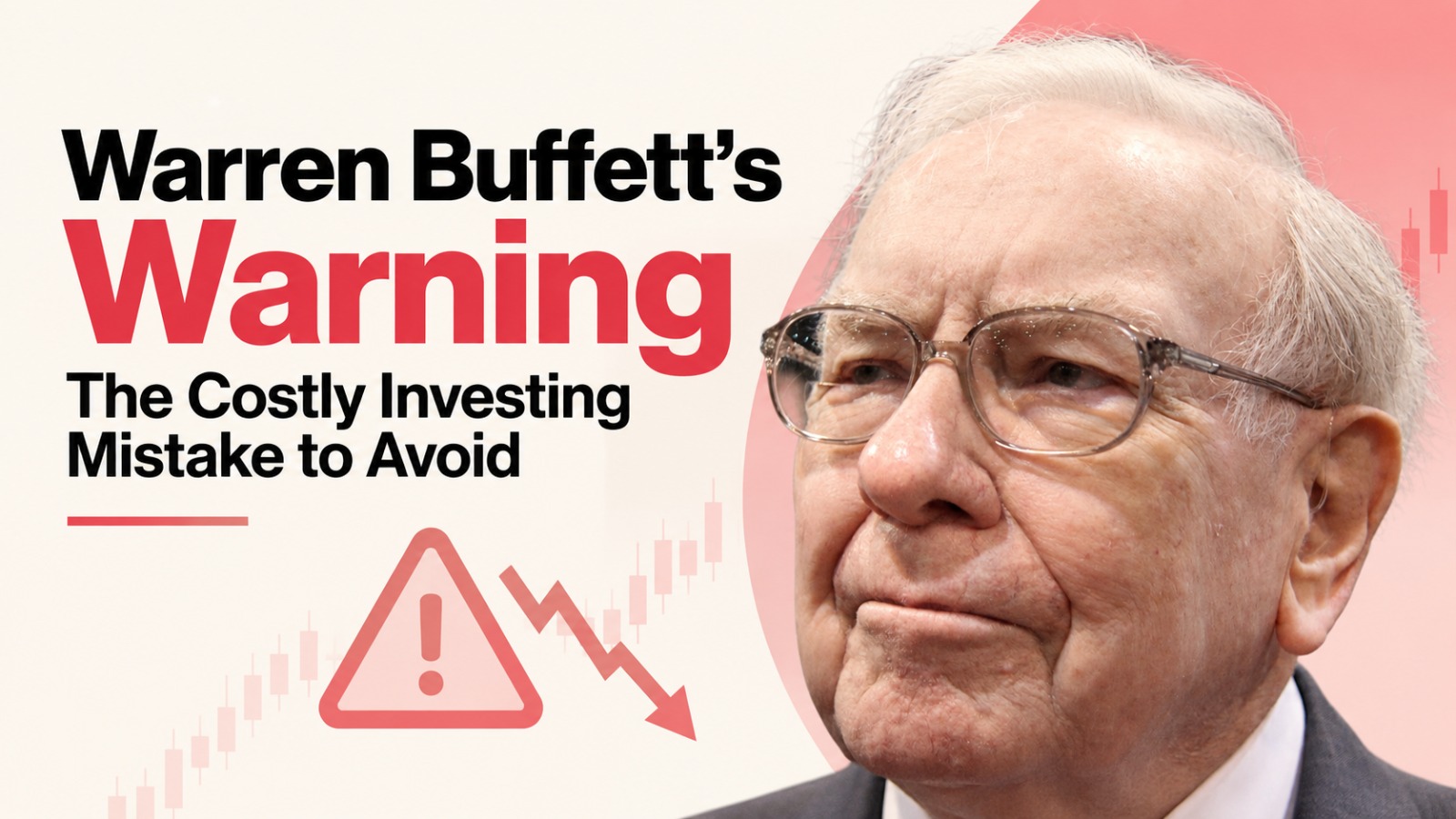
Market declines have a way of changing investor behaviour. A stock that looked attractive a few weeks earlier can suddenly feel dangerous once its price starts falling. Warren Buffett has long argued that this reaction can lead investors into one of the most damaging mistakes they make.
The mistake is surprisingly simple: investors who expect to keep buying stocks for years often celebrate when prices rise and become discouraged when prices fall.
Buffett challenged that thinking in Berkshire Hathaway’s 1997 shareholder letter. He pointed out that people who will be buying shares in the future should logically prefer lower prices, while those preparing to sell have more reason to welcome higher ones.
For long-term investors, that distinction can matter more than the market’s latest move.
Buffett’s warning is really about how investors react to price
Stock market volatility can create an uncomfortable contradiction.
An investor may say they are committed to buying strong businesses for the long term. But when prices fall sharply, fear can take over. Instead of looking at whether a company has become more attractively valued, they may stop investing altogether.
Some may go further and sell existing investments simply because prices have declined.
In his 1997 letter, he wrote that investors who are still going to be net buyers of stocks should not automatically feel good about rising prices. His argument was straightforward: future buyers benefit when the price of something they want to own becomes cheaper.
“Prospective purchasers should much prefer sinking prices,” Buffett wrote.
The principle turns the usual emotional response to a falling market on its head.
Why falling prices can create opportunities
Warren Buffett’s investing approach has traditionally centred on identifying businesses with durable competitive strengths and attractive long-term prospects, then seeking to buy them at prices below what he considers their underlying value. The article points to Berkshire Hathaway’s long-running Coca-Cola investment as an example of that patient approach.
That does not mean every falling stock is a bargain.
A lower share price can reflect genuine problems inside a business. Earnings prospects may have deteriorated, competitive advantages may be weakening, or the original investment case may no longer hold.
The key is to separate a falling price from a deteriorating business.
When investors sell aggressively across the market, shares of fundamentally stronger businesses can fall alongside weaker companies.
The article argues that investors should examine those stocks individually rather than treating every decline as a reason to retreat.
The costly part is what fear can make investors do
There are two ways this mistake can become expensive.
The first is staying out of the market simply because conditions feel uncertain. An investor who refuses to consider stocks during a downturn may miss the chance to buy companies at substantially lower valuations.
The second can be even more damaging: panic selling.
If investors sell solely because prices have dropped, they can turn a temporary decline into a permanent loss. The article specifically warns that fear over falling prices may cause people either to avoid investing at attractive levels or to sell existing positions at a loss.
Buffett’s broader lesson is not that investors should ignore risk. It is that price movement alone should not replace analysis.
Why the warning stands out in the current market backdrop
The discussion comes after a period in which the S&P 500 has recorded strong gains while investors have also faced several sources of uncertainty.
Higher U.S. prices, geopolitical turmoil involving Iran and the scale of spending by major technology companies on artificial intelligence infrastructure.
It also notes that stock valuations remain elevated when viewed through measures such as the S&P 500 Shiller CAPE ratio.
That combination can make investors particularly sensitive to signs of a correction.
When markets have already risen substantially, a sudden decline can feel like confirmation that something has gone wrong. Warren Buffett’s framework asks investors to look at the situation differently: if they still intend to accumulate investments over many years, lower prices may deserve examination rather than an automatic retreat.
The takeaway from Buffett’s warning
Buffett’s point is less about predicting the next market move and more about maintaining discipline when prices are moving against investor sentiment.
For someone who intends to keep buying stocks over a long period, a declining market does not automatically represent bad news. Lower prices can offer better entry points, provided the underlying company remains financially and competitively strong.
Buffett’s philosophy should not be reduced to “buy whenever stocks fall.” The more useful lesson is to judge businesses on their fundamentals, long-term prospects and valuation instead of allowing short-term market direction to make the decision.
The costly error, then, is not simply seeing a stock decline. It is allowing that decline to replace careful judgment with fear.
Also Read: Mercedes F1 Upgrade Targets End to Four-Race Pole Drought at Malaysian Grand Prix 2026