


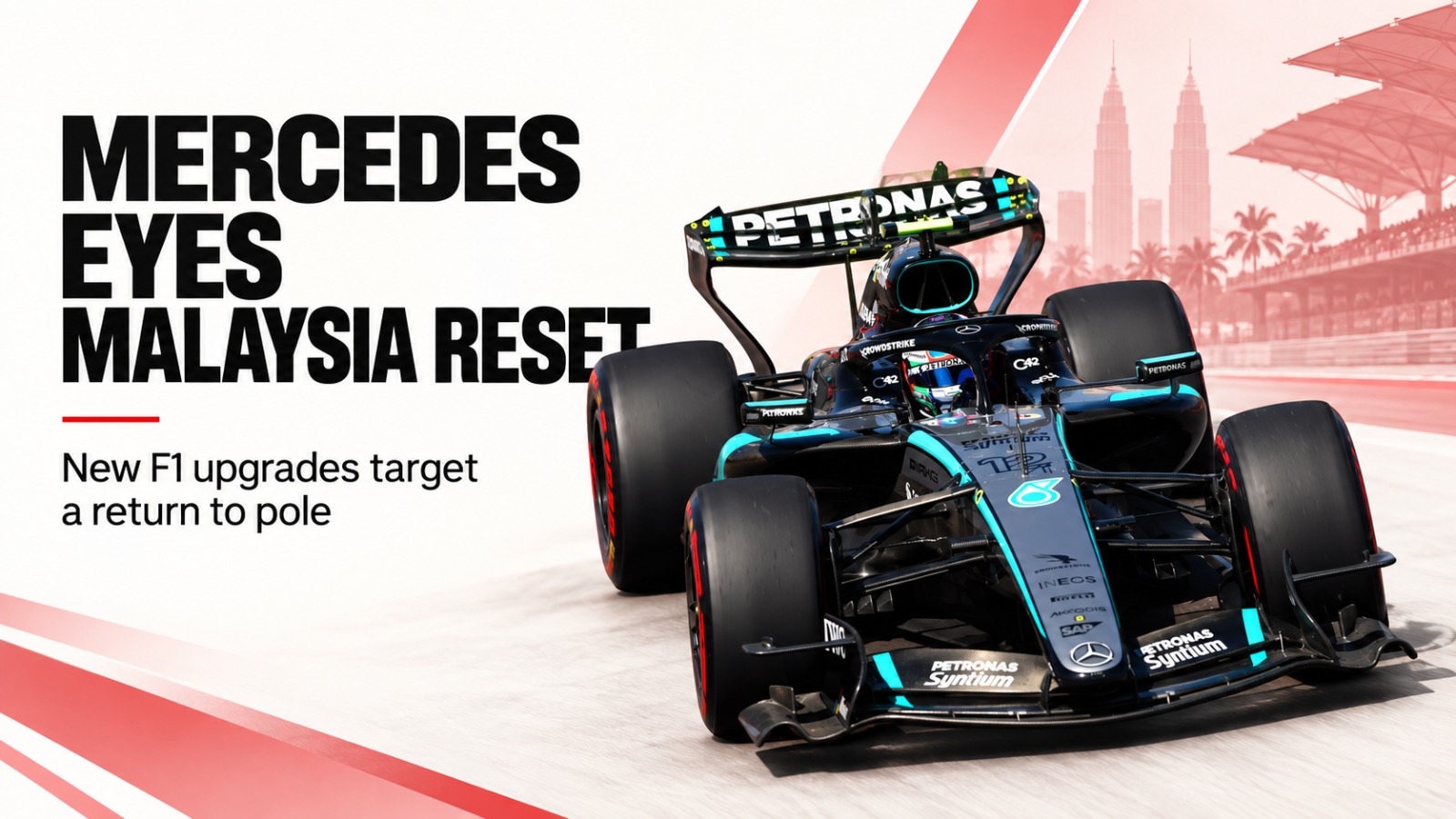
Mercedes will bring its next major Formula 1 upgrade package to the Malaysian Grand Prix, with the championship-leading team targeting a return to the front of the grid after an unusually long spell without pole position.
For much of the 2026 Formula 1 season, qualifying had been one of Mercedes’ clearest strengths. The team started the year by taking pole position at each of the opening 10 rounds.
Four races later, that sequence has become a drought.
Mercedes has now confirmed that a significant upgrade is scheduled to arrive from the Malaysian Grand Prix weekend, running from October 2 to 4, in an attempt to recover some of the qualifying advantage it enjoyed earlier in the campaign.
The timing is important. Mercedes remains comfortably ahead in the championship, holding a 145-point advantage over second-placed Ferrari, but its rivals have gradually reduced the performance gap while pursuing more aggressive development programmes. Mercedes’ previous major upgrade package arrived in Montreal in May, with the team largely relying on smaller, circuit-specific changes since then.
That approach has not stopped Mercedes from winning races, but the picture at the front has become considerably tighter.
Mercedes is still winning, but pole position has become harder to find
Mercedes won the first six grands prix of the season and has added four victories across the following eight races. Ferrari and McLaren have each taken two wins during that latter stretch.
More recently, Kimi Antonelli has delivered back-to-back victories for Mercedes at Monza and Madrid.
Yet despite those results, Mercedes has not started a race from pole since Antonelli went quickest at Spa in July. Three of the four poles since then have gone to McLaren’s Lando Norris.
It is a striking reversal from the beginning of the championship, when Mercedes arrived at race weekends expecting to be in contention for the fastest qualifying lap almost by default.
Trackside engineering director Andrew Shovlin acknowledged just how small the differences have become. He said the gap between finishing first and sixth can now be only “one or two tenths”, making the competitive order much harder to predict from one circuit to another.
That shrinking margin helps explain why Mercedes is placing significance on its Malaysia package even while continuing to win races.
Baku comes first, but Mercedes is not planning a major update there
Before Malaysia, Mercedes heads to Baku without substantial new components.
Shovlin said the characteristics of the Azerbaijan circuit make straight-line efficiency particularly important. Mercedes took encouragement from its performance at Monza, another venue where reducing drag is valuable, although Baku also presents the low-speed and street-circuit demands that require the car to handle a very different set of conditions.
The larger development step is being saved for what follows.
“And then the updates, well, they’re going to come Malaysia onwards and hopefully we’ll make a decent step,” Shovlin said.
His expectation is measured rather than extravagant. Mercedes is not suggesting the package will suddenly restore a commanding advantage. Instead, the immediate target is to arrive at qualifying with a realistic chance of fighting for pole again.
Malaysia could provide the first real measure of Mercedes’ latest development
The Malaysian Grand Prix therefore represents more than another stop in Mercedes’ title campaign.
It will offer the first indication of whether the team’s latest development work can restore the qualifying edge that defined its opening 10 races.
Malaysia is also returning to the Formula 1 schedule in 2026, taking Bahrain’s place on the calendar. Mercedes will arrive there after Baku with a car that, despite its championship advantage and recent victories, is operating in a much more compressed competitive field than it faced earlier in the year.
That distinction matters.
Mercedes does not need the Malaysia upgrade to rescue a struggling season. It needs it to protect an advantage that has become less obvious on Saturdays, even while strong race results have continued.
Shovlin’s comments also underline how difficult judging car performance has become from circuit to circuit. Monza rewarded a low-drag package, while the new Madrid circuit presented a very different challenge. Mercedes’ focus, he said, remains on extracting the maximum available performance rather than assuming one result will automatically carry into the next weekend.
The Malaysian upgrade should provide a clearer answer.
After opening the season with 10 consecutive poles, Mercedes now enters its next major development phase trying to recover something that seemed routine only a few months earlier: starting at the very front.
Also Read: Samsung Galaxy S27 Ultra Leaks: 7,000mAh Battery and 2nm Chip