For an investor whose career was built on identifying individual businesses, Warren Buffett’s plan for the money left for his wife is strikingly uncomplicated.
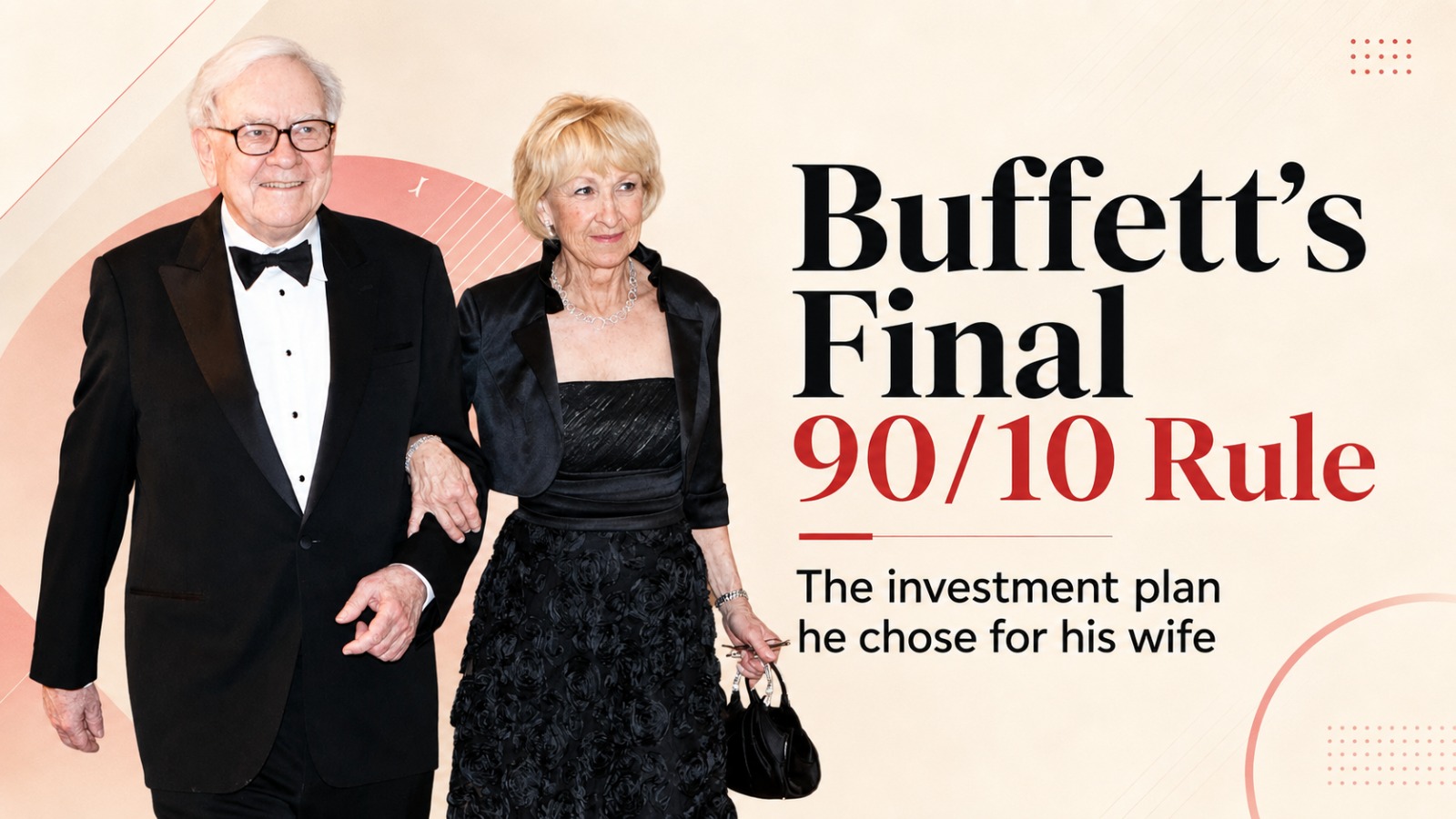
Buffett has instructed that cash left in trust for his wife should largely avoid the kind of individual stock selection that made Berkshire Hathaway famous. Instead, his direction is to put 90% of the money into a very low-cost S&P 500 index fund, while keeping the remaining 10% in short-term government bonds.
It is a remarkably simple allocation from one of the world’s best-known investors, and the overlooked part may be just as important as the headline-grabbing 90%.
Buffett is not telling the trustee to put every dollar into stocks.
Buffett’s two-part plan for his wife’s inheritance
Buffett disclosed the instruction in his 2013 letter to Berkshire Hathaway shareholders while discussing provisions in his will.
His direction to the trustee was straightforward: 10% of the cash should go into short-term government bonds and 90% into a low-cost fund tracking the S&P 500.
That means the core of the portfolio would not depend on choosing the next great company, trying to predict market tops and bottoms, or constantly shifting between investments.
Instead, most of the money would broadly follow the S&P 500.
What makes this strategy unique is the fact that the track record of Buffett in terms of Berkshire Hathaway was formed by years of investment and business experience. The total return on investment for the company during the period from 1964 till 2025 was 6,099,294%.
Yet the plan he laid out for his wife does not attempt to recreate that investing style.
Why Warren Buffett keeps coming back to index funds
The inheritance instruction is consistent with Buffett’s long-running view that most people should not try to beat the market by picking individual stocks.
At Berkshire Hathaway’s 2021 annual shareholders meeting, Buffett said he did not believe the average person could successfully pick stocks.
An index fund offers a very different proposition. Rather than relying on the fortunes of one company, it provides exposure to a collection of businesses across different industries.
It doesn’t eliminate the investment risk, however, because the markets can drop, and the index fund will go down along with them. However, this structure eliminates the risk that an investor’s success will be tied to only a few selected stocks.
Buffett’s preference also strips away another challenge: the temptation to constantly make decisions.
His instructions do not call for frequent trading, complicated market forecasts or a portfolio packed with fashionable investments. The basic allocation can remain understandable even when markets become uncomfortable.
The number behind Buffett’s confidence
Recent performance contributes to the importance of the S&P 500 when it comes to analyzing the approach used by Warren Buffet, although future success is not assured by past performance.
The index gained 16.39% in 2025, or 17.88% when dividends were included, according to S&P Global figures cited in the material.
Buffett’s case for broad index investing, however, is not simply about chasing one strong year.
The larger idea is participation in a wide section of major American businesses without having to correctly identify which individual company will outperform next.
That distinction matters. Someone following the philosophy is not trying to discover the next Berkshire Hathaway. They are buying exposure to the broader market instead.
But Buffett deliberately leaves 10% out of stocks
The most interesting part of the inheritance strategy may be the portion that receives less attention.
Buffett did not recommend putting 100% of the money into an S&P 500 index fund.
His instructions reserve 10% for short-term government bonds.
Short-term government bonds generally occupy a more defensive role than equities. The material highlights their appeal for investors seeking relatively lower risk and greater liquidity compared with longer-term bonds.
That creates a portfolio with two clearly different jobs.
The 90% equity allocation provides exposure to long-term market growth. The 10% bond allocation provides a more conservative component rather than forcing every dollar to remain exposed to stock-market movements.
So while the strategy is aggressive in its heavy weighting toward equities, it is not an all-or-nothing bet.
What Buffett’s plan does not mean
The existence of a 90/10 instruction does not make the same allocation automatically suitable for everyone.
The decision to invest relies on several considerations such as personal commitments, financial goals, risk tolerance level, and the investing stage of the person. This content highlights that the proper allocation should be determined based on the person’s financial position and the stage of investment.
That distinction is especially important because Buffett’s instruction was written for a specific trust established for his wife’s benefit. It was not presented as a universal asset-allocation formula for every household.
The broader lesson is simpler.
Buffett, despite possessing an investing record few people could hope to reproduce, chose a structure that does not require another Buffett to manage it.
Buffett’s inheritance plan may say more about simplicity than stock picking
There is an irony at the heart of the strategy.
Berkshire Hathaway became one of investing’s most closely watched companies because Buffett spent decades evaluating businesses. Yet when laying out instructions for money intended for his wife, he did not design an elaborate portfolio of hand-picked stocks.
He chose an index fund for 90%.
He chose short-term government bonds for 10%.
And he made the instructions simple enough that the strategy does not depend on predicting which company, industry or market theme will dominate next.
For investors fascinated by Buffett’s individual stock holdings, that may be the more revealing piece of investment advice: his plan for one of the most personal portfolios connected to him is built around diversification, low costs and very few moving parts.
Also Read: Warren Buffett Is Warning Investors Again, and This Time the Numbers Look Hard to Ignore