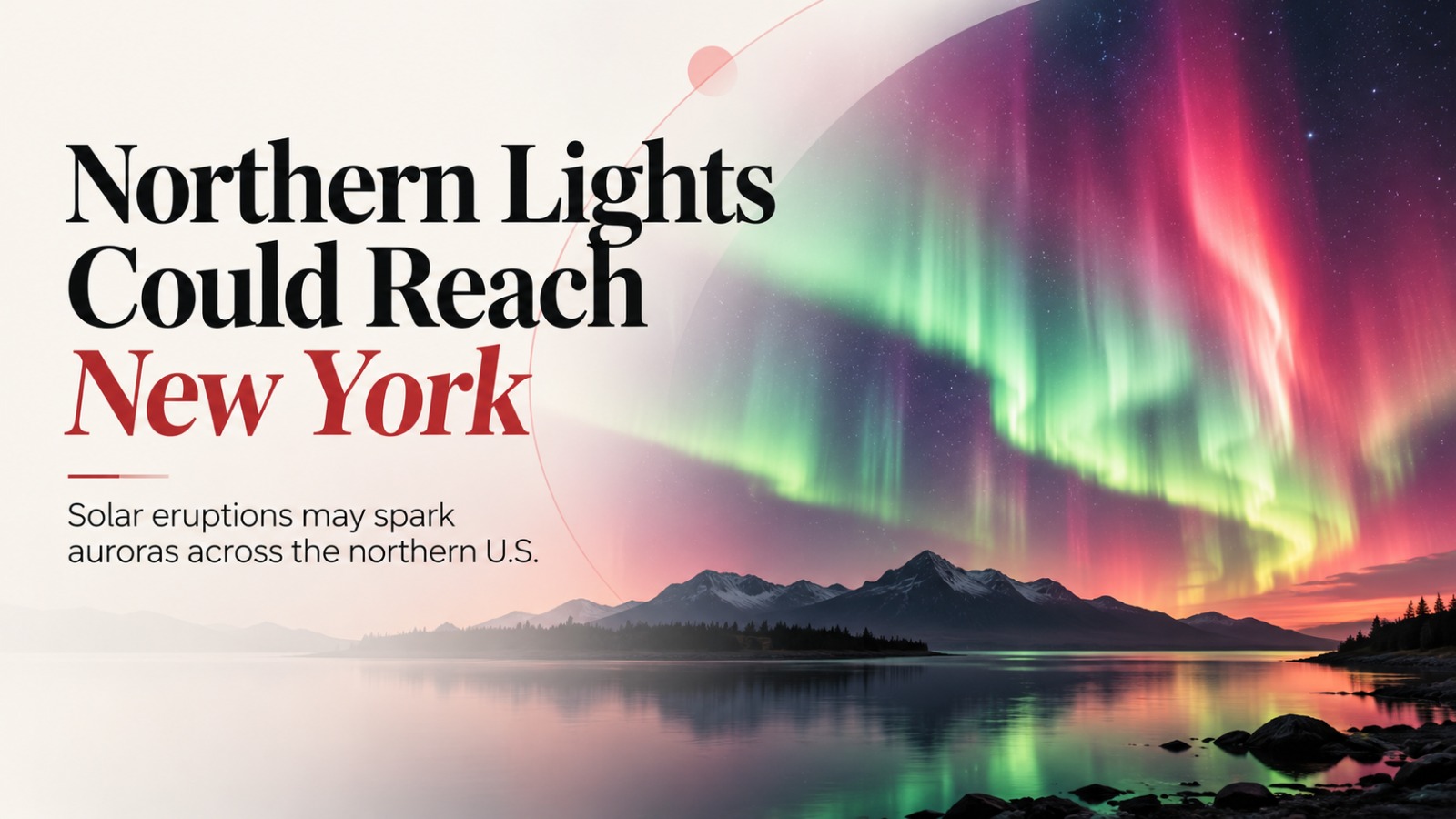
The northern lights could become visible across parts of the United States on Thursday night, October 8, and into Friday morning after a solar eruption triggered a geomagnetic storm watch.
The potential viewing area stretches as far south as New York, Wisconsin and Washington state, while a second eruption approaching Earth could prolong unsettled space weather conditions into the weekend.
The National Oceanic and Atmospheric Administration’s (NOAA) Space Weather Prediction Center issued the moderate storm watch following a coronal mass ejection (CME) that left the sun on Tuesday. The eruption, associated with a moderate solar flare, sent a large cloud of electrically charged particles and magnetic material towards Earth.
Forecasters predict mainly low geomagnetic activity, with occasional periods of moderate storming likely to occur. It is noted by the UK Met Office that there is a possibility of this storm having G3 strength, which is considered strong.
Northern Lights Could Appear Farther South Than Usual
The approaching solar material could create favourable conditions for aurora sightings across northern and upper Midwestern states, including places where the phenomenon is relatively uncommon.
“Aurora may be seen as low as New York to Wisconsin to Washington state,” NOAA’s Space Weather Prediction Center said in its alert.
Auroras typically occur closer to Earth’s polar regions, but stronger geomagnetic disturbances can expand their visibility towards lower latitudes.
The northern lights form when charged particles interact with Earth’s atmosphere, producing colourful displays across the night sky.
Although the forecast suggests an opportunity for unusual sightings, visibility is not guaranteed. Cloud cover, the arrival time of the solar material and the strength of its interaction with Earth’s magnetic field will determine whether observers can see the display.
Another Solar Eruption Expected to Reach Earth Over the Weekend
The immediate geomagnetic storm watch is linked to Tuesday’s eruption, but it is not the only solar event being monitored.
A second CME, associated with a smaller solar flare, is also travelling towards Earth. According to the UK Met Office, this eruption is expected to deliver a glancing blow over the weekend rather than a direct impact.
The additional eruption could contribute to unsettled geomagnetic conditions over the coming days, although its effects are expected to be comparatively limited.
The sequence of solar events has created an extended period of space weather activity, with the initial storm potentially producing auroras on Thursday night and Friday morning before the second CME approaches.
Could the Geomagnetic Storm Disrupt Technology?
Beyond the possibility of northern lights, geomagnetic storms can interfere with technological infrastructure by disturbing the magnetic environment surrounding Earth.
NOAA has indicated that the approaching activity could cause minor technological impacts, although the agency expects them to be largely manageable.
The possibility of G3 storm conditions remains a more severe scenario rather than the central forecast.
The eventual intensity of the disturbance will depend partly on the magnetic orientation of the incoming CME. That factor influences how effectively energy from the solar material is transferred into Earth’s magnetosphere.
When Will the Northern Lights Be Visible?
Thursday night into early Friday, October 9, is the main period identified for potential aurora sightings across the northern United States.
However, the precise timing remains uncertain because the incoming CME’s arrival and magnetic characteristics will influence when geomagnetic activity becomes strongest.
Clear skies will also be important for observers hoping to catch the display.
The possibility of further activity over the weekend adds another reason to monitor space weather forecasts, although the second eruption is expected to have a weaker impact.
For now, the storm watch offers skywatchers across parts of the northern United States an opportunity to witness a phenomenon usually associated with much higher latitudes.
Whether the lights reach New York, Wisconsin or Washington state will depend on how the approaching solar eruptions interact with Earth’s magnetic field.
Also Read: Is Google Gemini Down? Nearly 10,000 Outage Reports as Users Face AI Errors and Missing Chats