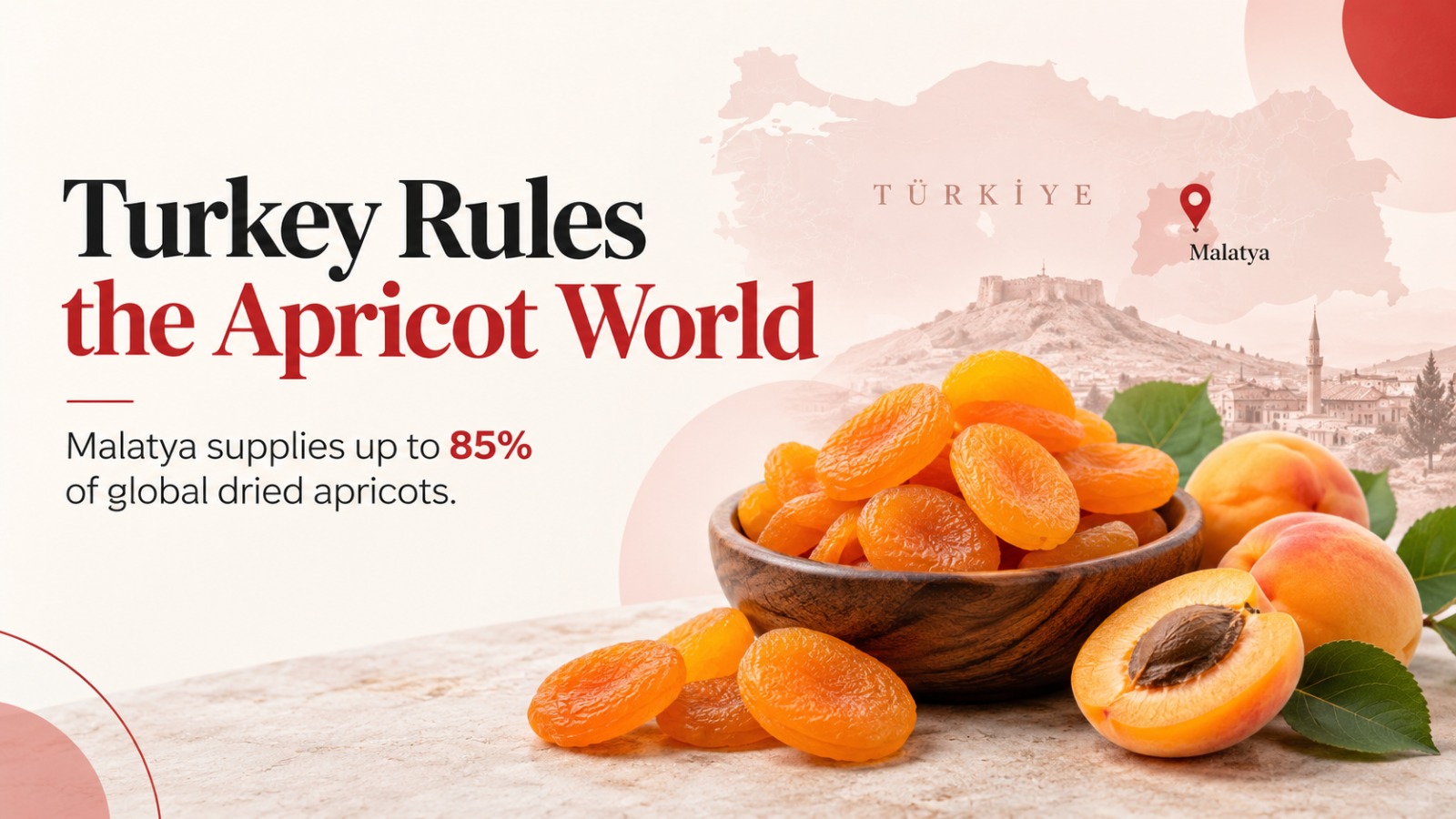
Turkey has built an unmatched position in the global apricot industry, producing more than 750,000 tonnes of the fruit in recent years and accounting for roughly one-fifth of worldwide output. Its lead is not simply a result of production volume. The country’s climate, farming traditions and the strength of Malatya’s dried apricot industry have made Turkey a major force in the international market.
The country has consistently ranked as the world’s largest apricot producer. In 2022, Turkey produced around 803,000 tonnes, significantly ahead of Uzbekistan, which recorded 451,263 tonnes. Iran followed with 305,932 tonnes, while Italy and Algeria produced 230,080 tonnes and 203,916 tonnes respectively.
Turkey’s production lead is hard to match
Turkey’s apricot advantage comes from a combination of regional climates, fertile soils and established farming practices. Its growing season generally runs from May to August, with differences between regions helping support a staggered harvest.
The scale of production gives Turkey a sizeable share of the global apricot market. The country’s 2022 output represented about 20% of global production, compared with approximately 11.5% for Uzbekistan and 8.5% for Iran.
| Country | Apricot Production in 2022 | Approx. Global Share |
|---|---|---|
| Turkey | 803,000 tonnes | 20% |
| Uzbekistan | 451,263 tonnes | 11.5% |
| Iran | 305,932 tonnes | 8.5% |
| Italy | 230,080 tonnes | 5.6% |
| Algeria | 203,916 tonnes | 5.2% |
| Pakistan | 174,546 tonnes | 4.5% |
Turkey’s lead becomes even more pronounced when the focus shifts from fresh apricots to dried fruit.
Malatya is at the centre of Turkey’s dried apricot trade
In eastern Anatolia, Malatya has become synonymous with Turkish apricots. The province is responsible for roughly 70% to 85% of the world’s dried apricot production, giving it an outsized role in an industry that reaches well beyond Turkey.
The region’s continental climate, volcanic soils and conditions around the Euphrates Valley provide an environment suited to apricot cultivation. Varieties including Hasanbey and Kabaaşı are among those associated with the region.
Malatya’s reputation also received formal recognition in 2017, when Malatya Kayısısı received Protected Designation of Origin status from the European Union. The designation links the product’s identity and characteristics to its geographical origin.
More than a crop for Malatya
Apricots are deeply connected to Malatya’s economy and cultural identity. The industry supports farming communities as well as businesses involved in processing and packaging, creating economic activity across rural areas.
The province has approximately 120,000 hectares devoted to apricot cultivation. Annual production is around 400,000 tonnes, while exports are estimated at approximately 100,000 tonnes and generate more than $300 million in revenue.
The wider Turkish apricot industry generates hundreds of millions of dollars in export earnings and supports thousands of livelihoods. For Malatya in particular, the harvest is also part of the region’s cultural calendar, with festivals marking the importance of the fruit.
Apricots appear in local food traditions as well, including jams and desserts. That connection between farming, food and local identity has helped make the crop more than an agricultural commodity.
Why Turkey continues to stay ahead
Turkey’s strength comes from several advantages working together. Its varied climate allows apricots to be cultivated across different regions, while dry conditions during the harvest period support traditional sun-drying practices.
Generations of farming knowledge also play a role in maintaining production and quality. In Malatya, these conditions have helped establish a distinctive dried apricot industry that has become closely associated with the region itself.
The result is a supply chain that stretches from orchards and rural farms to processing, packaging and international exports. Turkey’s enormous production base gives it the scale to lead the global market, while Malatya’s concentration in dried apricots gives the country a particularly strong position in one of the fruit’s most important forms.
For Turkey, the apricot is therefore much more than a seasonal crop. It is a major agricultural export, a source of rural employment and, in Malatya, a product whose name has become inseparable from the place where it is grown.
Also Read: Is Google Gemini Down? Nearly 10,000 Outage Reports as Users Face AI Errors and Missing Chats