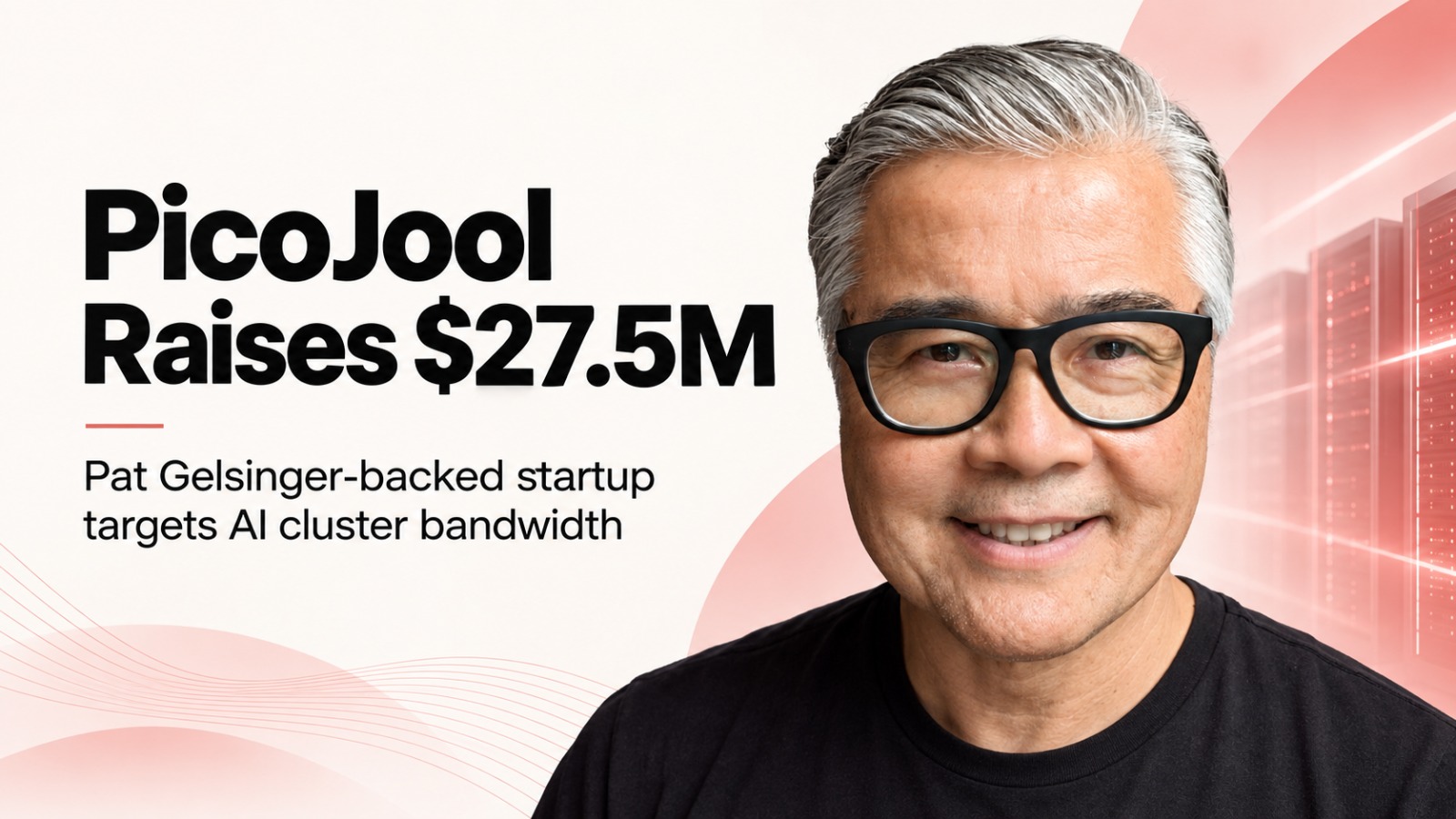
PicoJool has raised $27.5 million in a Series A funding round as the semiconductor startup moves from proving its high-speed optical technology toward commercial production for artificial intelligence data centers.
The round was led by Socratic Partners, with participation from Hudson River Trading. The financing takes PicoJool’s total funding to $39.5 million, following a $12 million seed round led last year by Playground Global, the venture capital firm associated with former Intel chief executive Pat Gelsinger.
The fresh capital arrives at a point when PicoJool is putting greater emphasis on turning its technology into products that can be qualified by customers and manufactured at scale.
Founded and led by CEO Al Yuen, the company is developing optical connectivity products based on Vertical Cavity Surface Emitting Laser, or VCSEL, technology. Instead of relying on conventional electrical connections, the approach sends data using light through optical links, with PicoJool targeting the high bandwidth and energy demands created by increasingly large clusters of AI processors.
As AI systems grow, the underlying computing infrastructure has to move enormous volumes of data between GPUs and other accelerators working together inside a cluster. That has increased pressure on traditional copper-based interconnects, particularly as operators try to raise bandwidth without allowing power consumption to climb at the same pace.
PicoJool is positioning its portfolio around that problem.
The company has developed 100G and 200G VCSEL products, alongside lower-power MicroVCSEL configurations that include 50G NRZ and 64G NRZ/PAM4 interconnects. Its MicroVCSEL platform uses a massively parallel architecture intended to aggregate bandwidth while reducing the energy required to move data within AI clusters. PicoJool says the architecture provides a path to connectivity of up to 3.2 terabits per second.
That 3.2-Tbps pathway gives the funding round a broader significance than a conventional capital raise. PicoJool is now trying to demonstrate that the performance it has achieved at the component level can be carried into a wider product portfolio and, eventually, customer deployments.
“Reaching 200G per lane proved that the performance is there,” Yuen said. “Our focus is now execution. This funding allows us to expand our teams in the U.S. and Taiwan, qualify products with customers and move a complete portfolio from chip-level VCSELs and MicroVCSELs into AOC and NPO modules.”
The company also plans to use part of the funding to accelerate research and development and expand its operations and sales teams. Still, commercialization appears to be the immediate priority.
PicoJool is working with WIN Semiconductors and other chip foundries to prepare its 200G VCSEL for mass production, with additional products expected to follow.
For PicoJool, the challenge is no longer simply demonstrating faster optical links. The next phase will involve moving those components through qualification and production while extending them into modules that can be deployed inside real-world data center infrastructure.
Gelsinger, whose Playground Global led PicoJool’s earlier seed round, framed connectivity as one of the major constraints facing AI infrastructure.
“The network is the AI, and connectivity is becoming one of the defining constraints on performance,” Gelsinger said. “The industry needs a solution that can increase bandwidth while sharply improving power and cost.”
For PicoJool, the new financing provides the capital to test that proposition commercially. The company enters this stage with a 200G-per-lane milestone already demonstrated, a broader MicroVCSEL portfolio under development, manufacturing work underway with foundry partners, and expansion planned across its U.S. and Taiwan teams.
Whether these efforts turn out to be successful on a larger scale would be contingent upon qualification of the customers and success in production. In any case, it is obvious that what PicoJool’s Series A has done is clearly move away from technology to deployment.
Also Read: What’s Going Wrong With Face ID on Some iPhone 18 Pro Models?