

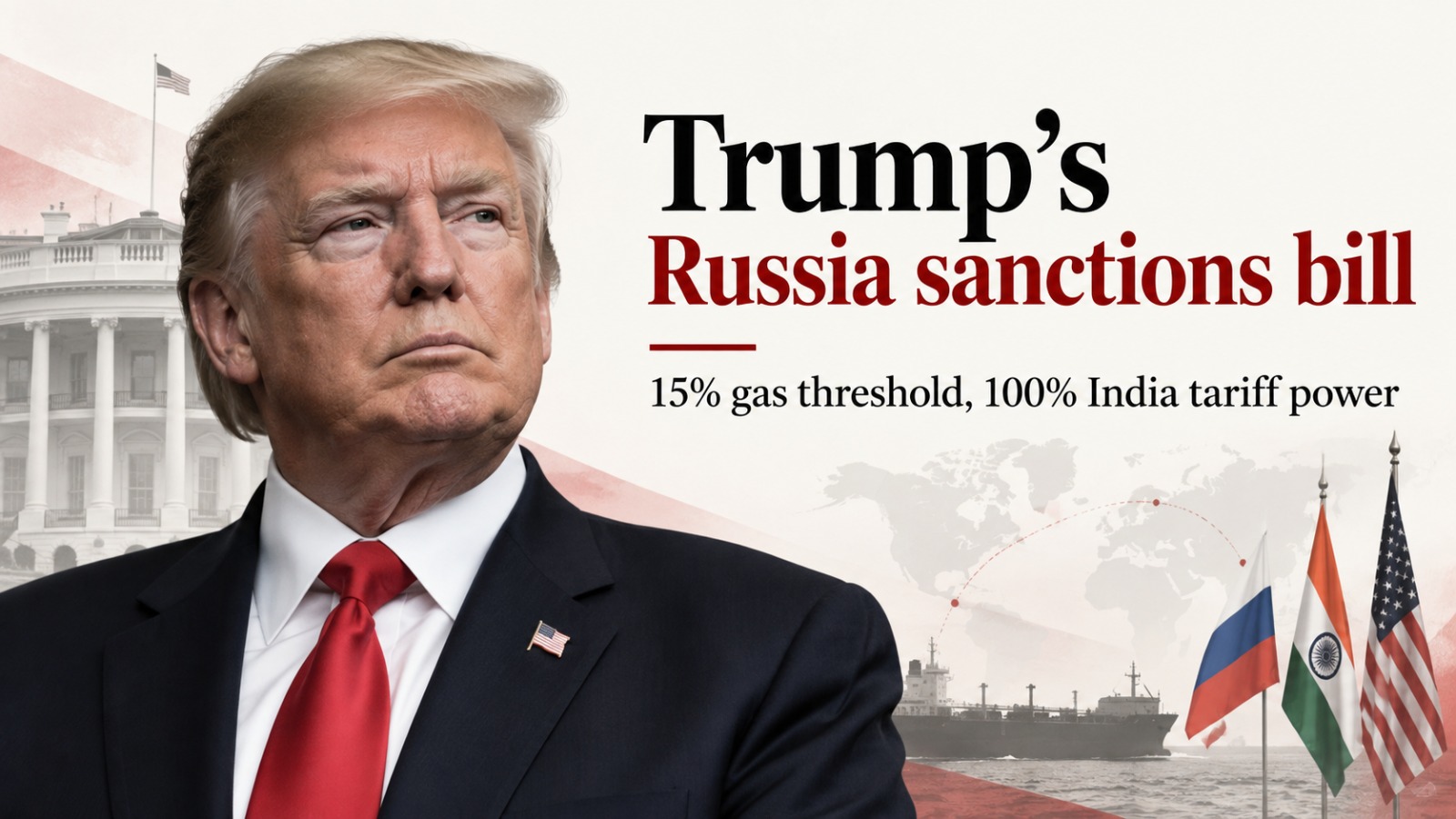
US President Donald Trump is expected to sign the Lindsey O. Graham Sanctioning Russia and Iran Act of 2026, a move that would give his administration a new legal route to impose tariffs of up to 100% on countries that continue buying Russian oil and gas.
India is among the countries that could be affected by the legislation because of its purchases of Russian energy. However, the bill does not automatically place a 100% tariff on Indian goods. Instead, it gives the US president the authority to impose such duties if the required conditions are met and the administration decides to use that power.
The legislation cleared the US House of Representatives by a 262-159 vote on September 16, after the Senate approved it 86-11 on August 7. It has now moved to Trump for his signature.
Why the 15% threshold matters
One of the less-discussed provisions of the legislation concerns countries that buy Russian natural gas.
The bill provides a potential exemption for countries importing less than 15% of Russia’s natural gas exports, provided they have also taken significant steps to reduce their dependence on Russian energy.
That provision adds another layer to the tariff framework. The legislation is not simply a blanket measure targeting every country that maintains energy ties with Moscow. Its provisions create conditions under which countries could face different treatment depending on their level of Russian energy dependence and efforts to reduce those imports.
For India, the bigger concern remains its continued purchases of Russian crude oil and the possibility that Washington could use the powers provided by the legislation against major buyers.
India says energy security remains the priority
India has already responded to the legislation, warning that the measure could have implications for both India-US relations and the wider energy market.
The Ministry of External Affairs said India was determined to take all necessary measures to protect its trade and economic interests. The government also said it had discussed the legislation at high levels with US interlocutors in recent months and had communicated its concerns about the potential consequences for the bilateral relationship and international energy markets.
India reiterated that its energy purchases are guided by national interest and that it remains committed to securing energy for its 1.4 billion people through diversified sourcing and changing market conditions.
The response comes as Russian crude remains an important part of India’s energy sourcing. Any major change in that trade could therefore have implications beyond the India-US relationship, particularly for the broader oil market.
What the bill gives Trump the power to do
The legislation is designed to increase economic pressure on Russia and also contains provisions targeting vessels linked to Russia’s so-called shadow fleet. These vessels have been associated with the movement of Russian energy despite Western restrictions.
The bill also incorporates provisions concerning Iran, including an extension of existing Iran-related sanctions. Trump’s support for the broader legislation was secured after the Iran provision was included in the package.
For India, however, the most consequential provision is the tariff authority.
If Trump signs the legislation, the administration would have a congressionally authorised mechanism to impose tariffs of up to 100% on countries purchasing Russian oil and gas under the conditions set out in the law. That does not mean Indian imports into the US would immediately face a 100% duty. A separate decision by the administration would still be required.
A new pressure point for India-US trade
The legislation adds another point of uncertainty to India-US trade at a time when Russian energy purchases have become a major issue in Washington’s dealings with New Delhi.
India has maintained that its energy decisions are based on national interest and energy security. The US legislation, meanwhile, gives the Trump administration a new instrument that could be used against countries continuing to purchase Russian energy.
The immediate question is therefore not whether a 100% tariff has already been imposed on India. It has not. The key question is whether and how the Trump administration chooses to use the authority that the legislation provides once it becomes law.
For Indian businesses and exporters, the distinction matters. The legislation creates the possibility of significantly higher US duties, but the actual tariff rate, affected products and timing would depend on subsequent action by Washington.
Also Read: Jar Raises Rs 29 Crore From Existing Backer Unitary Fund as Valuation Climbs 23%