

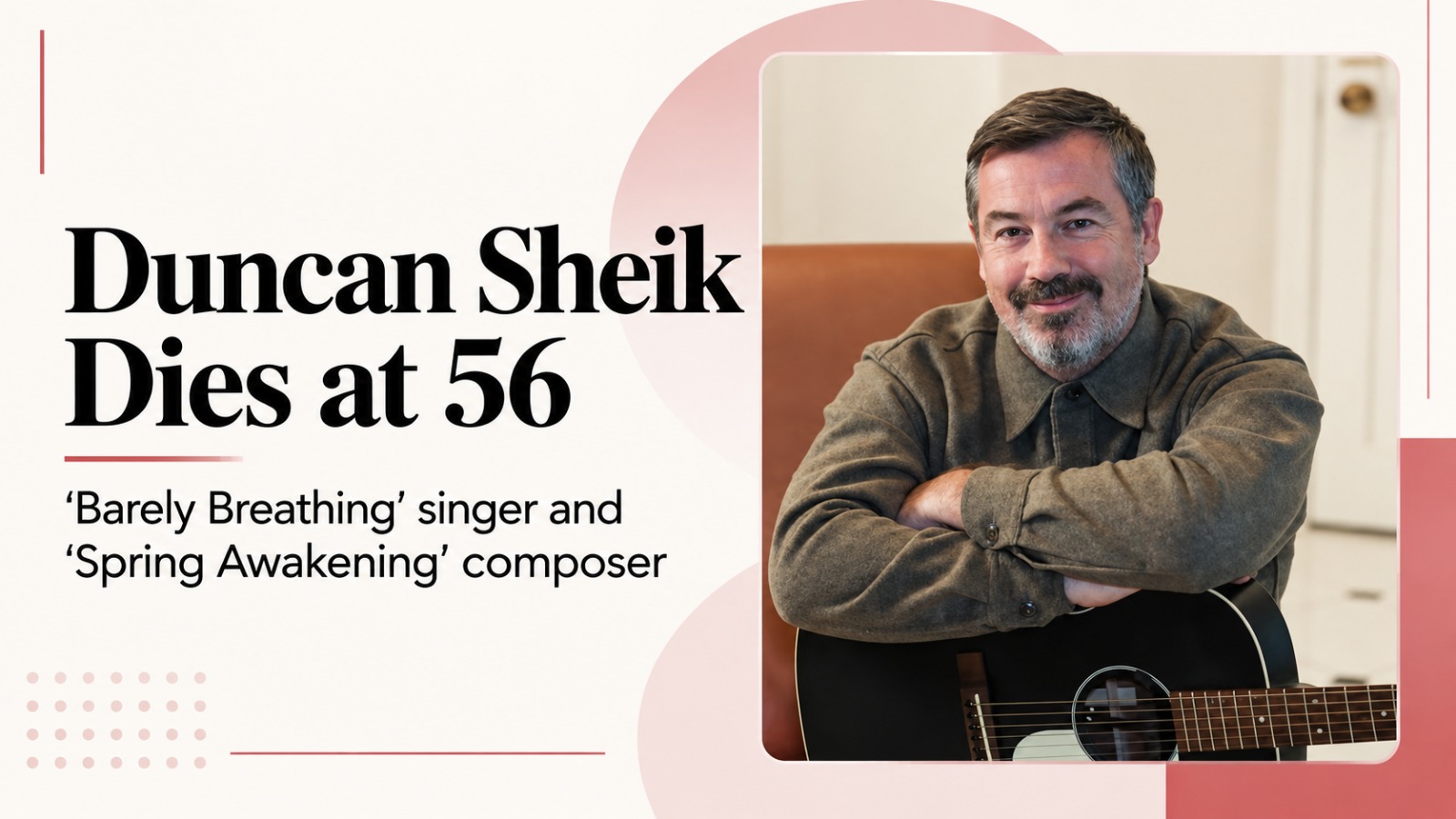
Singer-songwriter and Broadway composer Duncan Sheik, best known to pop audiences for the 1996 hit “Barely Breathing” and to theatergoers for his award-winning work on “Spring Awakening,” has died at the age of 56.
Sheik died on Thursday, Sept. 17, at a hospital in Manhattan, according to his mother, Suzanne Sheik. His family publicly confirmed his death the following day, describing him as a father, husband, son, brother and friend whose work had left a lasting mark on music and theater.
His death came after a period in which his health had increasingly entered public view. Throughout the summer, Sheik posted photographs from the hospital without explaining what he was being treated for. On Sept. 6, he shared another hospital photograph with the caption, “still bored in hospital.” Then, on Sept. 16, just two days before his death was announced, his family said he was receiving medical care and remained in “critical but stable condition.”
What is known about Duncan Sheik’s cause of death
The medical circumstances surrounding Sheik’s death have been described differently in reports published on Sept. 18.
TODAY reported that Sheik died from cardiac arrest, citing confirmation from his mother to The New York Times. The report also noted that it remained unclear what caused the cardiac arrest and that the family had not disclosed an underlying medical condition.
Fox News, meanwhile, reported that Suzanne Sheik said her son had died from organ failure. The outlet said representatives for Sheik had not immediately provided further comment.
With no additional medical details publicly released, the available reporting does not establish what underlying illness or condition led to his final hospitalization. His family had already indicated before his death that it would not be sharing further medical information.
That distinction matters because the reports provide different descriptions of his final medical event, while neither identifies a confirmed underlying diagnosis.
Family confirms the loss of a ‘singular talent’
In the statement announcing his death, Sheik’s family remembered him not only for his career but for the person he was away from the stage.
The statement described him as a “singular talent” and an influential voice in music and theater, adding that he would be remembered for the sensitivity, wit and depth of spirit he brought to those closest to him.
The announcement followed Wednesday’s health update, when the family asked for privacy while Sheik remained under medical care.
The timing made the news especially poignant for the theater community. His health update had arrived shortly before the Off-Broadway premiere of his new musical “Memoirs of Amorous Gentlemen” and alongside news of another Off-Broadway staging of “Spring Awakening.”
‘Barely Breathing’ gave Sheik his breakthrough
Long before Broadway became the defining second act of his career, Sheik was one of the recognizable singer-songwriters of the 1990s.
His breakthrough single, “Barely Breathing,” was released in 1996 and remained on the Billboard Hot 100 for 55 weeks, reaching No. 16. The song later earned him a Grammy nomination for best male pop vocal performance.
It proved to be more than a radio hit. Years later, the song continued to find new listeners through television appearances and remained closely associated with Sheik even as his career moved increasingly toward composing for the stage.
He ultimately released nine studio albums over the course of his career.
‘Spring Awakening’ transformed his Broadway career
Sheik’s most celebrated theater work came with “Spring Awakening,” the musical based on Frank Wedekind’s 19th-century play, with Sheik writing the music and Steven Sater providing the lyrics.
The Broadway production became a major success, running for 859 performances and winning eight Tony Awards, including best musical. Sheik won Tony Awards for his work on the production, while the show also received a Grammy for its musical theater album.
The original production also featured performers who would go on to prominent stage and screen careers, including Jonathan Groff, Lea Michele, John Gallagher Jr. and Gideon Glick.
Sheik continued composing for theater after that breakthrough. His later projects included “American Psycho,” “Whisper House” and “Legerdemain,” while his recorded work included the 2022 album “Claptrap.”
A career that moved comfortably between pop and theater
Born in Montclair, New Jersey, in 1969, Sheik spent parts of his childhood in New Jersey and South Carolina. He began playing guitar when he was young and received his first synthesizer at age 12.
That early interest eventually produced a career that was difficult to confine to one category. A musician initially known for a distinctly 1990s pop single later became an acclaimed Broadway composer, carrying his songwriting sensibility from radio into musical theater without abandoning his work as a recording artist.
Sheik is survived by his wife, Nora Ariffin, and their 7-year-old daughter, Ines.
His death closes a career that connected two very different audiences: listeners who first knew his voice through “Barely Breathing,” and theater fans who came to know his music through “Spring Awakening.”
Also Read: British Rapper Sway DaSafo Dies at 44 Days After ‘Chapter 44’ Birthday Post