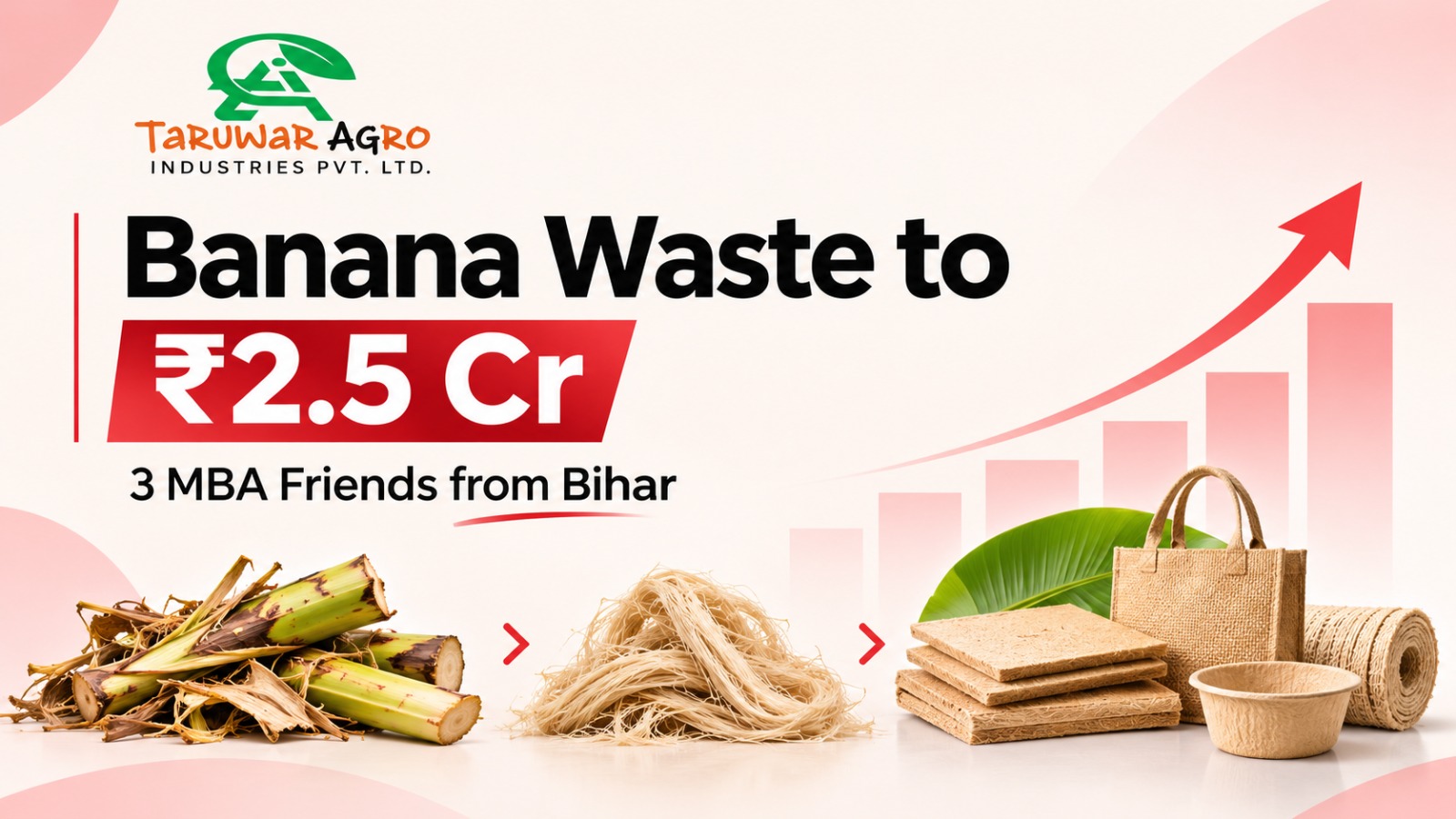
What started with an investment of around Rs 20 lakh has grown into a Rs 2.5 crore business for three MBA friends from Bihar. Their venture, Taruwar Agro, turns discarded banana stems into products such as yoga mats, baskets and file folders, creating commercial value from agricultural waste.
Founded by Jagat Kalyan, Satyam Kumar and Nitish Kumar Verma, the company recorded approximately Rs 2.5 crore in revenue in FY26. It has also expanded beyond banana fibre products into vermicompost, plant nutrition and makhana, while exploring opportunities in international markets.
The founders started the business with personal savings and family support, without raising external funding.
Three friends chose entrepreneurship over corporate careers
The founders met while pursuing their PGDM at Taxila Business School, where they specialised in SAP. Although each had a different professional background, they shared an interest in building something of their own.
Jagat Kalyan, who hails from Khagaria, Bihar, studied engineering in Bengaluru before moving into management education. He received job opportunities from organisations in Tanzania and Dubai, as well as IDFC First Bank, and gained experience in sales, marketing and business operations.
Satyam Kumar, from Darbhanga, studied Economics and developed experience in the sustainability sector through his association with EcoHoy. Nitish Kumar Verma, who belongs to Bihar Sharif, completed his BCom (Honours) from Nalanda and worked with organisations including S&P and Infosys.
The COVID-19 pandemic became a turning point for the three friends. Instead of following conventional corporate career paths, they decided to explore entrepreneurship in Bihar.
Jagat Kalyan, CEO of Taruwar Agro, said the founders turned down lucrative job opportunities, including overseas offers, because they wanted to establish their own venture and put Bihar on the national and global map.
Their search for a business opportunity eventually brought them to banana cultivation.
How discarded banana stems became useful products
The founders noticed that farmers often discarded banana stems after harvesting the fruit. These thick stems contain natural fibres that can be processed and used to manufacture different products.
With guidance from Dr Sunita Kushwaha, then Head and Senior Scientist at Krishi Vigyan Kendra (KVK), Vaishali, and her team, the founders began exploring banana fibre extraction and processing.
Taruwar Agro developed a collection system through which it sources discarded banana plants from farmers. The stems are processed using specialised machinery, after which the extracted fibre is cleaned, dried and converted into finished products.
Its product range includes file folders, yoga mats, baskets and prayer mats. The company is also exploring applications in vegan leather and blended textiles.
The business aims to use more than just the fibre. The leftover pulp goes into vermicompost production, while other parts of the banana plant are being explored for agricultural applications. Taruwar Agro also manufactures liquid plant nutrition products.
This approach allows the company to utilise different parts of the plant rather than focusing on a single commercial output.
From Rs 20 lakh investment to Rs 2.5 crore revenue
Getting the business off the ground required an initial investment of approximately Rs 20 lakh. The founders put in around Rs 15 lakh, with another Rs 5 lakh allocated as working capital. The money came from personal savings and family support.
The company has not raised external funding so far.
In its early stages, Taruwar Agro faced challenges involving fibre extraction, transportation and workforce availability. Banana stems are bulky, making their collection and movement difficult. Developing a workable processing system also required time and effort.
Finding skilled workers was another hurdle. The founders addressed the shortage by training local people, with women now accounting for nearly 60% of the company’s workforce.
The company operates through both business-to-business (B2B) and business-to-consumer (B2C) channels. It supplies banana fibre to other businesses while selling finished products through its own platform and online marketplaces, including Amazon, Flipkart and Meesho.
Makhana and international markets among expansion plans
Taruwar Agro has also diversified into makhana, selling raw and roasted varieties in more than 10 flavours.
Its future areas of exploration include banana flour, starch, vegan leather and sustainable textiles. These products could allow the company to expand the commercial applications of banana cultivation beyond fibre-based goods.
The founders have also started exploring international opportunities. Taruwar Agro has sent product samples to France and the Philippines as it looks to assess potential overseas markets.
The founders’ larger bet on Bihar
Taruwar Agro’s growth reflects the founders’ attempt to build a business around an agricultural resource that farmers often discard. By connecting banana growers with fibre processing, manufacturing and product sales, the company has created a model that involves both agricultural producers and local workers.
The venture also demonstrates the founders’ ambition to establish an enterprise in Bihar rather than move to established business centres for corporate careers.
From an initial investment of around Rs 20 lakh to approximately Rs 2.5 crore in FY26 revenue, Taruwar Agro has built its business by finding commercial applications for banana waste while exploring additional opportunities in agriculture and sustainable materials.
Also Read: Bengaluru Couple’s Samosa Singh Reaches ₹200 Crore Valuation Despite ₹5.7 Crore Loss