

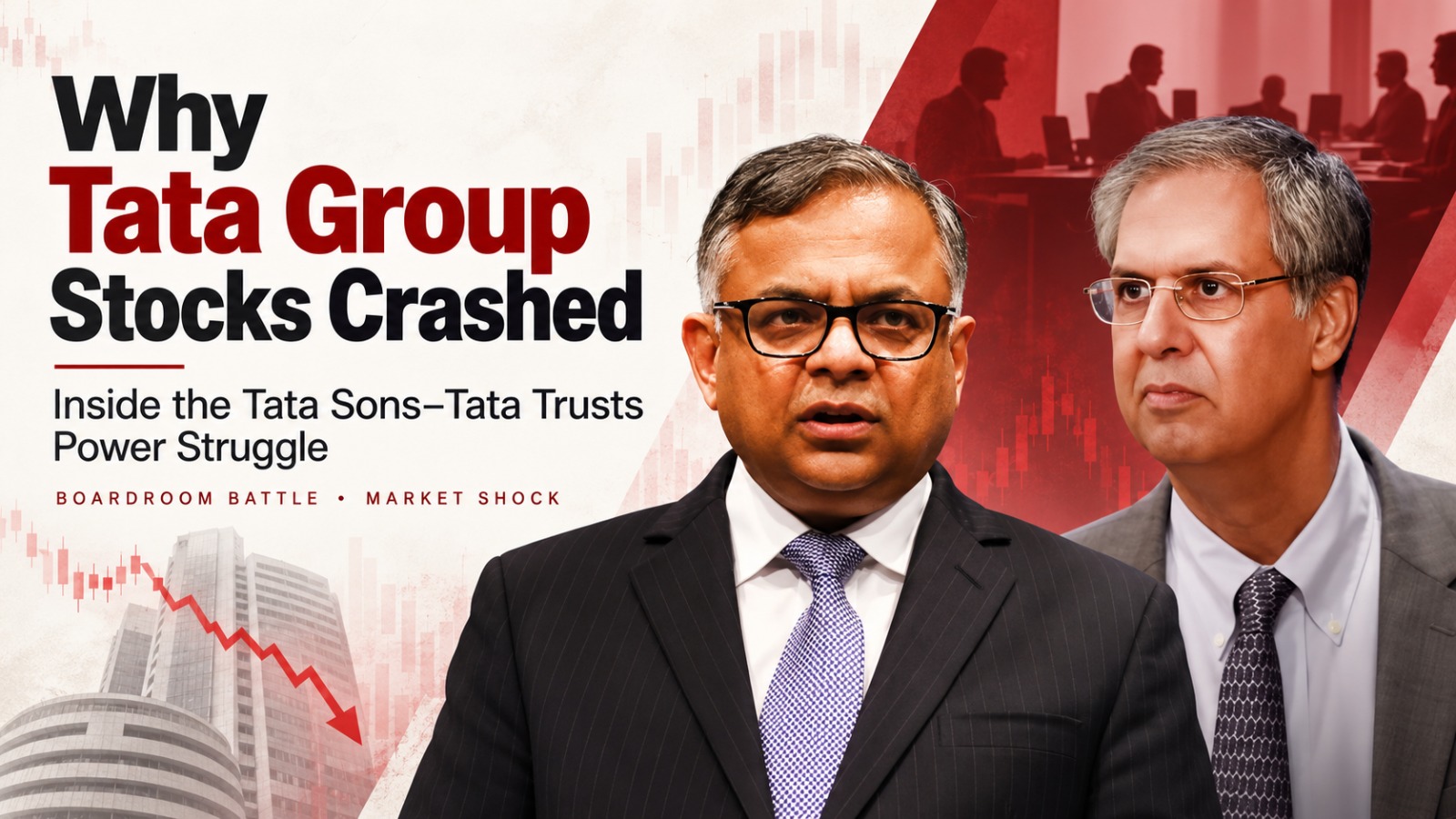
Tata Group Stocks: Something rare happened at Bombay House this week. India’s most storied business house, the one built on more than a century of studied caution and family discipline, is now in the middle of a very public boardroom fight, and the market noticed immediately.
On Friday, shares across the Tata Group tumbled hard. Tata Chemicals led the fall, down as much as 8 percent. TCS dropped close to 4 percent.
Tata Motors’ passenger vehicle arm, Tata Technologies, and Tata Investment Corporation all slid too. Curiously, not every Tata stock moved the same way. Tata Capital actually traded higher, a small but telling sign that investors aren’t reading this as a uniform crisis for the group, just a serious one at the very top of it.
What actually happened to Tata Group Stocks?
The story starts, oddly enough, with N Chandrasekaran trying to leave.
On August 12, Chandrasekaran told the Tata Sons board he did not want another term as executive chairman once his current one ends on February 20, 2027. He’s held the job since 2017, and by most accounts had reason to think that decision would stick. Tata Trusts, which controls roughly 66 percent of Tata Sons and effectively acts as its ultimate owner, formally accepted his decision the very next day and told the board to start looking for a successor.
Then things changed course. On September 3, the Nomination and Remuneration Committee unanimously recommended asking Chandrasekaran to reconsider. Whatever the reasoning, on September 17 the full Tata Sons board voted 4 to 1 to reappoint him for another five years, and in the same meeting, approved moving forward with plans to take Tata Sons public.
One director voted no. Noel Tata, chairman of Tata Trusts and the Tata family’s representative on the Tata Sons board, rejected the outcome outright, calling it illegal.
The argument underneath the argument
Noel Tata’s objection isn’t really about whether Chandrasekaran should stay. It’s about how Tata Sons is supposed to make decisions like this one.
His position, according to reporting from the Times of India, rests on Tata Sons’ Articles of Association, the internal rulebook that governs how the company operates. Tata Trusts maintains that appointing or reappointing the chairman requires support from a majority of the Trusts’ own nominee directors on the board, not just a majority of the board as a whole.
Since Noel Tata is that nominee and he voted against the reappointment, the Trusts’ position is that the resolution never actually passed, regardless of the 4-1 tally.
To back that reading, Noel Tata brought in outside legal firepower. He submitted a formal opinion from Dr. D.Y. Chandrachud, the former Chief Justice of India, supporting the Trusts’ interpretation of the rules. The board reportedly declined to formally record that opinion as part of its proceedings, a detail that has done little to cool tempers on either side.
There’s a second, quieter flashpoint sitting behind all of this. On September 11, just days before the board vote, the Reserve Bank of India rejected Tata Sons’ request to surrender its registration as a core investment company.
This categorization is important, as large scale investment companies are increasingly being encouraged by the regulators to list themselves on the stock exchange sooner or later. The effort of Tata Sons was to stay away from such a situation. The closure of this option by RBI and the board’s formal recognition of its necessity has made this structure uncertain all of a sudden.
This isn’t the first time a Tata Sons chairmanship has ended up in a legal fight
Anyone who followed Indian corporate news a decade ago will recognize the shape of this dispute, even if the players are different. Back in 2016, the Tata Sons board removed Cyrus Mistry as chairman. Chandrasekaran took the job a few months later. In December 2019, the National Company Law Appellate Tribunal ruled that Mistry’s removal had been unlawful and, in the same breath, declared Chandrasekaran’s own appointment illegal.
The Supreme Court eventually stepped in, stayed that order, and in March 2021 ruled decisively in Tata Sons’ favor, closing out one of the messiest corporate governance battles in Indian business history.
India’s largest and most closely watched business group is facing a genuine question about who gets the final say over its own leadership, and the market’s answer today was to sell first and ask questions later.
Also Read: Who Is Howard Buffett? Warren Buffett’s Farmer Son Who Now Chairs Berkshire Hathaway