

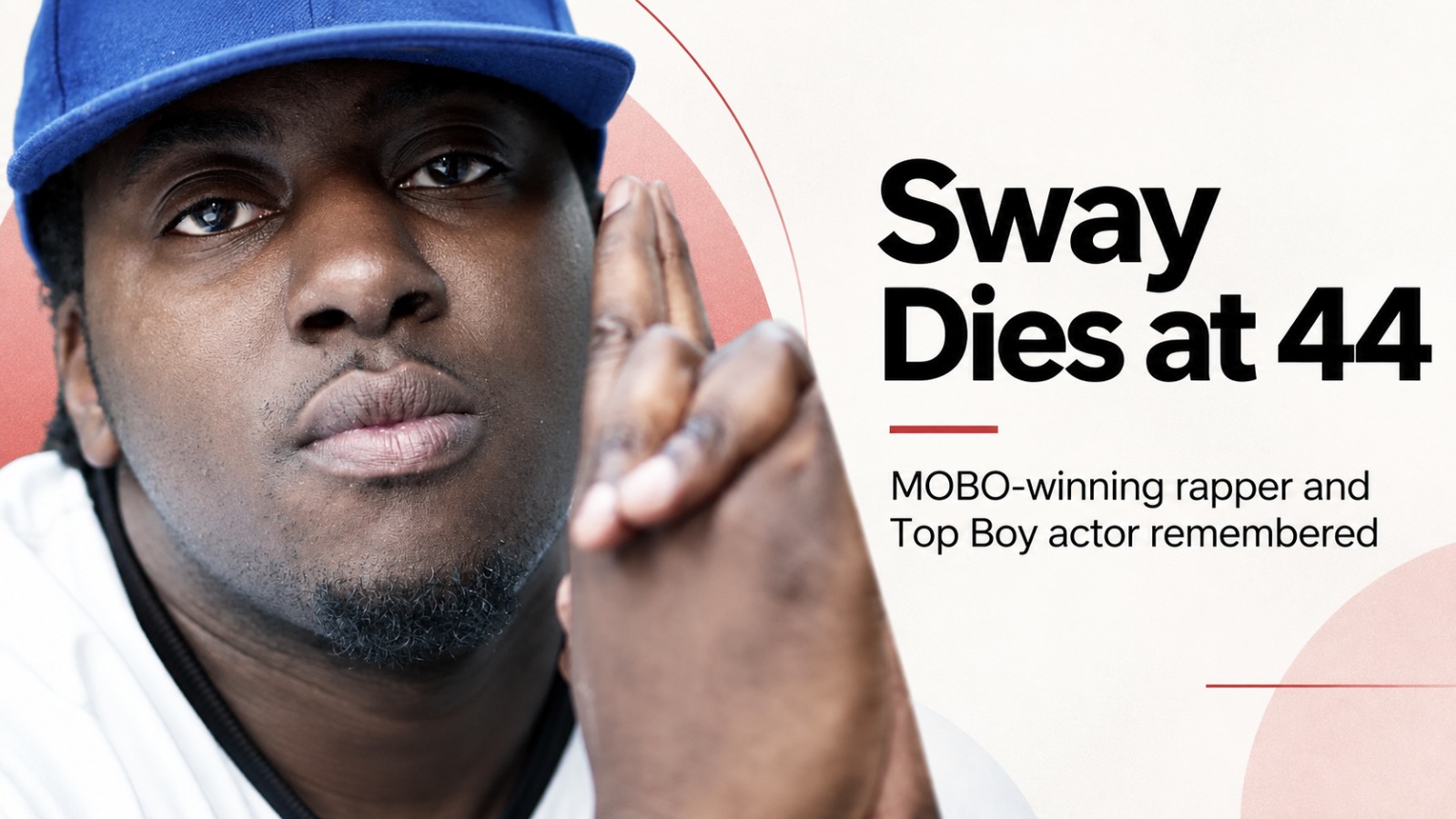
British-Ghanaian rapper and actor Sway DaSafo, one of the artists who helped push independent UK rap into the mainstream, has died at the age of 44.
The musician, born Derek Andrew Safo, died at his home in Ghana, according to his friend Kash Ahmad, who confirmed the news to the BBC. His death was initially announced by the MOBO organisation. No cause of death has been announced.
The news came only days after Sway marked his 44th birthday on Instagram. His final post showed him celebrating the milestone with the simple caption “Chapter 44”. At the time of his death, he was also working on new music.
It is a striking final snapshot of an artist whose career had repeatedly moved between reinvention, independence and opening doors for others.
The unsigned rapper who made MOBO history
Long before independent releases became an established route into the charts, Sway built his career outside the traditional label system.
Raised in north London, he developed his craft through pirate radio and credited BBC Radio 1Xtra with giving him an early break in 2002. Rather than immediately signing with a major company, he released his own music and sold mixtapes through markets and independent record shops.
That approach led to a breakthrough moment in 2005, when Sway won Best Hip-Hop Act at the MOBO Awards, defeating a field that included US stars 50 Cent and The Game. Sky News described him as the first unsigned artist to win a MOBO Award, while the organisation later called the victory a major moment for both Sway and UK hip-hop.
For an artist working independently, the win carried significance beyond the trophy itself. It placed Sway alongside internationally established names while he was still building his career on his own terms.
From ‘This Is My Demo’ to the Mercury Prize
Sway followed that breakthrough with his debut album, This Is My Demo, in 2006.
The project brought him further into the British mainstream and earned a Mercury Prize nomination, putting him in the same year’s field as artists including Arctic Monkeys and Muse. His single Little Derek also reached the UK Top 40.
His career would later stretch well beyond that first wave of UK rap recognition.
After being diagnosed with Hodgkin lymphoma in 2010, Sway underwent chemotherapy and radiotherapy and went into remission later that year. He later described the diagnosis through the image of being dropped into the middle of the sea without a lifejacket, and wrote about the experience for Lymphoma Action. He also recorded a song titled The Sea about what he had gone through.
There is no announced connection between that earlier illness and his death. The cause of death remains undisclosed.
A second chart chapter and collaborations across music
Sway returned to major commercial success in 2012 with Still Speedin’ and Level Up, the latter becoming a top 10 hit. He continued recording and collaborating with artists across British and international music, with credits involving names including Ed Sheeran, Akon, Mark Ronson and Childish Gambino.
Sky News also reported collaborations with Riz Ahmed, Tinchy Stryder and Kaiser Chiefs, reflecting the unusually wide range of artists he worked with during his career.
His influence was not limited to his own releases.
Through his record label Dcypha, Sway worked on developing emerging performers, including Tiggs Da Author and KSI. KSI later became one of the artists paying tribute following news of Sway’s death.
“You believed in me when many didn’t. You gave me a chance when many didn’t,” KSI wrote, thanking Sway for the role he had played in his development.
Sway also found a place on screen
Away from music, Sway pursued acting and appeared in Top Boy, playing Ross Rosten in the first two episodes of the series in 2011. He also took roles in films including The Grind.
Those appearances added another dimension to a career that had already moved from pirate radio and independently sold mixtapes to awards stages, chart success, record-label work and collaborations with some of the biggest names in British music.
Tributes remember a UK rap pioneer
The MOBO Awards said it was “deeply saddened” by Sway’s death and recalled his landmark 2005 victory, saying it was proud to have him as part of the organisation’s history.
Tributes also came from figures across British music and entertainment.
Top Boy actor Kadeem Ramsay called him a “Legend”, while singer Lemar remembered his talent and the conversations they had shared. Actor Adam Deacon also paid tribute.
BBC Radio 1Xtra presenter Remi Burgz described Sway as a “UK Rap pioneer” and said he had helped demonstrate that UK rap could occupy a genuine place in mainstream music.
That description captures a large part of Sway’s significance.
His career began at a time when British rap artists were still fighting for space beside dominant American acts. Sway’s route was distinctive because he did not wait for a major-label machine to establish him first. He built an audience independently, won one of British music’s best-known awards while unsigned, converted that momentum into chart success and then helped other artists find their own footing.
More than two decades after that early breakthrough, the image from his final Instagram post now carries an unexpected weight: Sway standing in the sunshine, beginning what he called “Chapter 44.”
Also Read: Who Is Howard Buffett? Warren Buffett’s Farmer Son Who Now Chairs Berkshire Hathaway