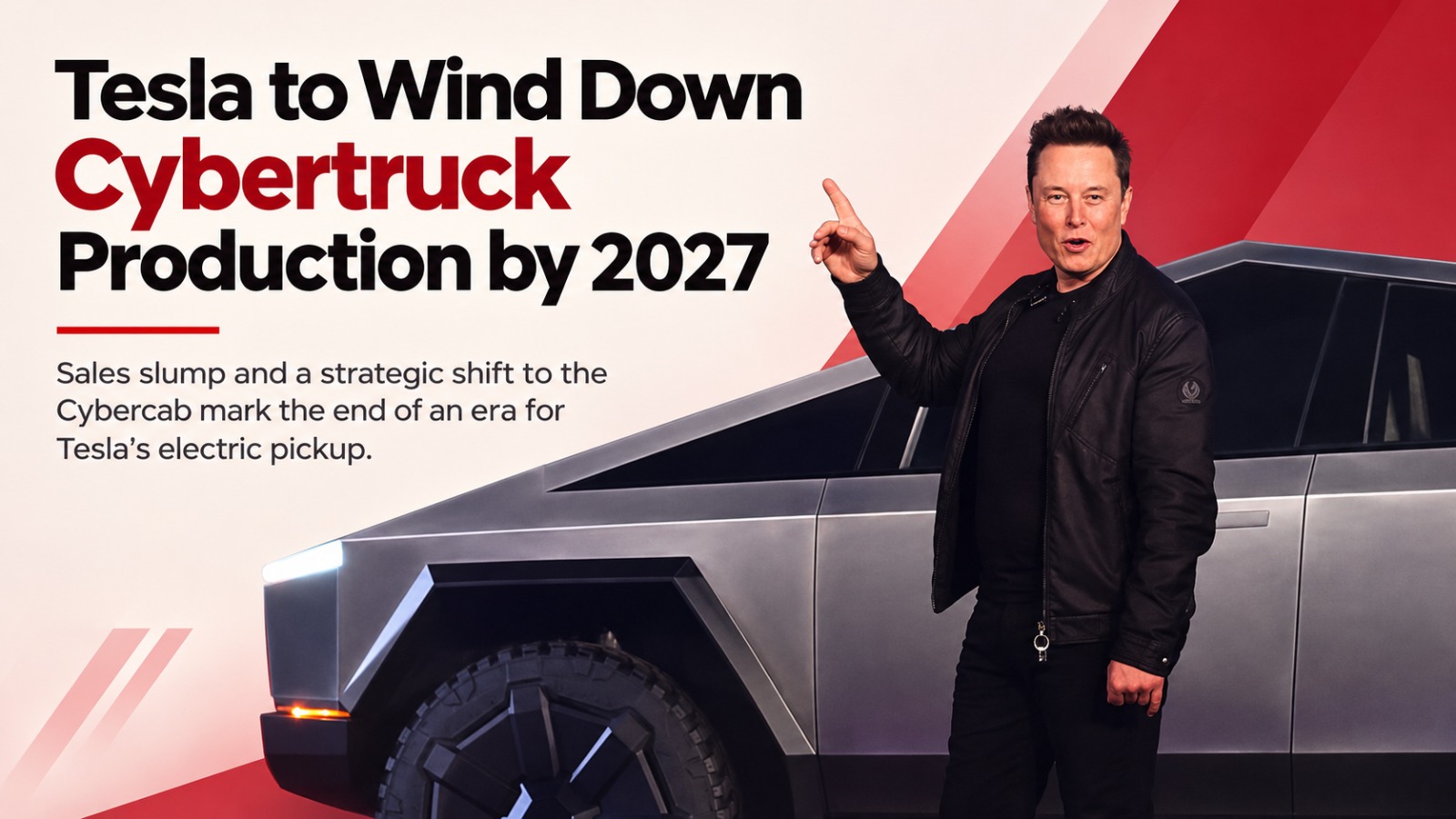
Tesla is preparing to wind down production of its Cybertruck at its Texas gigafactory around mid-2027, bringing an uncertain future for one of the company’s most talked-about vehicles. CEO Elon Musk announced the decision on Friday, November 6, after years of disappointing sales, with the automaker now looking to make more room for its Cybercab robotaxi.
Musk confirmed the plans in a post on X, saying the production changes would help Tesla increase Cybercab output. The decision signals a shift in priorities for the company, which has been placing greater emphasis on self-driving technology and robotics.
It is easier to understand why with the help of sales figures. In 2025, Tesla sold only 20,237 units of its Cybertruck model in the US, which is a 48% decrease compared to 38,965 models sold in the previous year, reports Kelley Blue Book. These figures are far away from the 250,000 annually forecasted by Musk back in 2023.
However, the announcement does not necessarily mean the Cybertruck is being discontinued altogether. Reuters reported that Tesla has yet to clarify whether manufacturing could move elsewhere or whether production will eventually end completely. The Austin gigafactory is currently the only known Tesla facility capable of producing the specialized components needed for the truck.
When Musk introduced the Cybertruck, in 2019, it received an overwhelming amount of attention. It was because of its sharp angles, stainless steel body, and very futuristic design, which was quite different from all other vehicles. It was delivered by Tesla to the clients towards the end of 2023 and competed against trucks like Ford and GM.
Turning that attention into steady demand proved much harder. The vehicle faced criticism over its design, changing prices and reliability concerns. Since deliveries began, Tesla has issued 11 Cybertruck recalls, according to the National Highway Traffic Safety Administration. While some problems could be addressed through software updates, others required owners to have their vehicles physically repaired.
The truck’s design also made international expansion difficult. Its rigid, sharp-edged stainless-steel exterior prevented it from meeting pedestrian safety requirements in Europe, effectively keeping it out of a major electric vehicle market.
Former Aston Martin CEO Andy Palmer said the weak sales made the decision to scale back production understandable.
“It doesn’t make sense to keep it going when it’s not meeting its targets,” Palmer said.
The Cybertruck did find a significant customer in another business controlled by Musk. SpaceX purchased $131 million worth of the vehicles at list prices in 2025, according to its initial public offering filing.
Despite the setbacks, Musk has continued to defend the pickup. Responding to a user on X, he described the Cybertruck as the “best vehicle Tesla has ever made” and called the planned wind-down the “end of an era.”
Tesla’s next big focus is the Cybercab, a two-seat vehicle developed specifically for autonomous transportation. Unlike a conventional car, it has no steering wheel, pedals or mirrors. Its distinctive butterfly doors are another indication that Tesla is pursuing a different approach to vehicle design.
Production of the Cybercab began earlier in 2026, and Tesla started offering paid rides using a small fleet in Austin in September. Musk sees the vehicle as a major part of his plans for a global robotaxi network, although the program is still in its early stages.
Figures from the Texas Department of Motor Vehicles show that around 570 of the more than 1,200 Tesla robotaxis operating in the state are Cybercabs. Most of the remaining vehicles are Model Y cars. Tesla has disclosed installed Cybercab production capacity of more than 125,000 units, but the program has yet to operate at anything close to that scale.
There are regulatory hurdles, too. In September, the National Highway Traffic Safety Administration opened an audit to examine whether Tesla had properly certified the Cybercab as meeting federal vehicle safety standards. The review comes as the company works to expand its autonomous driving operations.
For now, the Cybertruck remains part of Tesla’s lineup, but its future beyond the planned 2027 production wind-down is unclear. The decision leaves Tesla moving away from a vehicle that generated considerable excitement but never delivered the sales Musk expected.
Whether the Cybercab can become the commercial success Tesla is counting on remains an open question. What is clear is that the company’s manufacturing priorities are changing, with autonomous vehicles taking a more prominent place in its plans.
Also Read: Dhanteras 2026: Gold Falls ₹2,560 to ₹1.43 Lakh, but Is This the Right Time to Buy?