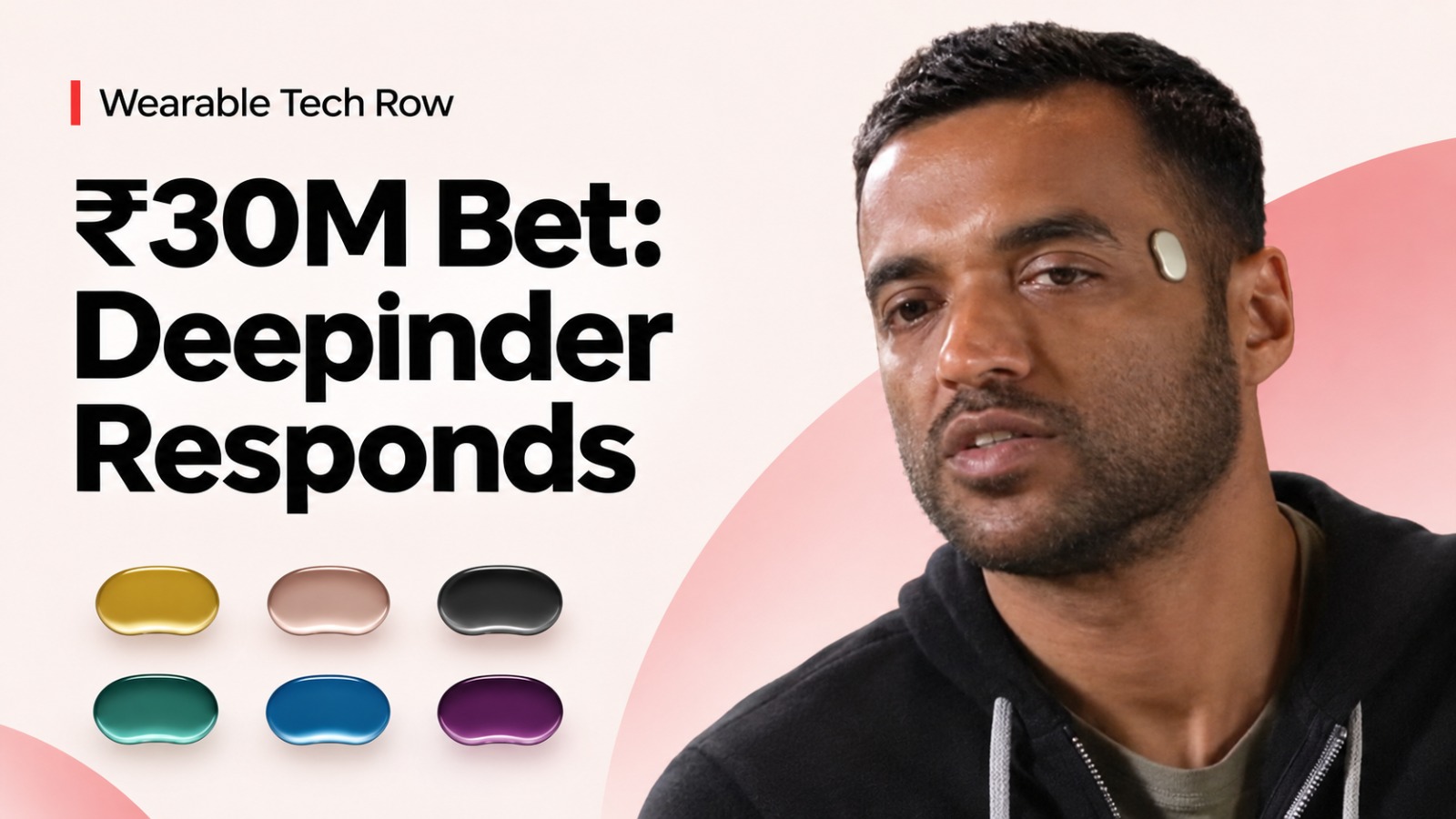
Zomato founder Deepinder Goyal has defended his ₹85,000 Temple wearable against criticism from doctors, revealing that he has invested $20 million of his personal wealth in developing the device as part of a $30 million investment in the project.
In a lengthy post on X addressed to “Concerned Indian Doctors” on Thursday, Goyal rejected allegations that Temple was a scam and maintained that the company stands firmly behind its scientific claims.
He argued that the product’s 14-day, no-questions-asked return policy would quickly expose any shortcomings. According to Goyal, customers would be able to identify within days whether the device delivers on its promises, making it difficult for the company to recover even a fraction of its research and development expenditure if the product fails.
“If Temple were a scam, and any of what we said weren’t true, people would know it in just a few days of using Temple,” he wrote.
Deepinder Goyal Says Temple Is Not About Making Money
Goyal disclosed that Temple has already received $30 million in investment, of which $20 million came directly from his personal funds.
He argued that selling a few thousand devices would recover only a small portion of the money spent developing the technology. He also questioned why anyone would undertake such an expensive project if the intention were simply to make quick money.
The Zomato founder further pointed to his decision to step down as CEO of Eternal to concentrate on Temple, describing the project as a pursuit of purpose rather than another commercial opportunity.
“I left the Eternal CEO role to chase purpose with Temple. This is not about money. I have enough of it to last for generations,” Goyal said.
He added that he was not willing to put a reputation built over two decades at risk for short-term financial gains.
Doctors Question Temple’s Scientific Claims
Goyal’s response follows criticism from members of the medical community, including hepatologist Dr Cyriac Abby Philips, widely known as The Liver Doc.
Doctors have questioned the scientific basis of Temple’s claims and whether the wearable offers meaningful clinical value.
The device, priced at ₹85,000, opened for pre-orders on November 1. It is designed to track physiological signals associated with blood flow and other health metrics.
The debate intensified after Goyal claimed earlier this week that Temple had outperformed several leading wearable devices in heart-rate accuracy tests.
However, the testing was funded and conducted by Temple itself and had not undergone peer review. This has raised questions about the independence of the findings and the evidence supporting the company’s performance claims.
Independent Research Yet to Be Published
Addressing concerns about scientific validation, Goyal said Temple plans to publish independent research and defended the use of preprints as an early step towards peer-reviewed scientific publications.
He maintained that wearable technology companies often launch products before external validation studies become available.
“We hold ourselves to a higher standard; pre-prints are a step prior to peer-reviewed publications, and they are coming up,” he stated.
Goyal reiterated his confidence in the technology, saying the company stands by its research methods and scientific claims.
He also suggested that Temple has capabilities that have not yet been publicly disclosed, adding that some of its most significant features have little to do with doctors.
The exchange highlights the growing debate around Temple’s scientific credibility, particularly as the company prepares to establish its position in the wearable technology market. While Goyal has defended the investment and promised further research, independent validation of the device’s claims remains an important part of the discussion.
Also Read: India Launches Three Homegrown AI Models, Two Designed to Run Offline