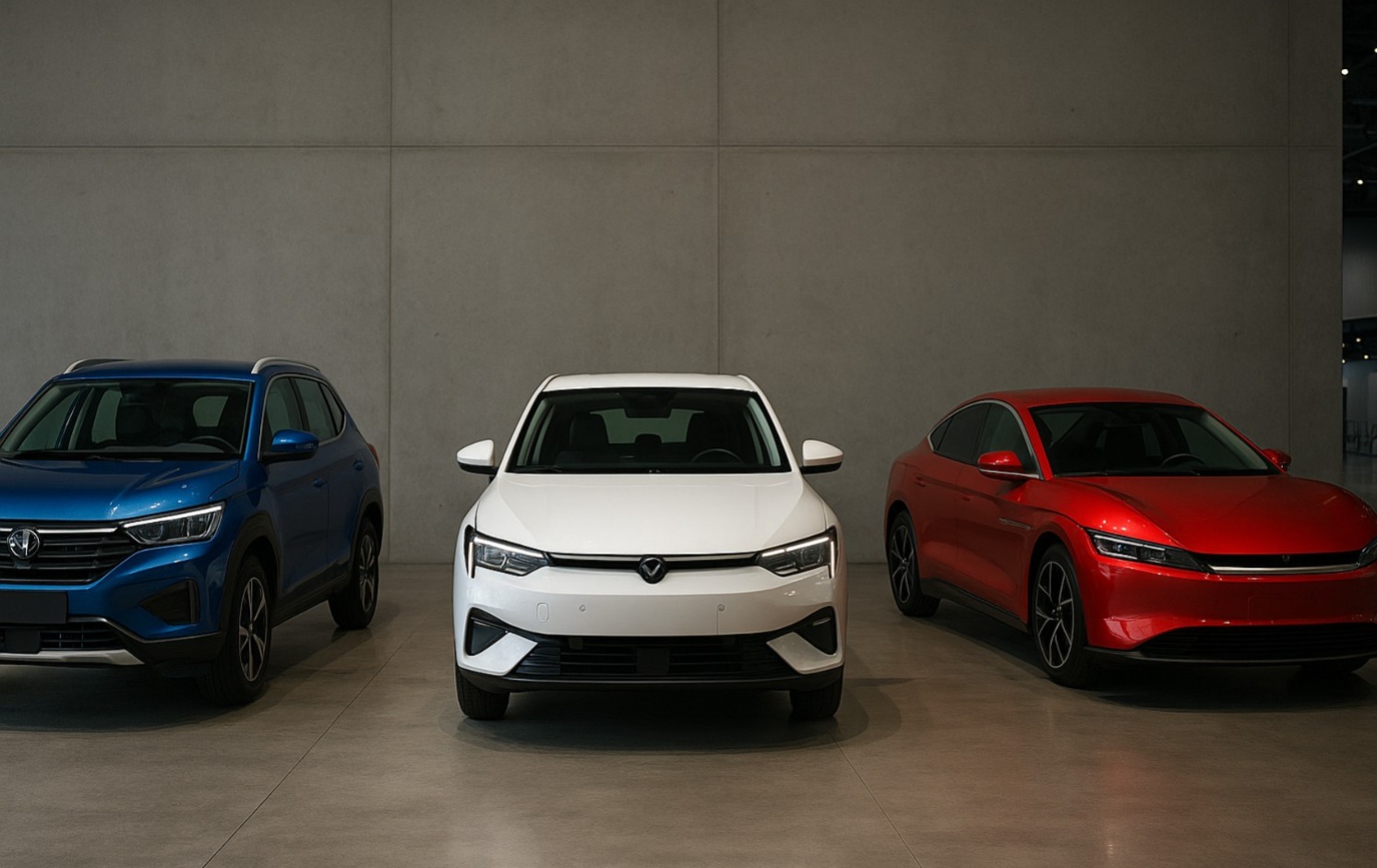
India’s EV market has hit a turning point. In just over a year, China-linked brands and joint ventures have moved from the margins to the mainstream, now accounting for roughly one in every three electric passenger vehicles sold in the country.
The shift is not loud or dramatic. It is happening through steady showroom expansion, aggressive product launches and deep-pocketed investments that are reshaping what was once almost a single-brand market.
From Tata’s near-monopoly to a three-way fight
For years, the electric passenger vehicle segment in India was effectively synonymous with Tata Motors. At one point, Tata commanded around 85% of the market, riding on early bets in affordable EVs and a wide dealer network.
That picture has changed sharply over the past 12–18 months. Brands with Chinese ties, notably JSW Motor (through its association with China’s SAIC for MG Motor India), BYD, and Volvo, now jointly control about 33.3% of India’s electric passenger vehicle sales. Their growth between January and October has been explosive, with volumes rising 165% year-on-year, more than doubling in under a year.
The result is a market that is no longer defined by a single domestic champion, but by a new axis of competition between legacy Indian players and capital-rich, technology-heavy Chinese-backed entrants.
Data shows who is really driving EV growth
Official numbers underline how central these new players have become to India’s EV story.
- Data from the Federation of Automobile Dealers Associations (FADA) shows that one out of every three electric cars sold in India today has Chinese ties, either through ownership, technology or joint ventures.
- Between January and October, electric passenger vehicle sales grew 87% to reach 136,610 units. Without the contribution of the Chinese-linked brands, overall growth would have been closer to 63%, indicating how much of the incremental demand they are driving.
- In sharp contrast, the traditional internal combustion engine (ICE) segment has been sluggish. According to the Society of Indian Automobile Manufacturers (SIAM), ICE passenger vehicle sales actually declined by 1.4% in the six months ending September.
In other words, while the broader passenger vehicle market is barely moving, the EV sub-segment is expanding rapidly and much of that surge is being captured by Chinese-backed brands.
JSW, MG, Leapmotor: India’s new EV alliances
Indian conglomerates are not sitting out this shift; they are partnering with Chinese players instead of competing with them head-on.
- JSW Group has tied up with China’s SAIC to scale up MG Motor India, with plans for multiple new models to hit the market.
- Separately, JSW has also partnered with China’s Chery to bring an all-new passenger vehicle brand to India by 2027.
- JSW has announced an investment plan of ₹26,000 crore and aims to launch up to 25 new models by 2030, spanning pure EVs, hybrids and range-extender vehicles, with entry prices starting at around ₹8 lakh.
These alliances signal two trends: Chinese manufacturers see India as a critical growth market, and Indian groups see Chinese technology and product pipelines as the fastest way to scale up in EVs.
BYD’s quiet march and Tesla’s cautious entry
Among the foreign EV makers, BYD has emerged as one of the strongest contenders in India’s premium electric car space.
- The company is already the fifth-largest EV maker in India, selling roughly 500–550 units a month.
- It operates 47 showrooms across 40 cities, giving it a footprint that many newer EV brands are still building.
- Its current portfolio is priced between ₹25 lakh and ₹53 lakh, firmly targeting the upper-middle and premium segments.
- BYD is now exploring a local manufacturing plant in India, a move that could enable sharper pricing and deeper localisation.
On the other end, Tesla has taken a much quieter route so far. Since entering India in July, it has sold 104 units of the Model Y in August and September combined and has opened a retail centre in Gurugram aimed squarely at premium buyers.
Where BYD is building breadth through showrooms and steady volumes, Tesla appears to be testing the waters and establishing brand presence before any larger play.
Why Chinese-linked brands are gaining ground
The rise of Chinese-backed EV brands in India is driven by a combination of factors that go beyond price:
- Product depth and speed: Chinese EV makers are known for rapid product cycles and a wide portfolio across segments. Through joint ventures and technical partnerships, that depth is now being channelled into the Indian market, from compact SUVs to high-end crossovers.
- Capital and scale: Investments such as JSW’s planned ₹26,000 crore commitment, alongside plans for up to 25 models by 2030, signal long-term intent rather than opportunistic bets.
- Dealer push and visibility: BYD’s network of 47 showrooms in 40 cities illustrates how distribution is being built out aggressively, even at relatively modest sales volumes. For EVs, where test drives and charging education are critical, such physical presence can be a differentiator.
- Shifting consumer mindset: With ICE sales almost flat and EV growth at 87%, buyers with the budget and access to charging are clearly more open to going electric. Chinese-linked brands are positioning themselves to catch this first wave of adopters.
A market still in flux
Despite the surge of Chinese-backed brands, India’s EV race is far from settled. Tata Motors remains a formidable player with early-mover advantage, strong brand recall and a wide service network. Other domestic manufacturers are also sharpening their EV plans, and policymakers continue to tweak incentives and localisation norms.
At the same time, global majors are lining up:
- Stellantis, headquartered in the Netherlands and owner of multiple European, Italian and American brands, is preparing to bring Leapmotor, a Chinese-backed EV marque, into India, with product and powertrain strategies now being finalised.
As these launches unfold, the share of Chinese-linked brands in India’s EV space could rise further, or meet stiff resistance from home-grown rivals that accelerate their own EV transitions.
The contest is not just about selling more electric cars. Whoever dominates this phase of India’s EV transition will gain:
- Control over crucial charging and service ecosystems
- A head start in customer data and software-driven services
- A strategic foothold in what is projected to be one of the world’s largest EV markets
Chinese-backed brands have already captured around a third of India’s electric passenger vehicle market and are responsible for a big chunk of its growth.
The quiet land grab is over. The next chapter will decide whether India’s EV future is led primarily by domestic champions, global Chinese-linked players, or a hybrid model where partnerships, rather than stand-alone companies, define who wins the race.
Also Read: 79-Year-Old Woman Loses ₹1.1 Cr in ‘Digital Arrest’ Scam