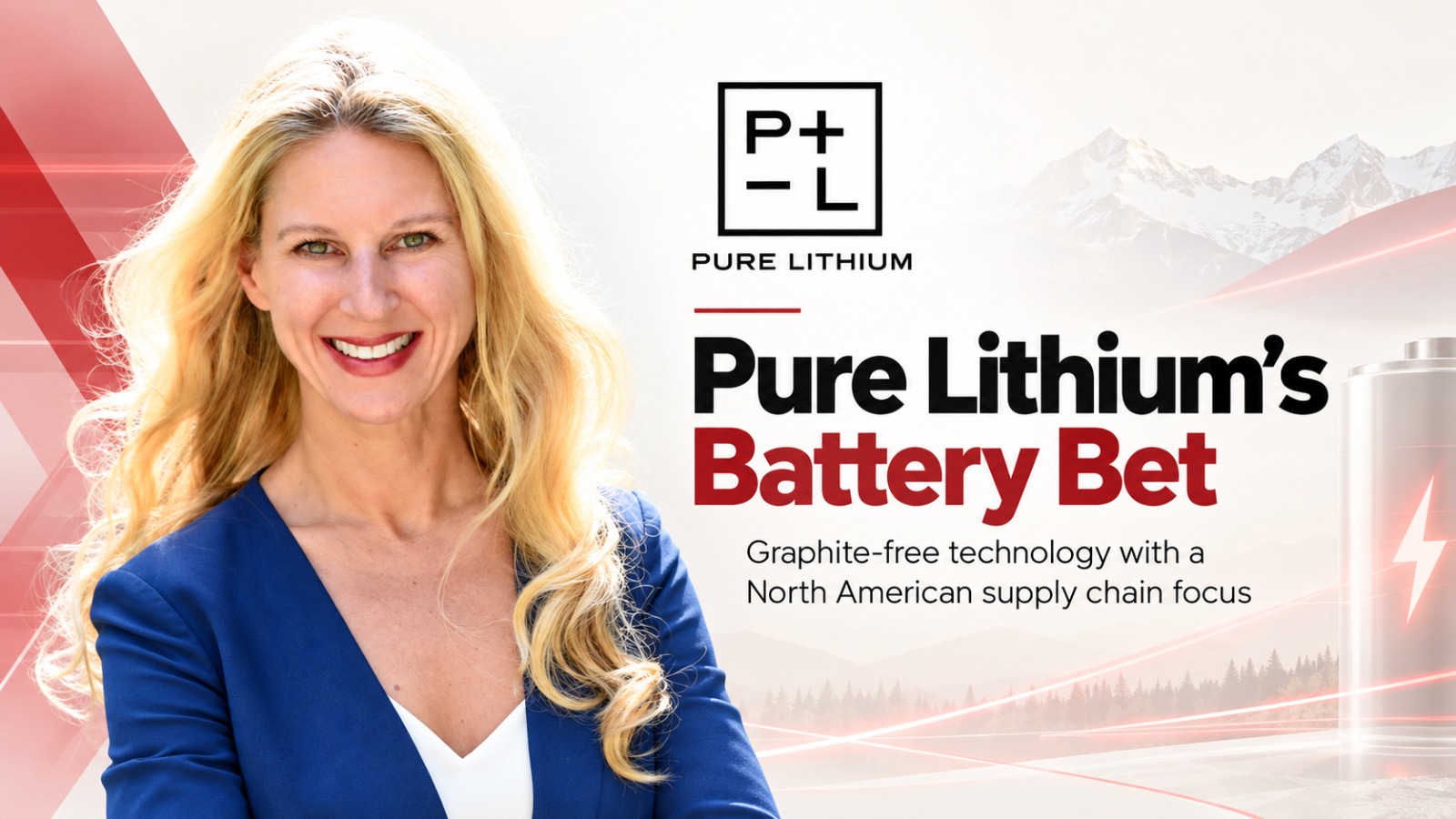
The Chicago-based battery technology startup Pure Lithium is building its case around a simpler idea: remove some of the materials that make today’s batteries heavy, complex and deeply tied to overseas supply chains, then rethink how lithium reaches the cell in the first place.
The race to build the next generation of batteries has produced no shortage of ambitious ideas. Solid-state cells, silicon anodes and new cathode chemistries have all been pitched as possible answers to the limitations of today’s lithium-ion technology.
Pure Lithium is taking another route.
The company describes itself as a vertically integrated lithium metal vanadium, or LVO, battery technology business. At the centre of its approach is its Brine to Battery™ electrodeposition technology, designed to turn unconventional sources of lithium into a battery-ready electrode without first going through the conventional compound-production route.
The company says that process can create an electrode in a single day.
That manufacturing philosophy is important to understanding Pure Lithium. Rather than treating lithium extraction, processing and battery manufacturing as disconnected stages, the company is trying to bring them much closer together.
And at the battery level, its ambitions go beyond changing where lithium comes from.
Pure Lithium is also working on lithium-metal cells that eliminate graphite from the anode. The technology highlighted in recent testing pairs a lithium-metal anode with lithium iron phosphate, or LFP, chemistry. Pure Lithium says this configuration removes the need for graphite as well as nickel, manganese and cobalt, materials that feature prominently in conventional battery supply chains.
That matters because graphite remains one of the less visible dependencies in the battery industry.
More than 90% of the world’s graphite processing takes place in China. In a conventional lithium-ion battery, graphite acts primarily as a host material for lithium ions during charging and discharging. Pure Lithium’s approach is to remove that host altogether and use lithium metal directly, opening additional room inside the cell for energy-storing material.
For Chief Executive Emilie Bodoin, eliminating graphite is central to the company’s performance argument.
“It’s half the weight and double the energy density of the battery that we’re all using today,” Bodoin said in an interview cited by InsideEVs.
Those claims are still being tested against the realities of commercial production, but Pure Lithium has recently put forward a striking laboratory result.
The company said one of its lithium-metal cells reached 9,315 charge-discharge cycles, with testing conducted at a 1C charge and discharge rate. That means the cell was repeatedly charged over one hour and discharged over another hour. Pure Lithium said the result was unprecedented for a lithium-metal battery tested under equivalent conditions.
The test was not uninterrupted. Pure Lithium paused testing around the 6,000-cycle point while moving its headquarters from Boston to Chicago, leaving the cell at room temperature for roughly four months. When testing resumed, the company reported that the cell continued to show strong capacity retention. It also disclosed that some of the earlier fluctuations in the test were linked to a lack of temperature control and multiple power failures in its Boston laboratory.
A previous test in January 2025 had shown that a Pure Lithium cell had maintained over 80% of its charge capacity after 2,200 cycles at the same 1C rate. It should be noted that the company has also claimed its Gen 1 battery to have 300 Wh/kg energy density, with its Gen 2 model projected to achieve 425 Wh/kg. However, the energy density of the particular cell used for testing 9,315 cycles was not provided.
That distinction is important. Long cycle life in a laboratory cell is not the same thing as a commercially produced automotive battery, and Pure Lithium has not yet reached mass production.
The company is currently building a pilot line in Chicago and is looking for partners to help commercialise the technology. Bodoin has said Pure Lithium is in discussions with more than 40 companies about scaling its approach.
The way Pure Lithium manufactures its lithium-metal anode is another part of the story.
Its battery is graphite-free, but not anode-free. Instead, lithium metal is deposited directly onto a copper current collector through electrodeposition until the required thickness is reached. In effect, the anode is formed as part of the manufacturing process rather than being produced through the conventional graphite-based route.
Bodoin has described that electrodeposition step as a way of making the lithium anode in a single manufacturing stage.
For Pure Lithium, that manufacturing method connects back to the bigger idea behind Brine to Battery™: shorten the distance between raw lithium and a usable battery component.
It is an approach that could become increasingly relevant as battery companies rethink both chemistry and supply chains.
Pure Lithium is not alone in pursuing lithium-metal technology. Factorial, Solid Power and QuantumScape are also developing graphite-free lithium-metal batteries, although their technical routes differ. Factorial and QuantumScape have focused on solid-state or semi-solid-state electrolytes, while Solid Power has been developing technologies around a sulfide solid electrolyte. Pure Lithium, by contrast, uses a liquid electrolyte and is placing particular emphasis on how its lithium-metal anode is produced.
That difference may ultimately prove as important as the chemistry itself.
The battery industry is not simply looking for a cell that stores more energy. Companies are also trying to reduce manufacturing complexity, lower material dependence and create supply chains that can operate closer to where batteries will eventually be produced.
Pure Lithium’s proposition touches all three.
Its technology is still moving from laboratory validation toward pilot production, and commercial scale will be the harder test. The company will need to show that the performance seen in controlled testing can be repeated in larger cells, manufactured consistently and produced at a cost that makes sense for customers.
Pure Lithium does not see the future of batteries as simply a better version of the supply chain that exists today. Its bet is that the battery itself, the lithium processing route and the materials inside the cell can all be redesigned together.
And if that model works at industrial scale, Pure Lithium would not just be proposing a new battery chemistry. It would be proposing a very different way of getting from lithium in the ground to energy inside a cell.
Also Read: Google Turns 28: The Search Engine Once Called BackRub