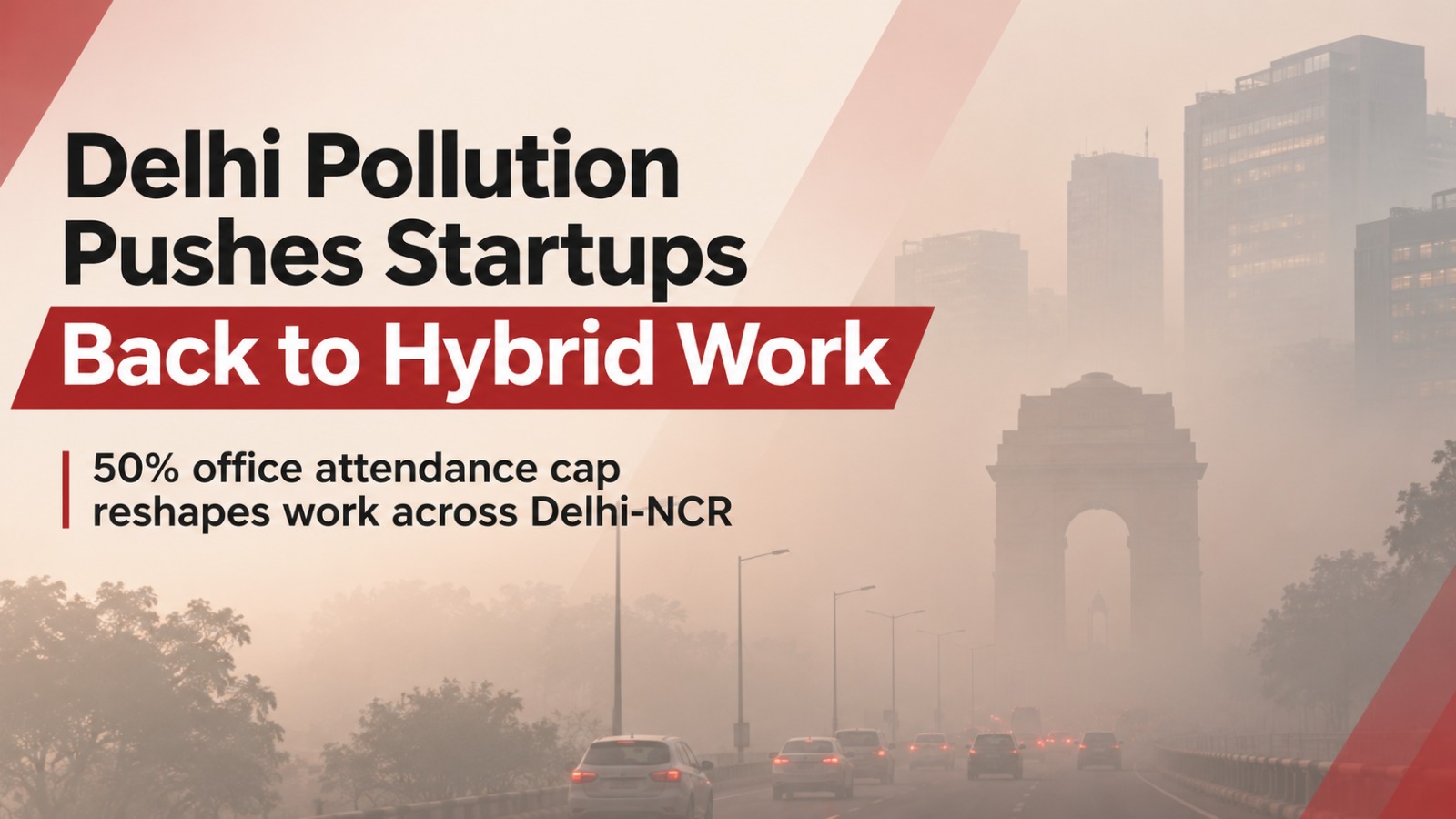
Worsening air pollution across Delhi-NCR is forcing companies to rethink their office schedules, with Snapdeal, Spinny and Eternal among the businesses reducing physical attendance to 50% under government restrictions aimed at cutting pollution from daily commuting.
The changes follow an October 30 directive from the Commission for Air Quality Management (CAQM), which requires government and private offices in Delhi and five neighbouring districts to ensure that at least half their employees work from home between November 5 and November 20.
The restrictions cover Gurugram, Faridabad and Sonipat in Haryana, along with Ghaziabad and Gautam Buddha Nagar in Uttar Pradesh. Delhi has a separate arrangement extending similar attendance restrictions until January 31.
E-commerce platform Snapdeal has introduced remote working for nearly half its employees from November 5 to November 13. The company said it would assess further changes based on government instructions.
Used-car marketplace Spinny has also reduced its in-office workforce. Founder Niraj Singh confirmed that the company implemented a 50% work-from-home arrangement immediately after the government circular was issued.
Eternal, the parent company of Zomato and Blinkit, has similarly restricted physical attendance at its Gurugram office to 50%. The company is following directions issued by the Gurugram district administration.
However, businesses are responding differently to the pollution situation.
Aparna Agarwal, founder and CEO of Sandbox, said the company is prioritising employee health and safety amid worsening air pollution across Delhi-NCR. She said we are taking necessary measures to maximise work-from-home arrangements for tasks that do not require employees to be physically present in the office.
The workplace restrictions come as Delhi experiences another period of hazardous winter air pollution.
On November 10, the capital’s 24-hour average Air Quality Index (AQI) approached 390, placing it in the ‘very poor’ category. Several monitoring stations recorded readings above 400, which fall in the ‘severe’ category.
The CAQM introduced the attendance limits as part of preventive measures intended to reduce emissions during a period when pollution levels frequently rise.
The commission cited air quality records from 2018 to 2025 showing that Delhi-NCR repeatedly experienced severe and severe-plus pollution episodes during early and mid-November.
Weather conditions also contribute to the problem. Low wind speeds and limited vertical movement of air during winter make it harder for pollutants to disperse. Vehicle emissions, local pollution sources, agricultural residue burning and biomass burning further increase pollution levels.
By reducing the number of employees travelling to workplaces, authorities aim to limit commuting-related emissions. Industrial establishments and essential services where remote working is impractical have been exempted from the requirement.
The duration of the restrictions differs between Delhi and surrounding NCR districts.
While the CAQM’s regional attendance directive runs from November 5 to November 20, Delhi’s winter pollution action plan requires government and private offices in the capital to maintain a maximum of 50% physical attendance from November 1 until January 31.
Private establishments in Delhi have also been directed to introduce staggered working hours and encourage employees to use carpooling, ride-sharing and public transport.
In Gurugram, the district administration issued an implementation order on November 3, instructing offices to prepare attendance rosters and maintain records that officials can inspect to check compliance.
The CAQM has additionally restricted dust-generating demolition and outdoor construction activities across the NCR from November 5 to November 20.
For companies operating across Delhi-NCR, the measures mean that hybrid working arrangements are once again becoming part of their response to the region’s recurring winter pollution problem.
With attendance restrictions already in effect, businesses must balance workplace operations with government directions aimed at reducing emissions and limiting employee exposure to polluted air.
Also Read: Bay Raises $50 Million to Stop AI Agents From Making Dangerous Decisions Inside Companies