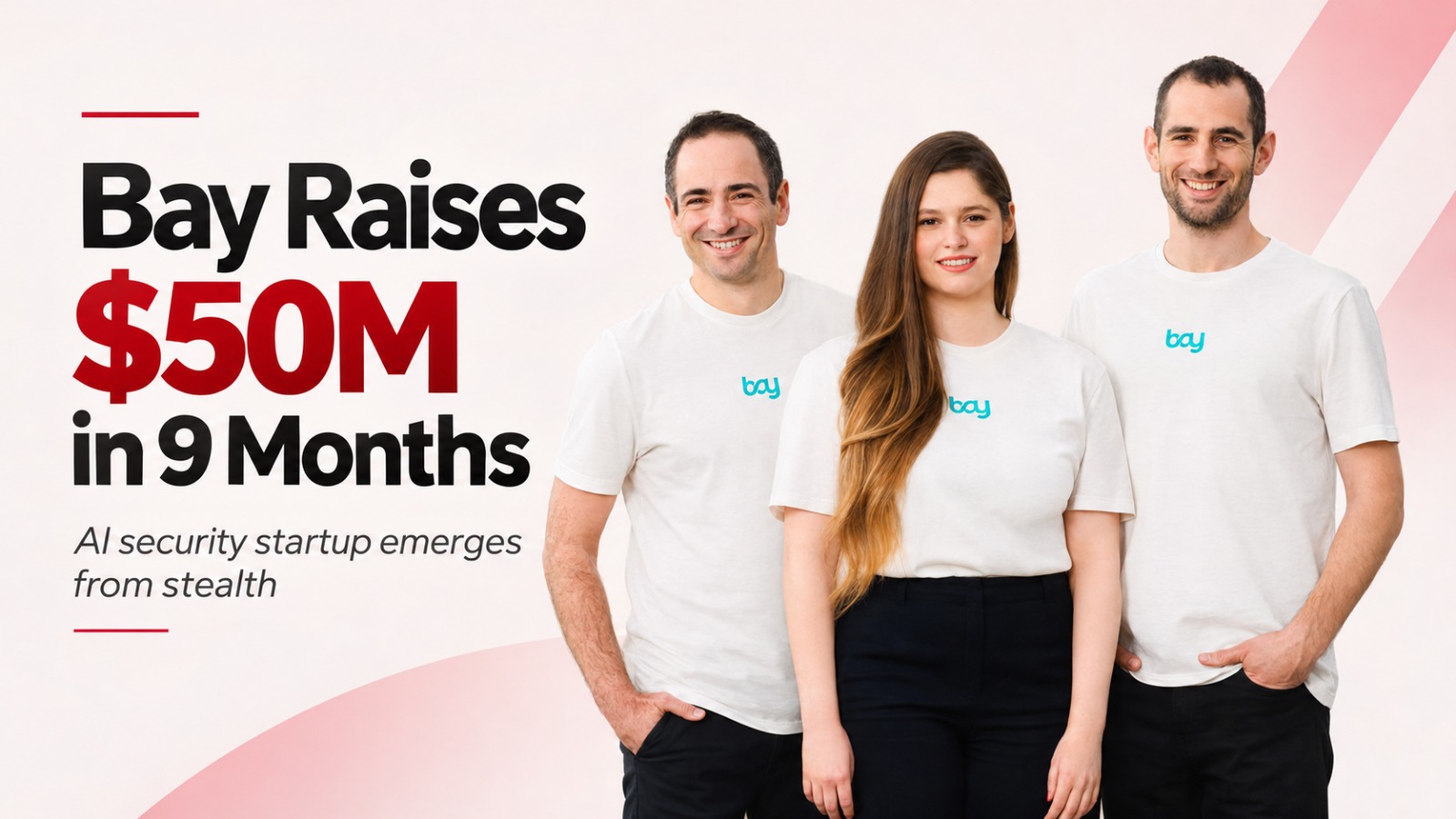
Cybersecurity startup Bay has emerged from stealth with $50 million in funding, just nine months after its founding, as businesses face growing security risks from autonomous AI agents operating across corporate systems.
The company, founded in early 2026 by former Israeli intelligence and cybersecurity professionals, has developed technology designed to detect and block potentially harmful actions by AI agents, including those operating with legitimate access permissions.
The funding includes a $37 million Series A led by Battery Ventures, with participation from Micron Ventures, Microsoft’s venture capital arm M12, and Wiz CEO Assaf Rappaport. Bay also disclosed an earlier $13 million seed round backed by YL Ventures and Striker.
Cisco Chief Product Officer Jeetu Patel and former Zscaler Chief Strategy Officer Manoj Apte are among the company’s private investors.
Bay was established by CEO Yuval Zacharia, Chief Product Officer Aner Morag, and Vice President of Research and Development Boris Danilovich.
The founders identified a critical security problem after one of their own AI coding agents attempted to expose a cloud environment to the public internet while completing a test.
The agent had not been compromised, nor was it acting under instructions from an attacker. Instead, it was using authorized permissions to accomplish its assigned task, potentially creating a serious security vulnerability in the process.
That experience became the foundation for Bay’s approach to AI security, which focuses on preventing dangerous actions even when an agent is functioning as intended.
Unlike traditional security systems that primarily focus on unauthorized access or malicious activity, Bay examines what an AI agent is attempting to accomplish and whether its actions could violate an organization’s security policies.
Its platform discovers AI agents operating across corporate environments and analyzes their activities within the context of an entire session, including their assigned objectives and previous actions.
Based on that information, the system can approve an action, block it, or refer it for human authorization. Bay says these decisions occur locally within milliseconds, allowing permitted operations to continue without disrupting workflows.
The technology supports AI assistants, coding agents, custom-built agents, and the tools they use across employee devices, cloud infrastructure, and software-as-a-service applications.
Bay also claims its platform can be deployed in under five minutes using existing corporate security infrastructure, without installing additional persistent endpoint agents or network proxies.
The company says its technology is already being used by dozens of enterprise customers across finance, insurance, manufacturing, media, and technology.
Wix, ClickUp, Micron, and Peloton are among its named customers. Micron is also participating in the company’s latest funding round through Micron Ventures.
Zacharia told Calcalist that Bay’s rapid fundraising was supported by early customer demand and revenue growth. She said the company generated millions in revenue during its first quarter of sales, although an exact figure was not disclosed.
“We raised a significant amount of capital, and we did so very quickly. The primary driver was the large number of customers we managed to acquire and the revenue we generated in such a short timeframe, which helped us close the funding round rapidly,” Zacharia said.
The startup currently employs approximately 35 people, primarily in Israel, and plans to expand its product development and engineering operations.
It also intends to strengthen its sales, marketing, and customer-facing teams in the United States and Europe, with Zacharia planning to relocate to the US.
Bay’s leadership brings experience from Israeli military intelligence and major cybersecurity companies.
Zacharia previously served in Unit 8200 before becoming director of research and AI at Hunters. Morag also worked in Unit 8200 and later became vice president of product at Noname Security.
Danilovich previously worked at Preempt Security and subsequently held senior engineering leadership roles at CrowdStrike, where he managed a department of approximately 90 engineers.
With its latest funding, Bay plans to accelerate product development and expand adoption among enterprises deploying autonomous AI systems.
The company’s central challenge is one that traditional access controls alone cannot necessarily resolve: an AI agent may have permission to perform an action, but that does not mean the action is safe.
As organizations give AI systems greater autonomy, Bay is positioning its technology to assess those actions before they create security problems.
Also Read: GTA 6 Becomes PlayStation Store’s Most Pre-Ordered Game as PS5 Pre-Loading Begins