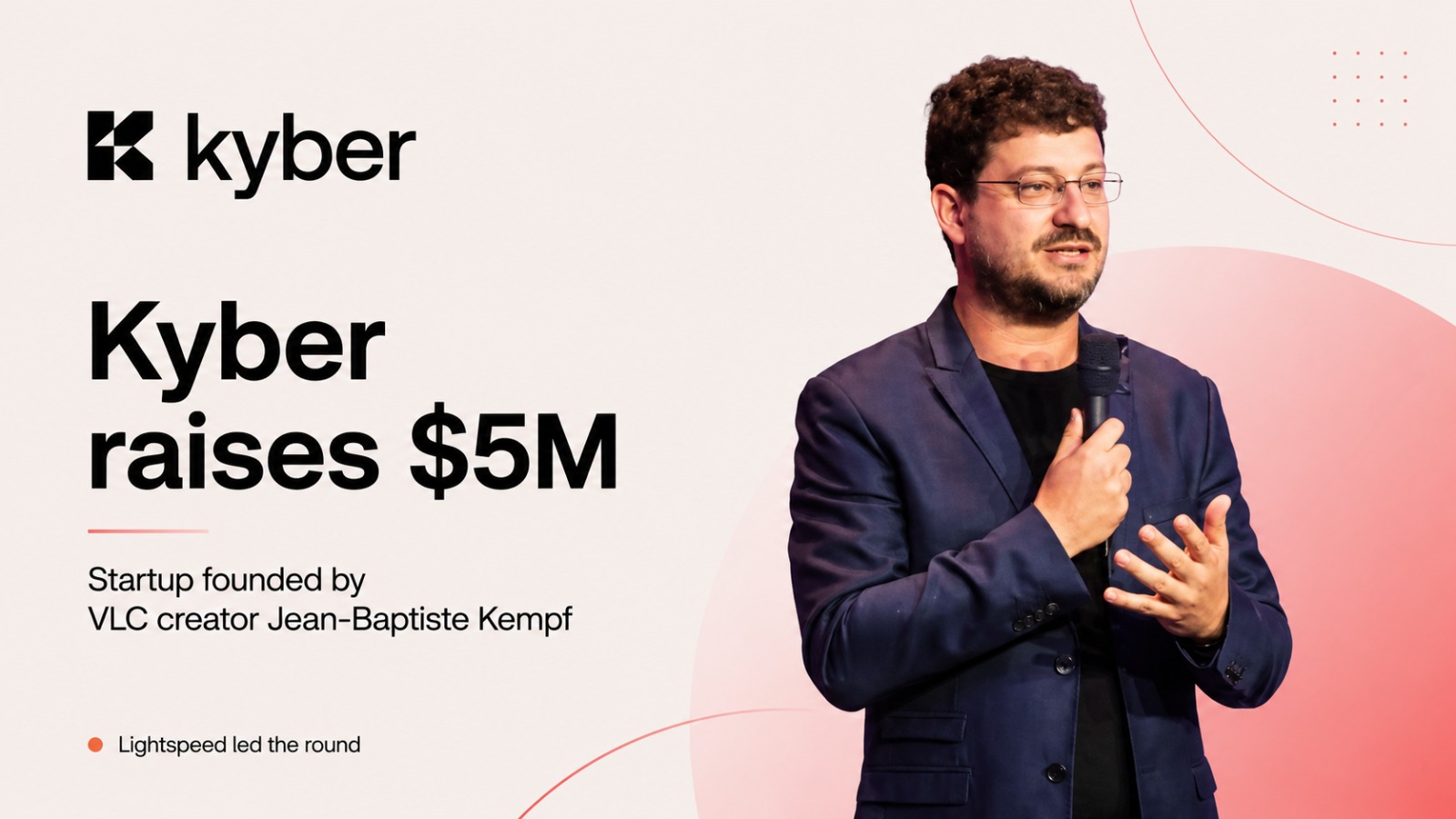
Paris-based startup aims to build the infrastructure layer for large-scale robotics and physical AI systems
Kyber, a startup founded by VLC Media Player creator Jean-Baptiste Kempf, has secured $5 million in fresh funding to accelerate the development of its real-time remote device control platform. The investment round was led by Lightspeed Venture Partners, with participation from OVNI Capital and Kima Ventures.
The Paris-based company is developing technology that enables ultra-low latency communication and control for connected devices. Its platform is designed for use cases involving robotics, drones, artificial intelligence systems, and remote IT operations, where speed and reliability are critical.
With the new funding, Kyber plans to strengthen its position in a growing market that increasingly relies on real-time interactions between software and physical devices.
Building the Foundation for Physical AI
Kyber is focused on solving one of the most significant technical challenges in robotics and remote operations: maintaining fast, synchronized communication between devices and operators.
The company’s software development kit (SDK) enables the simultaneous transmission of video, audio, sensor data, and control commands. By keeping these streams synchronized, the platform helps ensure that remote devices can be monitored and controlled with a high degree of accuracy.
Kyber is already being deployed across sectors including defence, telecommunications, and artificial intelligence. The company sees itself as a foundational infrastructure provider for what is often referred to as physical AI, a category that combines AI systems with machines capable of interacting with the real world.
As industries continue to adopt autonomous and semi-autonomous systems, demand for reliable communication platforms is expected to grow. Kyber is positioning itself to serve as the technology layer that supports these increasingly complex operations.
Also Read: Architect Labs Raises $24 Million Seed Round to Accelerate AI-Driven Chip Design
Turning Video Streaming Expertise into Robotics Infrastructure
The startup’s technology is built on Kempf’s long-standing experience in video streaming and media software development. He is best known for his work on VLC Media Player, one of the world’s most widely used open-source media applications, and his contributions to the FFmpeg multimedia framework.
Drawing on that background, Kyber has adapted techniques traditionally used in video streaming to meet the needs of robotics and remote control systems. The company’s platform is designed to deliver highly responsive communication between users and devices, minimizing delays that can affect performance.
In a demonstration conducted in 2025, Kyber reported achieving glass-to-glass latency of just 8 milliseconds. Such low latency is particularly important in applications where even minor delays can impact device responsiveness and operational accuracy.
By applying streaming technology principles to robotics and connected devices, Kyber aims to address a critical requirement for next-generation remote operations.
Preparing for a Future of Massive Device Fleets
According to Kempf, one of the biggest challenges facing the industry is scaling remote device management from thousands of units to millions.
Today, many large fleets operate in the range of 2,000 to 3,000 devices. As robotics adoption expands across industries, the number of connected machines is expected to rise significantly. Managing these systems efficiently will require infrastructure capable of handling vast amounts of data and communication traffic.
Kyber is developing its platform with this long-term vision in mind. The company is also integrating observability capabilities that help operators monitor system performance and maintain reliability across large deployments.
This approach places Kyber in competition with remote access and device management platforms such as Citrix while also positioning it as an enabling technology for emerging robotics ecosystems.
Open-Source Principles Meet Enterprise Growth
Reflecting Kempf’s open-source roots, Kyber has adopted a dual-licensing model for its technology. The company offers its core SDK free of charge while generating revenue through enterprise-focused products and customized deployments.
This strategy is intended to encourage broader adoption of the platform while providing businesses with advanced features and tailored implementations suited to their operational needs.
Kyber currently employs a team of 25 people, including a significant number of forward-deployed engineers who work closely with customers on integrations and deployment requirements. This hands-on approach allows the company to adapt its technology to a wide range of environments and industry-specific use cases.
With fresh capital, a strong technical foundation, and growing interest in robotics and physical AI, Kyber is seeking to establish itself as a key infrastructure provider for the next generation of connected machines.
Also Read: HealthQuad Raises Rs 550 Crore for Fund III, Targets Rs 1,700 Crore Corpus