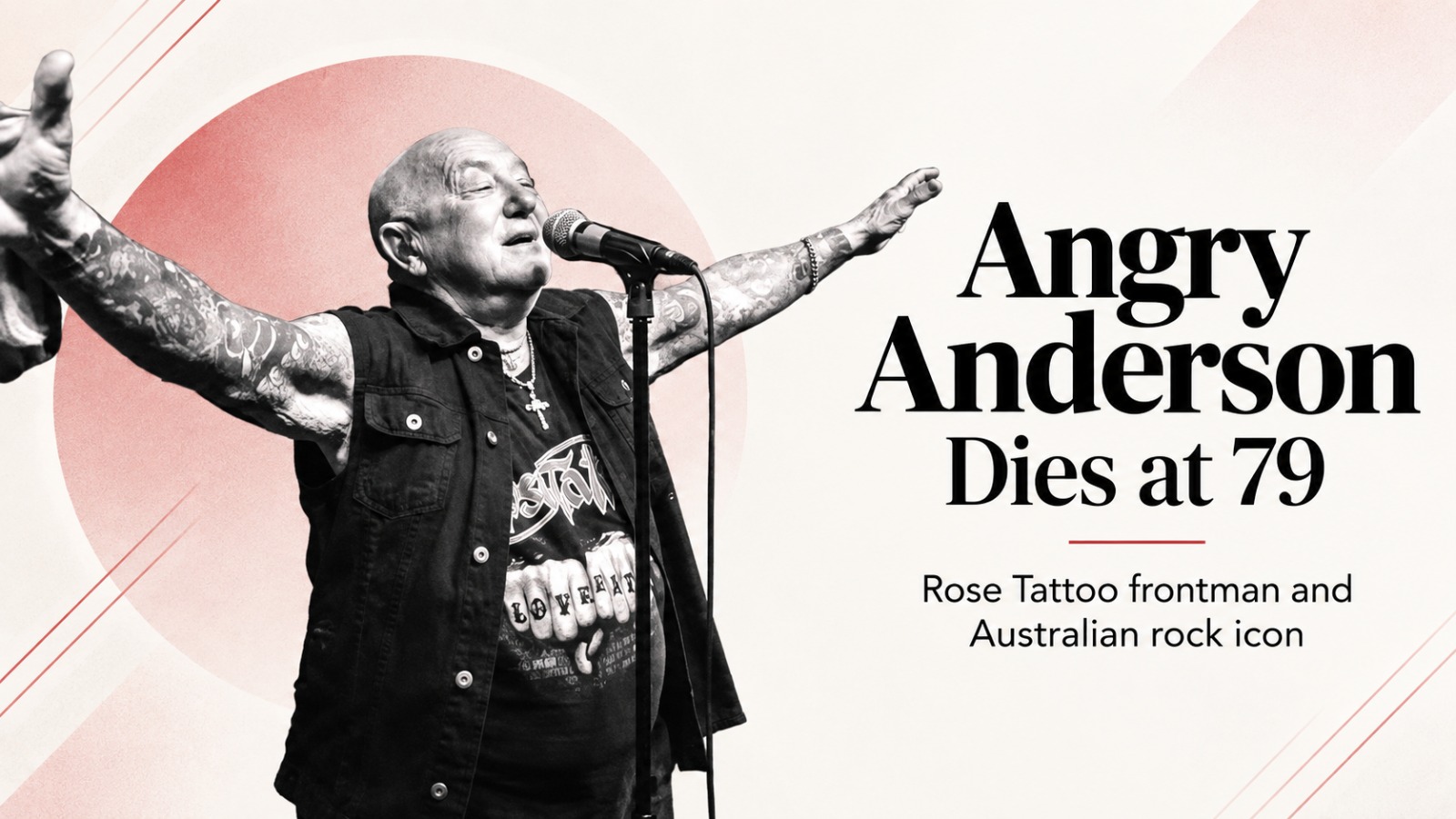
The Australian singer, born Gary Anderson aka Angry Anderson, spent five decades in music, carried Rose Tattoo from the pub-rock circuit to international recognition and found an unlikely second life for his voice through the ballad “Suddenly”.
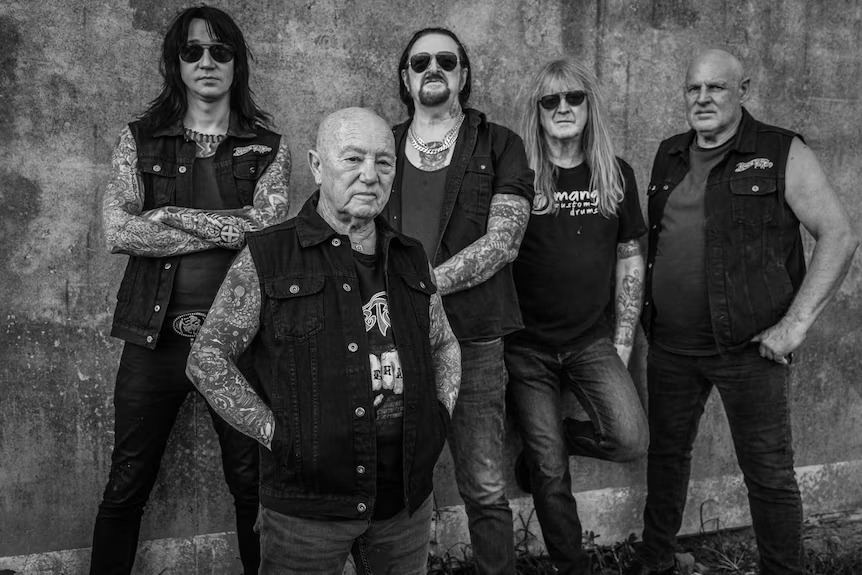
Angry Anderson, the unmistakable voice of Australian hard-rock band Rose Tattoo, has died aged 79, bringing to a close a career that stretched across five decades of music, film, television and community work.
Anderson, whose real name was Gary Anderson, died on Monday, September 21, surrounded by loved ones in Australia, according to a statement issued by his family and Rose Tattoo bandmates.
“Angry was a devoted father, and much-loved bandmate, friend, and member of the wider music and entertainment community,” the statement said, adding that his loss would be felt in Australia and overseas.
His family and band have asked for privacy and said they would not be giving interviews. The statement announcing his death did not specify a cause.
The news comes only weeks after a health emergency brought Rose Tattoo’s European tour to an abrupt end.
A final tour interrupted
Anderson suffered a cardiac arrest in August while Rose Tattoo was touring Europe. He was admitted to hospital in Germany, and the band subsequently abandoned the remainder of the European leg of its 50th anniversary tour.
Rose Tattoo publicly confirmed on August 31 that Anderson had suffered a cardiac arrest and was receiving treatment, while asking supporters to respect the privacy of the singer and his family.
Nine reported that nine European shows were still to be played when the tour was cancelled, with the run scheduled to finish in Busdorf, Germany, on August 21.
For a performer who had spent so much of his life on stage, it proved to be a sudden interruption to another chapter of touring.
The boy from Coburg who found an outlet in music
Anderson was born in Melbourne on August 5, 1947, and grew up in Coburg. His mother had moved to Australia from Mauritius while pregnant with him.
Some of the most revealing stories about his early life had little to do with rock-star mythology.
In a 2009 interview with ABC’s Talking Heads, Anderson recalled his mother trying to scrub his first tattoo from his skin. He remembered seeing tears in her eyes and realising he had broken her heart.
He also spoke openly about a difficult childhood and his strained relationship with his father. School brought its own challenges. Anderson said he loved English and reading even though he was expected to become a fitter and turner, and recalled being bullied as other boys grew taller while he remained 156 centimetres tall.
Music became somewhere to put the anger.
Anderson said it gave him an outlet for the angst and aggression that had earned him the nickname “Angry Ant”. His early band Buster Brown formed in 1973 before breaking up two years later.
He joined Rose Tattoo in 1976.
What followed was a sound that was loud, confrontational and difficult to confuse with anybody else. Anderson later described the group as fundamentally a blues band that simply liked playing things “really, really fast and very loud”.
Songs including Bad Boy for Love, Rock ’n’ Roll Outlaw, Nice Boys and We Can’t Be Beaten became part of the band’s catalogue as Rose Tattoo moved beyond Australia’s pub circuit. The group would eventually release eight albums and enter the ARIA Hall of Fame in 2006.
Their reputation was built as much on attitude as volume. In Rose Tattoo’s early years, Anderson and guitarist Mick Cocks were banned from ABC music program Countdown after swapping chewing gum without using their hands during a performance. An executive mistakenly believed the pair were kissing, and Anderson later recalled finding the reaction hilarious.
Then came “Suddenly”
The harder edges of Anderson’s public persona made his biggest solo success an unusual turn.
While Rose Tattoo was on a break in 1986, Anderson began work on a solo album. With Andy Cichon and Kevin Beamish, he wrote Suddenly, a love song from a singer who said he had never written one before.
The song found a huge audience after being used for Scott and Charlene’s wedding on Neighbours, with the characters played by Jason Donovan and Kylie Minogue.
The Australian Film and Sound Archive has described that 1987 episode as the “royal wedding of Australian soap” and said more than 20 million people watched it across Australia and Britain.
It was an extraordinary cultural detour for the frontman of one of Australia’s roughest pub-rock bands.
Anderson’s solo work also included Bound for Glory, which took him onto the field for a pre-game performance at the 1991 AFL Grand Final.
Life beyond Rose Tattoo
Anderson’s career eventually stretched well beyond recording studios and concert stages.
He appeared in Australian television productions and had a role in Mad Max Beyond Thunderdome, the film starring Tina Turner.
Television also gave him a platform for work of a very different kind. After becoming involved in social outreach, he took on a youth affairs role on Ray Martin’s Midday. One of his early reports examined child sexual abuse and included conversations with survivors as well as convicted offenders. Anderson later publicly disclosed that he had himself experienced abuse as a child.
His charity work extended to projects supporting children, young people, people affected by HIV/AIDS, people with disabilities and drought-stricken farmers. He was also associated with organisations including the Starlight Children’s Foundation, Canteen, Camp Quality and Make-A-Wish.
In 1993, Anderson was made a Member of the Order of Australia for his work as a youth advocate. Years later, speaking about the honour, he said he intended to spend the rest of his life earning it.
A public figure, but also a father
Fatherhood was another turning point Anderson spoke about with unusual openness.
He recalled meeting his first daughter, Roxanne, two weeks after she was born because Rose Tattoo had been on tour. Looking into her eyes, he said, changed him from a “wild, out-of-control rock dog” into someone thinking about ordinary family life.
Anderson and Lindy Michael had four children. Their son Liam died in 2018 at the age of 26. Anderson later told the court proceedings that followed that the death had left him “condemned to a life of sadness”.
That contrast ran through much of Anderson’s life in public. The bald head, tattoos, gravel-edged vocals and confrontational stage presence made him instantly recognisable, but the stories he told about himself often returned to family, childhood, affection and the responsibility he felt towards young people.
Rose Tattoo’s statement announcing his death closed with words closely associated with the band: “Stay young, grow strong.”
For Anderson, a performer whose career moved from small Australian pubs to international stages, television screens, film sets and community causes, it is a fitting final line.
Also Read: NAB Outage Explained: Why NAB Internet Banking and Mobile App Are Down