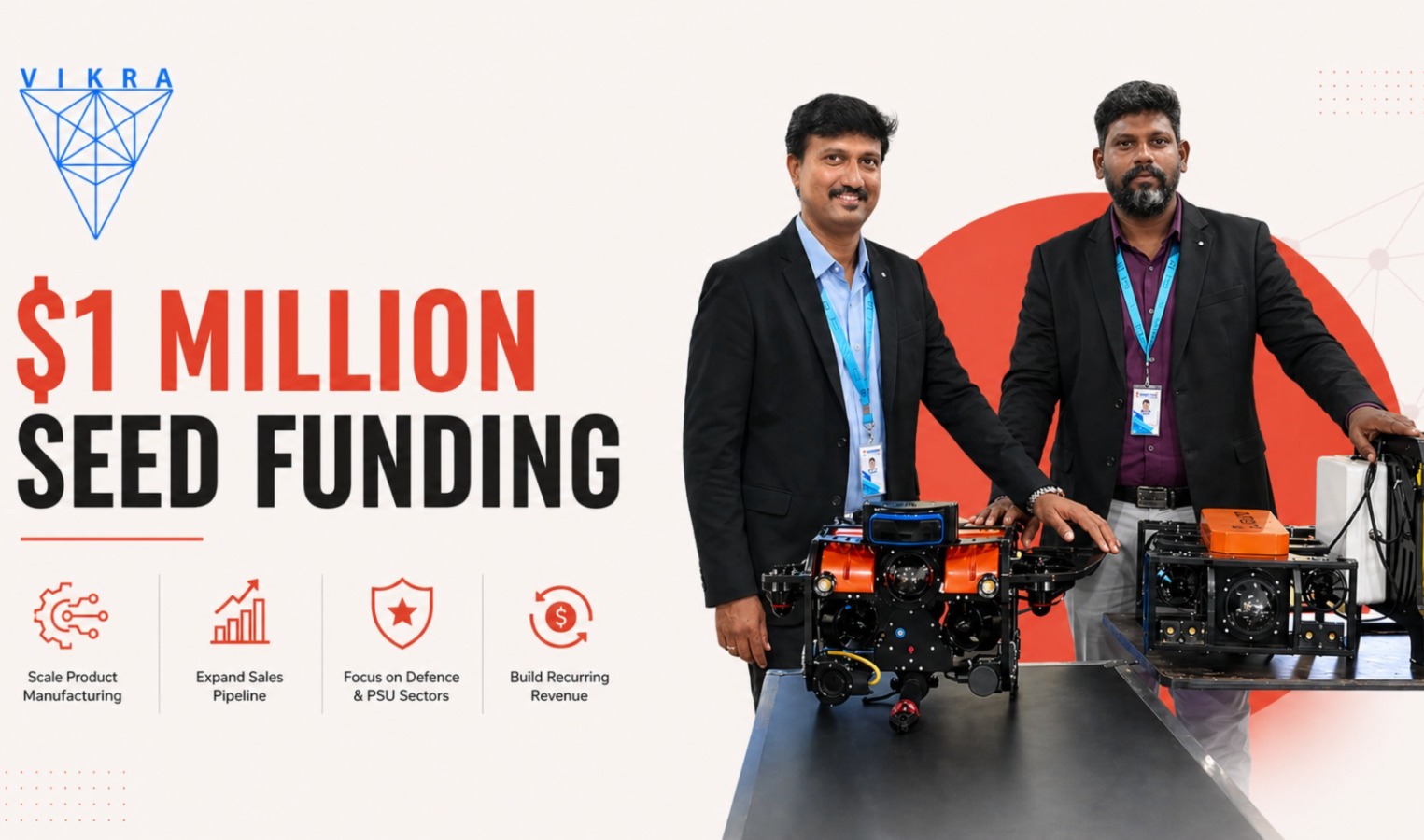
Deeptech startup Vikra Ocean Tech has raised $1 million in a seed funding round co-led by Finvolve and India Accelerator. The company plans to use the newly secured funds to scale its product manufacturing capabilities and expand its sales pipeline, particularly across defence organisations and public sector undertakings. A key focus will also be on building stable and recurring revenue streams as the company moves toward broader commercial adoption.
Building a Homegrown Ocean Robotics Ecosystem
Founded in 2019 by Rajeuv Govindan and Rajagurunathan Krishnasamy, Vikra Ocean Tech is working to develop a fully indigenous and modular ocean robotics ecosystem. Its portfolio includes deep-water remotely operated vehicles, autonomous surface vessels, amphibious crawling robots, and AI-enabled imaging and communication systems.
The company’s technology is designed to function through a unified control platform, allowing multiple systems to work together seamlessly. This interoperability is aimed at simplifying operations and enhancing efficiency across complex marine environments.
Reducing Dependence on Imports in Critical Sectors
A central goal of Vikra Ocean Tech is to reduce India’s reliance on imported underwater robotics solutions. By offering cost-effective and mission-ready systems, the startup is targeting critical applications such as defence operations, subsea infrastructure inspection, hydrographic surveys, and disaster response missions.
Its solutions are tailored to meet the specific needs of Indian conditions, which often differ significantly from global marine environments. This localisation approach is expected to provide both operational and economic advantages to domestic users.
Also Read: Sahi Raises $33 Million In Series B, Valuation Jumps To $200 Million
Integrated Technology Stack for Scalable Operations
The Chennai-based startup has built an integrated hardware ecosystem that supports its robotics platforms. This includes indigenous cameras, advanced lighting systems, diver communication tools, and AI-driven video enhancement technologies.
By developing these components in-house, the company aims to offer a more cohesive and scalable solution. The integrated approach also reduces dependency on external suppliers and enables better customization for different use cases.
Early Traction Across Defence and Commercial Segments
Vikra Ocean Tech reports strong early traction in both defence and commercial sectors. The company has secured two iDEX grants from the Indian Army and the Indian Coast Guard, indicating early institutional validation of its technology.
In addition, it has developed deep-ocean camera and lighting systems capable of operating at depths of up to 2,000 meters. Its autonomous surface vessel systems are also gaining traction in offshore marine exploration, where demand for reliable and efficient unmanned solutions is increasing.
Competitive Landscape in a Growing Sector
The startup operates in an emerging but competitive segment of India’s deeptech ecosystem. It faces competition from players such as Coratia Technologies, Planys, Eyerov, and Sagar Defence.
As demand for underwater robotics grows across defence, energy, and infrastructure sectors, companies in this space are focusing on innovation, cost efficiency, and localisation to gain a competitive edge.
Positioned for Growth in Strategic Marine Applications
With fresh funding and early validation from defence agencies, Vikra Ocean Tech is positioning itself as a key player in India’s push for self-reliance in advanced marine technologies. The company’s focus on modular, interoperable systems and indigenous development could play a crucial role in meeting the evolving needs of both government and commercial stakeholders.
As the marine robotics sector continues to expand, the company’s ability to scale manufacturing and secure long-term contracts will likely determine its trajectory in the coming years.Fresh Capital to Strengthen Manufacturing and Market Reach
Deeptech startup Vikra Ocean Tech has raised $1 million in a seed funding round co-led by Finvolve and India Accelerator. The company plans to use the newly secured funds to scale its product manufacturing capabilities and expand its sales pipeline, particularly across defence organisations and public sector undertakings. A key focus will also be on building stable and recurring revenue streams as the company moves toward broader commercial adoption.
Building a Homegrown Ocean Robotics Ecosystem
Founded in 2019 by Rajeuv Govindan and Rajagurunathan Krishnasamy, Vikra Ocean Tech is working to develop a fully indigenous and modular ocean robotics ecosystem. Its portfolio includes deep-water remotely operated vehicles, autonomous surface vessels, amphibious crawling robots, and AI-enabled imaging and communication systems.
The company’s technology is designed to function through a unified control platform, allowing multiple systems to work together seamlessly. This interoperability is aimed at simplifying operations and enhancing efficiency across complex marine environments.
Reducing Dependence on Imports in Critical Sectors
A central goal of Vikra Ocean Tech is to reduce India’s reliance on imported underwater robotics solutions. By offering cost-effective and mission-ready systems, the startup is targeting critical applications such as defence operations, subsea infrastructure inspection, hydrographic surveys, and disaster response missions.
Its solutions are tailored to meet the specific needs of Indian conditions, which often differ significantly from global marine environments. This localisation approach is expected to provide both operational and economic advantages to domestic users.
Integrated Technology Stack for Scalable Operations
The Chennai-based startup has built an integrated hardware ecosystem that supports its robotics platforms. This includes indigenous cameras, advanced lighting systems, diver communication tools, and AI-driven video enhancement technologies.
By developing these components in-house, the company aims to offer a more cohesive and scalable solution. The integrated approach also reduces dependency on external suppliers and enables better customization for different use cases.
Early Traction Across Defence and Commercial Segments
Vikra Ocean Tech reports strong early traction in both defence and commercial sectors. The company has secured two iDEX grants from the Indian Army and the Indian Coast Guard, indicating early institutional validation of its technology.
In addition, it has developed deep-ocean camera and lighting systems capable of operating at depths of up to 2,000 meters. Its autonomous surface vessel systems are also gaining traction in offshore marine exploration, where demand for reliable and efficient unmanned solutions is increasing.
Competitive Landscape in a Growing Sector
The startup operates in an emerging but competitive segment of India’s deeptech ecosystem. It faces competition from players such as Coratia Technologies, Planys, Eyerov, and Sagar Defence.
As demand for underwater robotics grows across defence, energy, and infrastructure sectors, companies in this space are focusing on innovation, cost efficiency, and localisation to gain a competitive edge.
Positioned for Growth in Strategic Marine Applications
With fresh funding and early validation from defence agencies, Vikra Ocean Tech is positioning itself as a key player in India’s push for self-reliance in advanced marine technologies. The company’s focus on modular, interoperable systems and indigenous development could play a crucial role in meeting the evolving needs of both government and commercial stakeholders.
As the marine robotics sector continues to expand, the company’s ability to scale manufacturing and secure long-term contracts will likely determine its trajectory in the coming years.
Also Read: Parag Agrawal’s Quiet AI Comeback Gets a $2 Billion Signal