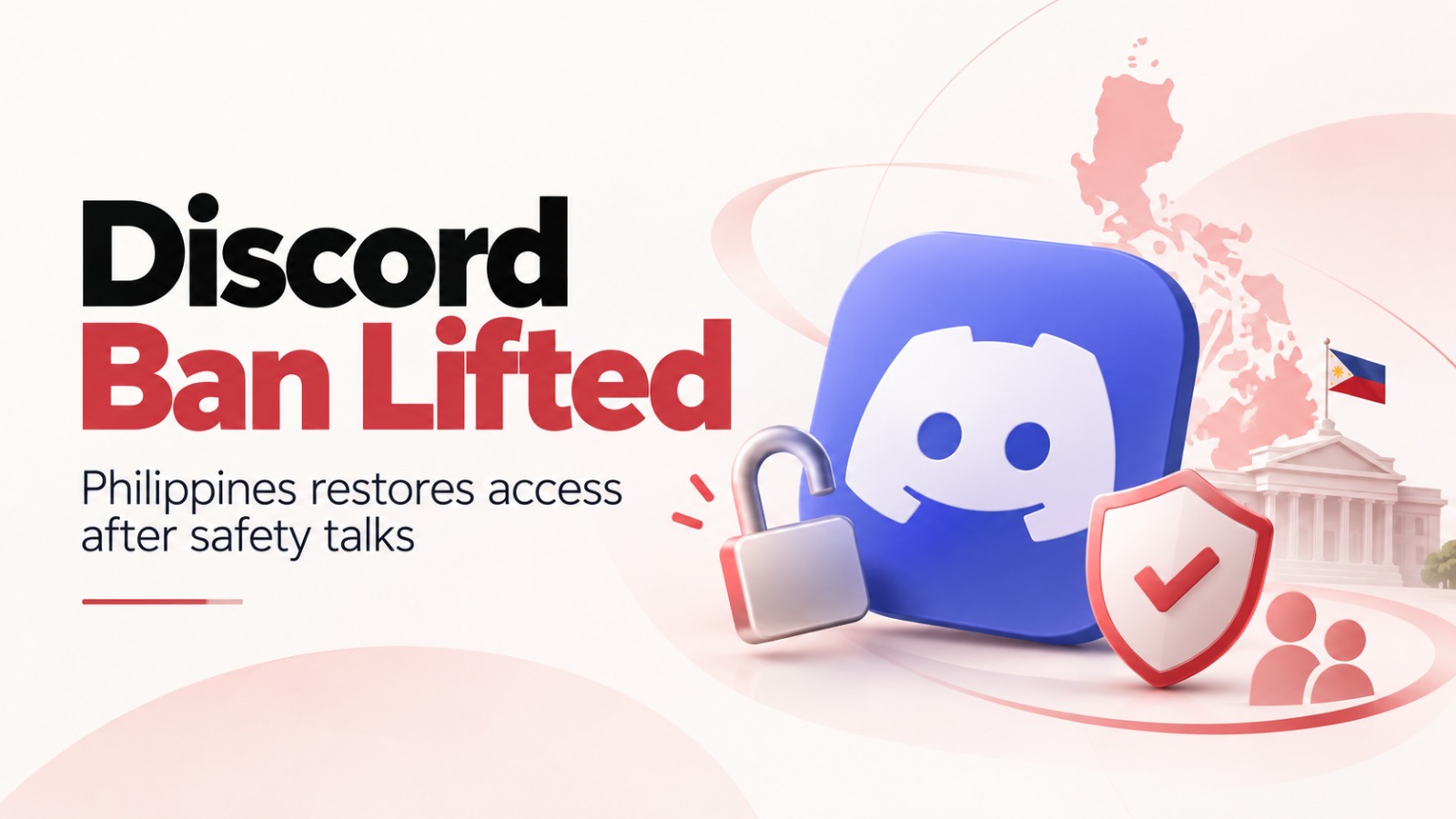
MANILA, Philippines: Discord’s brief ban in the Philippines ended almost as quickly as it began, but the episode was not simply about blocking another social media platform.
At the centre of the dispute were online child safety, faster cooperation with Philippine authorities and the government’s demand for a reliable local point of contact when investigators need information, content removed or action taken against potentially dangerous accounts.
The Department of Information and Communications Technology, or DICT, lifted the restriction on Discord on September 24 after talks between Philippine cybercrime officials and representatives of the platform. The Cybercrime Investigation and Coordinating Center, or CICC, then asked the National Telecommunications Commission to begin restoring access.
What changed was not the existence of the government’s concerns. Instead, Discord gave authorities commitments on how the two sides would work together when child-safety, cybercrime and other serious online threats arise.
Why was Discord banned in the Philippines?
The immediate government concern centred on allegations that Discord hosted servers linked to what authorities described as Nihilistic Violent Extremism, or NVE, as well as spaces allegedly being used to groom minors. Philippine officials said those risks required urgent intervention.
DICT Secretary Henry Aguda also pointed to Discord’s encrypted communications as part of the child-safety concern. He acknowledged that encryption has legitimate cybersecurity uses, while questioning its role in communications involving minors. He contrasted Discord’s encrypted communication with services where conversations can be more readily monitored by parents.
The government’s stated legal rationale was also significant. Aguda said the action was not, in the government’s view, a freedom-of-expression issue. He said authorities were relying on the state’s responsibility under the parens patriae doctrine, the principle under which the state may act to protect people who are considered unable to fully protect themselves, particularly children.
CICC Executive Director Renato Paraiso separately said the blocking was connected to efforts to counter violent extremism and protect children from grooming into violence.
These were the government’s stated reasons for the intervention. They should not be read as a finding that Discord itself created or endorsed such activity.
The dispute began with a 24-hour deadline
The ban was preceded by a much broader regulatory demand.
On September 22, the CICC gave both Discord and Reddit 24 hours to designate a resident agent or local representative in the Philippines. The purpose, according to authorities, was to make Philippine jurisdiction and communication with the companies more effective when urgent cases arise.
Rappler reported that the government wanted a Philippine presence because officials were seeking quicker response times in emergencies, including cases requiring content or account takedowns.
That distinction matters. The argument was not simply that a global platform needed an office for administrative reasons. Philippine officials wanted a dependable mechanism through which investigators could rapidly reach someone empowered to respond.
How was the Discord ban actually implemented?
The restriction was carried out through the National Telecommunications Commission.
Telecommunications companies and internet service providers began excluding Discord’s URL at around 5 p.m. on Wednesday, turning the government’s warning into a service disruption for users in the Philippines.
The restriction lasted only for hours.
That short duration is important because the Discord episode was less a prolonged platform prohibition than a rapid escalation in a regulatory confrontation that moved from deadline, to blocking, to direct negotiations and restoration.
What did Discord agree to for the ban to be lifted?
There was no indication in the supplied reporting of a single formal “deal” document with a fixed list of contractual conditions.
Instead, authorities described a set of operational commitments and cooperation mechanisms that emerged from discussions with Discord.
The most important was the creation of what Philippine officials called a “green lane.”
The green lane is intended to give Philippine authorities a direct route for flagging potentially harmful material to the platform for expedited review and possible removal. Officials also said it would help investigators obtain faster responses when trying to identify threat actors.
Rappler similarly reported that the arrangement would allow government agencies to raise concerns directly with Discord representatives and streamline investigation requests.
In practical terms, this appears to have addressed one of the government’s central complaints: that dealing with a global platform during an urgent cybercrime or child-safety investigation could take too long.
What kind of content would the faster process cover?
The proposed fast-track mechanism was described as covering several categories of potentially harmful or illegal material.
These included:
- online sexual abuse and exploitation of children, or OSAEC
- child sexual abuse and exploitation material, or CSAEM
- scams
- misinformation
- harmful content
- material associated with NVE
The inclusion of this wider list shows that the dispute had expanded beyond the specific allegations that prompted the immediate block. The government was attempting to establish an ongoing process for future cases as well.
Discord also offered its existing safety and law-enforcement tools
Discord representatives did not limit their response to the proposed green lane.
Discord Senior Public Policy Advisor Vasundhara Singh said the company was prepared to brief Philippine officials on its newly introduced Global Teen Experience, which includes age-assurance measures designed to place teenage users into age-appropriate settings by default.
Discord also offered to brief authorities on its Family Center features and Kodex, a system through which law-enforcement agencies can submit lawful takedown and data requests and receive expedited responses.
Taken together, those commitments gave the Philippine government something closer to the response structure it had been seeking: designated channels, faster escalation procedures and clearer ways for law enforcement to submit requests.
Why did the government lift the Discord ban so quickly?
The turning point was direct engagement between the CICC and Discord.
Paraiso confirmed that the ban was lifted after officials held talks with Discord management and outlined concrete steps to improve cooperation. The CICC then asked the NTC to start the process of restoring access.
The Philippine News Agency similarly reported that the DICT lifted the ban after Discord committed to cooperate with authorities on online child-safety measures.
So the ban was not lifted because the government withdrew its child-safety concerns. It was lifted after officials said they had secured a faster and more direct channel for dealing with those concerns.
What happened to Reddit?
Reddit was part of the same 24-hour ultimatum, but the sources provided do not describe an equivalent hours-long blocking of Reddit.
Reddit committed to establishing an office in the Philippines and creating a team to coordinate with the CICC. No specific timeline was given.
That makes the two platforms part of the same regulatory push, but not identical cases.
The ban also exposed how widely Filipinos use Discord
The government action had consequences beyond gaming.
Discord may still be closely associated with gaming communities, but reporting from MindaNews showed how it has become embedded in work, remote employment, education, relationships and community organising in the Philippines.
Virtual assistant John Elfreth Geromiano Bongon told MindaNews that remote workers use Discord to communicate with clients, organise discussions through servers and channels and even discover employment opportunities.
The platform was also being used by debate communities for tournament coordination and by people maintaining long-distance relationships through video calls and shared online activities.
That broader reliance helps explain why even a short-lived restriction generated immediate criticism.
Watchdogs questioned the use of a blanket ban
Scam Watch Pilipinas opposed blocking the entire platform, arguing that the measure also affected legitimate Filipino users working in virtual assistance, freelancing, education, technology, gaming, content creation and professional communities.
The organisation argued that authorities should focus on harmful material and criminal actors rather than block access for every user. It also called for a more proportionate, long-term approach that holds technology companies accountable without making legitimate users “collateral damage.”
Democracy.net.ph raised a separate civil-liberties concern, arguing that platforms used by extremist actors should not automatically be treated as the cause of extremism and questioning the executive branch’s authority to threaten or block services during negotiations.
Those criticisms do not resolve the legal debate, but they illustrate the central tension exposed by the Discord episode: how governments respond rapidly to genuine online-safety concerns without disrupting legitimate work, communication and communities that depend on the same platform.
What the Discord ban ultimately changed
The lasting significance of the Discord episode may therefore be less about the few hours when the platform was inaccessible and more about the regulatory arrangement that followed.
Philippine authorities wanted three things that repeatedly appear across the government’s statements: a reachable local representative, faster escalation channels and quicker action when serious online threats are reported.
Discord’s willingness to cooperate, participate in a green-lane mechanism and explain its existing safety and law-enforcement systems gave officials enough ground to reverse the restriction.
For Filipino users, that meant access could be restored without the government abandoning its child-safety demands.
For Discord, continued operation in the country now comes with much closer engagement with Philippine cybercrime authorities than existed before the dispute.
And for other global platforms, the episode offers a clear indication of what Philippine regulators are increasingly asking for: not merely access to a corporate email address, but a functioning local pathway for urgent law-enforcement and online-safety cases.
Also Read: Xiaomi 18 Pro and Pro Max: Battery, Camera, Display, Launch Date and Everything We Know