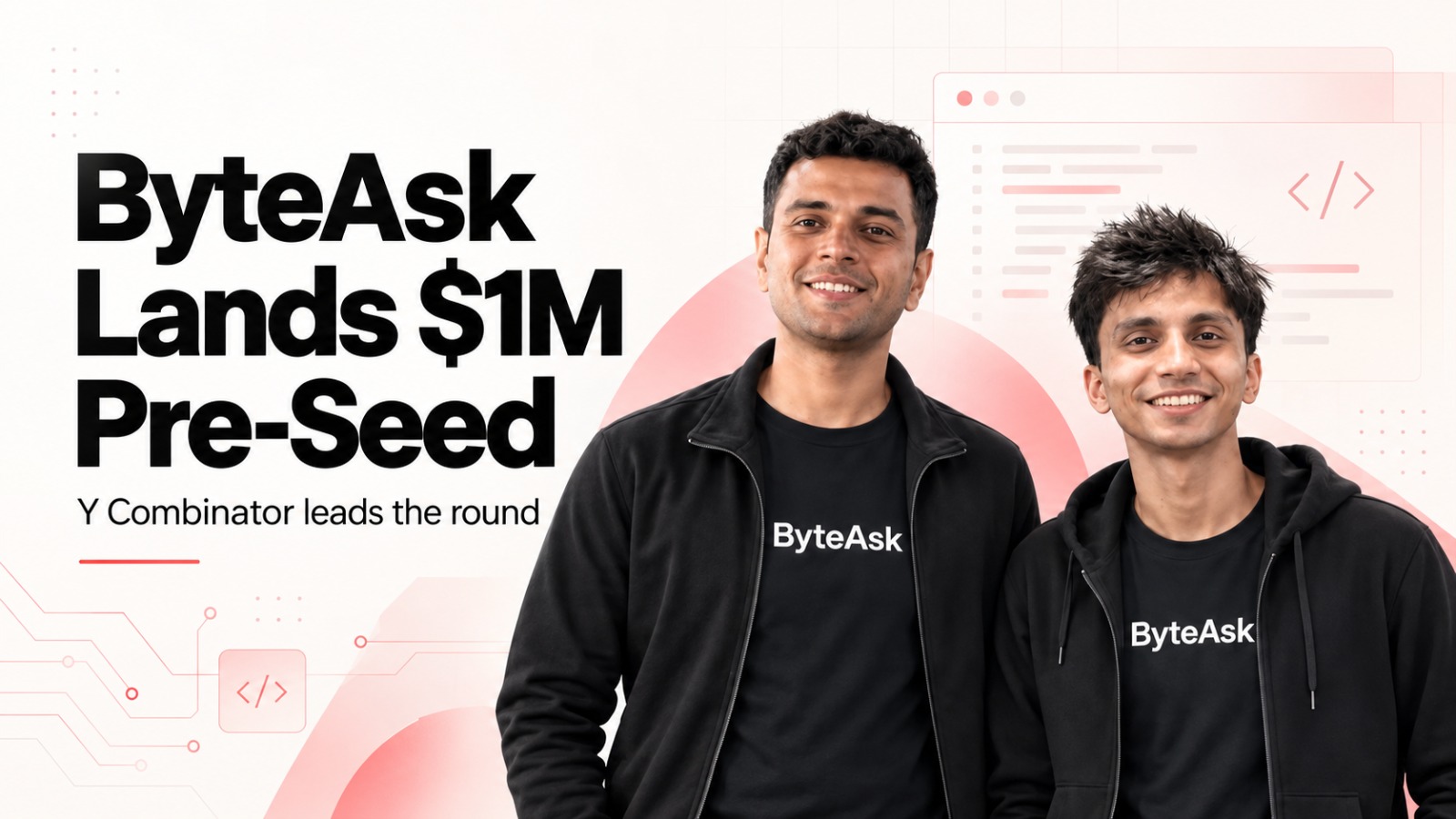
The Anirudha Kulkarni and Pratyush Saini-founded startup is building AI coding agents for C and C++, with an initial focus on engineering teams working on performance-sensitive and mission-critical software.
ByteAsk has raised $1 million in a pre-seed funding round led by Y Combinator and Entrepreneur First, with participation from angel investors. The fresh capital will go towards product and infrastructure development as the startup builds AI coding tools aimed specifically at C and C++ engineering.
Founded by Anirudha Kulkarni and Pratyush Saini, ByteAsk is developing AI coding agents for engineers working on software where reliability, performance and correctness carry greater weight. Its target use cases span areas including aerospace, robotics, high-frequency trading, finance, embedded systems and automotive applications.
The company is taking a narrower path than general-purpose AI coding assistants. Its focus is on the particular challenges involved in C and C++ development, especially in environments where mistakes can have a direct impact on system behaviour or performance.
Kulkarni and Saini have also worked together before. The founders previously built LawSutra AI, a legal AI startup that was later sold to Manupatra.
Funding to go into engineering, compute and infrastructure
ByteAsk plans to use the pre-seed capital to strengthen both its product and the infrastructure behind it. The company intends to hire across engineering, spend on GPU compute and training data, and invest further in enterprise-grade security and privacy infrastructure for customers.
That enterprise focus is also reflected in its initial go-to-market plans. ByteAsk intends to target large companies in areas such as high-frequency trading, automotive and embedded systems before moving into adjacent markets.
The startup is betting that specialised tooling can perform better in these environments than coding agents built primarily for broader programming workflows.
ByteAsk has also shared an early technical benchmark to support that approach. In a test based on real firmware engineering tickets, the company said a smaller model using its grounding environment was able to resolve 89% of tickets, compared with 61% for the best model it tested without that environment. The figures are ByteAsk’s own benchmark results and have not been independently validated in the material reviewed.
A C++-trained model is next on the roadmap
One of the more notable parts of ByteAsk’s roadmap is its plan to go deeper into C++ rather than treating the language simply as another addition to a general coding assistant.
The startup is developing a post-training approach for C++ and plans to release a language model trained specifically for C++ within the next six to eight months.
That timeline gives the newly raised round a clear technical objective. Rather than using the funding only to expand an existing coding assistant, ByteAsk is putting resources into specialised models, training data, compute and infrastructure built around a defined set of engineering problems.
The company has also cited industry estimates placing annual engineering salary spend associated with C++ at around $400 billion, while describing agentic coding as a roughly $10 billion opportunity. These figures are estimates cited by ByteAsk rather than independently verified market-size calculations.
For ByteAsk, the next phase will therefore centre on whether a specialised approach to C and C++ development can translate into broader adoption among enterprise engineering teams. With fresh pre-seed funding in place and a C++-focused model already on its roadmap, the startup is choosing a technically demanding corner of AI-assisted software development as its starting point.
Also Read: Meta VR Glasses: All About Price, Weight, Features, Launch Date and Muse Charm