Meta VR Glasses launch in spring 2027 with a 5K micro-OLED display, eye and hand tracking, controller-free navigation and built-in Meta AI. Mark Zuckerberg also revealed Muse Charm, a keychain-sized device designed to put the company’s AI agent within speaking distance without opening a phone.
Meta is trying to make virtual reality feel less like wearing a computer on your head.
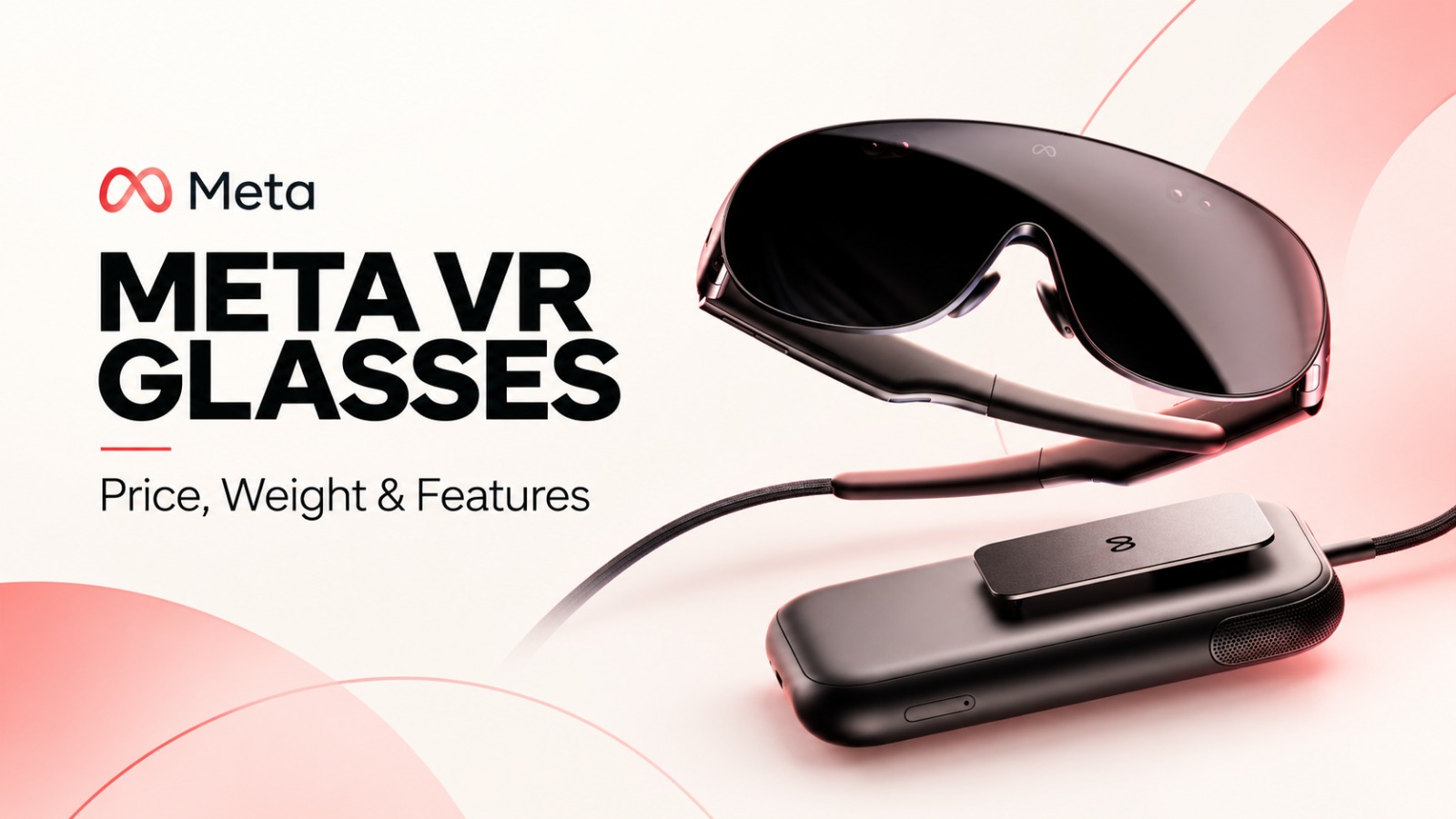
At Meta Connect 2026, CEO Mark Zuckerberg unveiled the company’s new Meta VR Glasses, a roughly 100-gram device that takes an unusual approach to one of VR’s oldest problems: weight. Instead of squeezing the processor, battery and storage into the glasses themselves, Meta has moved those components into a separate puck that can be clipped to a pocket or bag. The glasses remain connected to it through an optical tether.
The result is a pair of VR glasses that Meta says are about five times lighter than the Quest 3. They are expected to go on sale in spring 2027 for $1,299.99.
That lighter design is only one part of Meta’s pitch. The company is also trying to broaden what people might actually do inside VR, moving beyond gaming into films, work, video calls, live sports and AI-assisted computing.
Meta VR Glasses: A 5K display without the usual headset bulk
The Meta VR Glasses use what the company calls a 5K Infinite Display, built around micro-OLED panels. The display delivers 57 pixels per degree and supports Dolby Vision, while the glasses also include spatial audio.
What makes the hardware different is where the heavy lifting happens.
The glasses themselves carry the display and sensors. Processing, battery and storage are handled by the connected external puck. By splitting the system in two, Meta has been able to reduce the amount of hardware sitting directly on the wearer’s face.
Meta is also doing away with the need for traditional handheld controllers for many interactions. Users can operate the interface through voice commands, eye movements and hand gestures, including opening applications, adjusting virtual workspaces and searching. The company says Meta AI is integrated directly into the operating system.
The glasses can also connect to Mac or Windows computers for work, allowing virtual screens to be placed around the user. Meta has shown a system that can turn a flat surface into a virtual keyboard and touchpad, while multiple virtual displays can be arranged around a workspace.
Meta is pitching VR as a cinema as much as a gaming device
Gaming remains part of the product, but Meta’s presentation suggests the company wants the glasses to spend just as much time playing films and sports.
More than 75 games are expected to be available around launch, alongside access to the Meta Quest catalogue. Xbox Cloud Gaming support will also allow games to be streamed to the glasses using a Bluetooth gamepad.
Entertainment, however, appears to have received equal billing.
Meta says the glasses will become the first IMAX Enhanced-certified VR device, with support for selected films in IMAX’s expanded aspect ratio. The company is also working with Disney on 3D and immersive experiences involving titles including Avengers: Infinity War and Star Wars: A New Hope.
Amazon Prime Video, YouTube, DIRECTV, AMC+, Crunchyroll, Plex and Tubi were among the services named in connection with the device, while Peacock, HBO Max and Paramount+ are expected to offer 3D media catalogues.
Meta also demonstrated holographic video calls designed to create a virtual representation of the person on the other end of a conversation.
Sports form another part of the plan. Meta is working with ESPN on immersive broadcasts featuring 8K streaming and 180-degree views. The company says users could eventually have access to more than 500 immersive live sporting events each year, with partners including MLB, NBC Sports, TNT Sports and UFC.
Then Zuckerberg pulled an AI device out of the VR story
The more unusual reveal came toward the end of the keynote.
Zuckerberg introduced Muse Charm, a compact device designed specifically around Meta’s Muse personal AI agent. Small enough to sit in a pocket or attach to a keychain, the device is intended to let people speak with Muse without first reaching for a phone or opening the Muse application.
The device combines Muse with Meta’s real-time voice model. It can also use the user’s surroundings as context during conversations, according to details shared at the event.
For now, Muse Charm is much earlier in its product cycle than the VR glasses. Only a small number of working units have been built. Zuckerberg said Meta was aiming to have it ready to ship around the holiday season in December, but the company has not announced a price or a firm commercial release date.
Meta has also been expanding what Muse can do, including travel-related functions, bookings, reservations and food and drink ordering through integrations involving OpenTable, Spotify and Ticketmaster.
A broader hardware push around AI
The VR glasses and Muse Charm were not the only products shown at Meta Connect 2026.
Meta also introduced Ray-Ban Meta Audio, a camera-free pair of smart glasses with music playback, calling and AI-assistant features. They are expected to launch in October at $349. Meta also announced third-generation Ray-Ban Meta glasses with a slimmer design and longer battery life, priced at $449.
Taken together, the announcements show how Meta is spreading AI across several kinds of hardware rather than keeping it confined to an app or a conventional headset.
The most immediate change is physical. With Meta VR Glasses, the company has removed much of the computing hardware from the user’s head and placed it in their pocket. With Muse Charm, it is attempting almost the reverse: taking an AI assistant out of the phone and turning it into a small object people can carry wherever they go.
Whether either form factor becomes an everyday habit will only become clearer once the products reach consumers. For now, Meta has put two very different ideas on the table: a 100-gram VR system built around an external computing puck, and an AI companion small enough to live on a keychain.
Also Read: Morgan Stanley Accidentally Shares 100-Plus Deal Pipeline, Including India IPOs