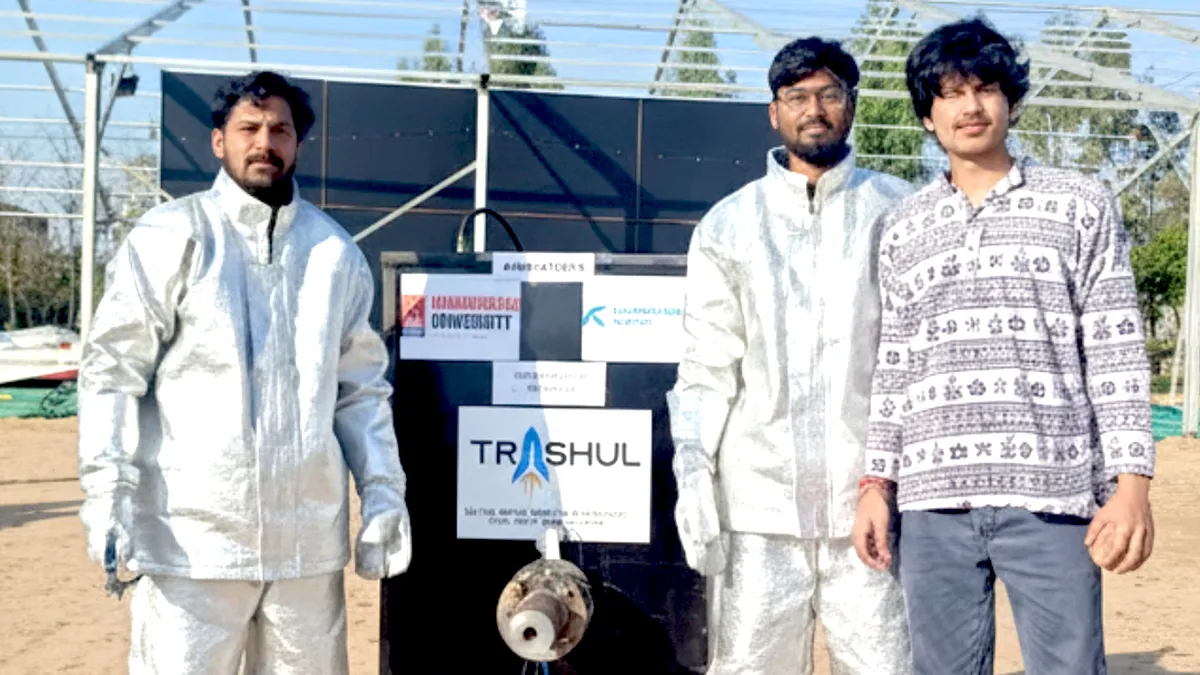
In a major step for India’s fast-growing spacetech sector, Trishul Space has raised ₹4 crore in pre-seed funding, led by IAN Angel Fund, with support from 8X Ventures and ITEL. The round marks a critical early validation for the Prayagraj-based startup, giving it the capital needed to accelerate the development of its liquid-propulsion technology, the backbone of modern launch vehicles.
From College Labs to Cutting-Edge Propulsion
Founded in 2022 by Aditya Singh, Divyam, and Rajat Choudhary, Trishul Space began as a collaboration between young engineers united by a vision: to make India self-reliant in space propulsion.
Their company focuses on liquid rocket engines designed for small-satellite launch vehicles, an area of immense global opportunity as demand for compact and cost-efficient launch solutions continues to surge.
Inside the Engine Room: The Harpy-1 Mission
At the heart of Trishul’s efforts is its flagship project, Harpy-1, a next-generation liquid-propulsion engine designed to deliver high efficiency, modularity, and reusability.
The startup’s engineers are working on one of the toughest parts of any rocket engine: the turbopump system. This high-precision component circulates fuel and oxidizer at extreme pressures, and its success determines both reliability and thrust output. With the new funding, Trishul plans to strengthen its R&D setup, build specialized test rigs, and begin component-level trials to validate each part of the Harpy-1 engine.
Also Read: Meet Beside: The AI That Answers Your Phone
Turning Funding Into Engineering Firepower
The ₹4 crore pre-seed round is more than just a financial milestone, it’s a launchpad for experimentation and validation. Most of the funds will go into building a dedicated test-stand infrastructure, conducting turbopump testing, and refining designs for ground-level hot-fire trials.
This stage, though less glamorous than launches, is where most rocket programs succeed or fail. It involves months of calibration, testing, and data analysis before an engine can safely reach flight-ready status.
An Ecosystem Ready for Take-Off
Trishul Space’s funding aligns perfectly with the broader momentum in India’s private space industry. With new reforms by IN-SPACe and a surge of investor interest in space-hardware ventures, the country’s ecosystem is more welcoming than ever to deep-tech startups.
India’s private launch sector is expanding rapidly, from building satellite buses to full launch systems, and propulsion technology remains the critical missing piece. Startups like Trishul are filling that gap by focusing on indigenous innovation, cost efficiency, and scalable production.
From Blueprint to Blast-Off: What Comes Next
The next chapter for Trishul will be focused squarely on testing and validation. The team is expected to complete subsystem verifications, conduct integrated engine tests, and prepare for small-scale demonstrations.
If successful, these milestones could pave the way for strategic partnerships with satellite manufacturers or small-launcher builders and potentially open the door for a larger Series A round in the future.
For now, Trishul’s focus is simple, to prove that its engineering works, consistently and safely.
A Small Step for Funding, A Giant Leap for Ambition
Though ₹4 crore may look like a small amount when compared to the budgets of international space agencies, it is nevertheless a very important factor for an early-stage hardware startup. In a way, it is an instrument that confirms the feasibility of Trishul’s plan and is a visible sign of increasing investor confidence in India’s ability to manufacture high-quality propulsion systems completely from scratch.
If the startup can successfully demonstrate its Harpy-1 engine and scale its manufacturing capabilities, it could soon emerge as a key contributor to India’s goal of building self-sustaining, affordable access to space.
India’s Propulsion Future Looks Brighter
Trishul Space is the hallmark of the youth of India who are not simply coding but are creating the hardware that is going to be the base of the future. The company becoming successful is very much in line with a change of India’s attitude towards space – a place for human adventures no more, but a field ruled by the brilliance of engineering and private business.
As Trishul prepares for its next series of tests, it carries both the optimism and responsibility of a new India, one that dreams big, builds locally, and aims for the stars on its own terms.
Also Read: Who Is Brendan Foody? The 23-Year-Old Behind $10B AI Startup Mercor