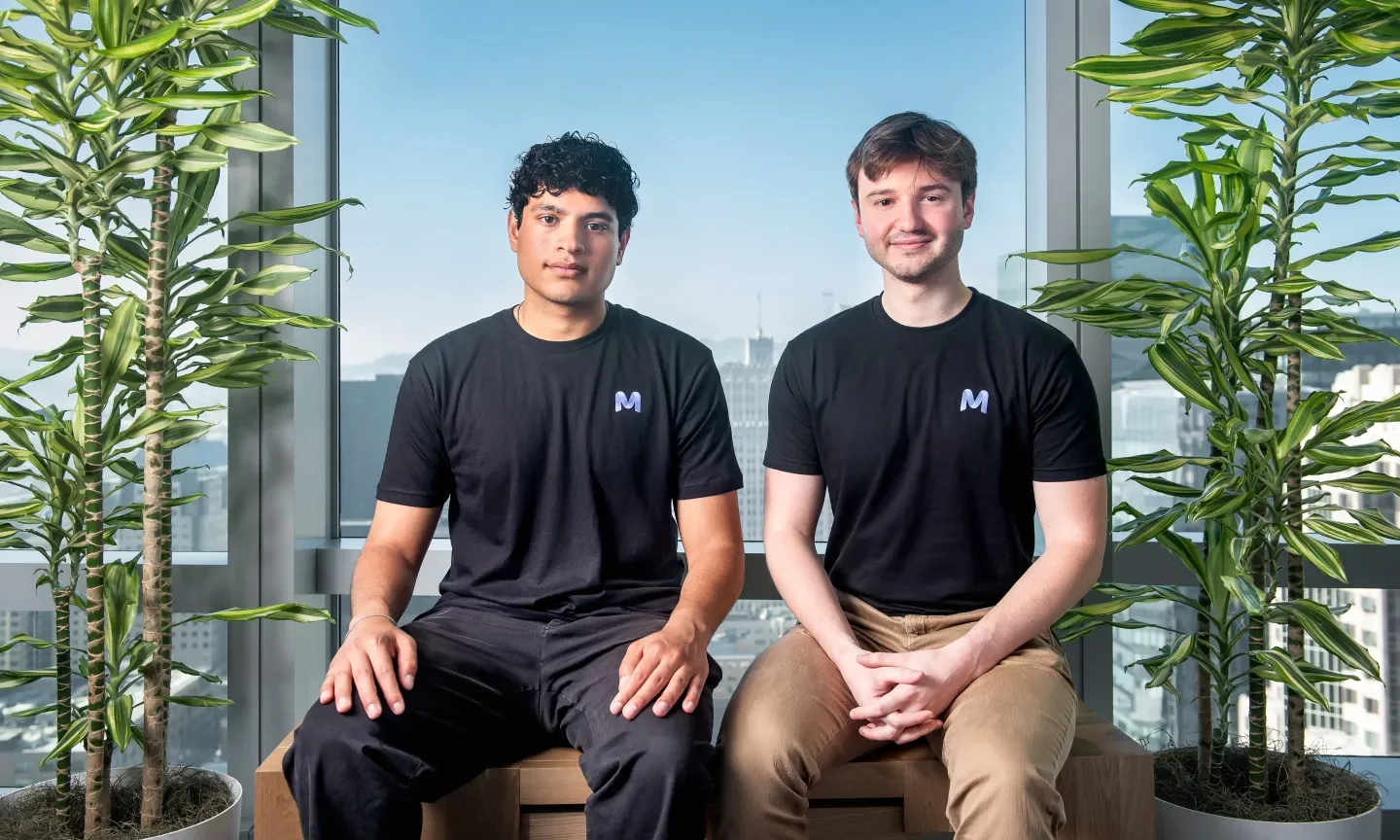
In the spring of 2023, while classmates at Georgetown University were buried in textbooks and exam schedules, 23-year-old business student Brendan Foody quietly chose a different deadline: the moment he stopped showing up for finals and walked out of college for good.

Two years on, that decision has produced one of the most closely watched companies in the AI economy. Mercor, the startup Foody co-founded with his former high-school debate teammates Adarsh Hiremath and Surya Midha, is now valued at around $10 billion, and the trio is among the world’s youngest self-made billionaires.
Their big idea is deceptively simple: use human experts not to compete with AI, but to grade it, turning professional judgment into structured data that trains the next generation of models.
The exam Brandan Foody skipped and the question he couldn’t
Foody enrolled at Georgetown in 2021 to study business administration and economics, but by his second year he was spending more energy on side projects than on coursework. The break point came in his sophomore spring. As he later recalled to Fortune, he had already made up his mind: he wanted to drop out before finals, and simply never went to the exams.
At roughly the same time, an experiment far from Washington, D.C., was changing his sense of what “work” could look like. At a hackathon in São Paulo, Foody and his friends prototyped a marketplace that connected companies with skilled software developers abroad.
The model was straightforward: a firm would pay a weekly fee for an engineer, one early client agreed to $500 a week, Mercor would pass about 70% of that to the developer and keep the remainder as a service fee while handling logistics.
Within nine months, that side project had become a real business with a revenue run rate of about $1 million, an unusually steep ramp-up for a team that was still barely out of college age.
From talent marketplace to human-in-the-loop AI
What began as a cross-border hiring platform quickly morphed into something more ambitious. Both Fortune and The Times of India describe how the founders realised that the same structure that matched companies with talent could be used for a different purpose: evaluating and training AI models using human expertise as feedback.
Mercor now recruits professionals, including consultants, lawyers, bankers, analysts and doctors, to design “evals” and detailed rubrics that test how AI systems perform on real-world assignments.
Instead of asking a model to solve a puzzle, Mercor might have it:
- draft a financial memo,
- analyse a legal case, or
- review a medical chart.
Human evaluators then score each output against strict criteria, with their judgments fed back into the models to refine future performance.
Every completed task, improves both sides of the network: companies get more reliable AI tools, while evaluators contribute their domain expertise and, in the process, help shape smarter systems.
Within nine months of launch, Mercor’s approach had already pushed it to that $1 million revenue run rate; two years later, its model placed it “at the center of the AI economy”, backed by investors who see human-in-the-loop automation as a critical layer in AI deployment.
APEX: Turning white-collar work into a benchmark
At the heart of Mercor’s pitch is APEX, the AI Productivity Index, its proprietary benchmark for measuring how effectively AI performs economically valuable work.
APEX does not test models on abstract maths problems or logic games. Instead, it evaluates them on about 200 tasks drawn from the actual workflows of investment bankers, lawyers, consultants and physicians, the kind of assignments people in those roles complete every day, from writing a financial memo to analysing a legal case.
To build APEX, Mercor assembled a heavyweight advisory group including former U.S. Treasury Secretary Larry Summers, former McKinsey managing partner Dominic Barton, legal scholar Cass Sunstein and cardiologist Eric Topol. Each helped shape the case structures and evaluation rubrics so that the benchmark would reflect the realities of high-stakes professional work rather than stylised test questions.
The Fortune piece frames APEX in Mercor’s own language: it is “great to have 10,000 PhDs in your pocket,” the company says, but even better to have a model that can reliably perform complex tasks such as doing your taxes.
“Teaching them what only humans know”
Foody often describes Mercor’s mission in philosophical terms. In his conversations with Fortune, he argues that the real opportunity is not simply to see what AI can do out of the box, but to “teach” models aspects of human cognition that are hardest to capture in code: judgment, nuance and taste.
In his view, AI is not so much destroying work as reallocating it. As software automates repetitive white-collar tasks, he believes humans will move up the value chain, leaning into roles where they define standards, set rubrics and decide what “good” looks like, effectively becoming supervisors of digital labour.
Foody is blunt about the scale of change he anticipates. He has suggested that as AI advances, it could automate “maybe two-thirds of knowledge work,” freeing up capacity for breakthroughs in areas like healthcare and space exploration.
He also links Mercor’s culture to his personal work ethic. He tells Fortune that he has not taken a day off in three years; even at dinner with his parents, he says, his mind is on the company. For him, work stopped feeling like “work” once he could see the compounding return on each hour invested. “People burn out when they work hard on things that don’t feel compounding,” he says. “I see the ROI of my time every day.”
The youngest self-made billionaire
Fortune has described Foody as the world’s youngest self-made billionaire, a label that reflects both Mercor’s rapid valuation rise and the timing of its founders’ success.
Both accounts emphasise the same turning points: the second-year decision to leave university, the Sao Paulo hackathon that crystallised the initial business model, the nine-month sprint to a seven-figure revenue run rate and the eventual $10 billion valuation that thrust the founders into the billionaire ranks.
Where Mercor sits today is at the intersection of two powerful trends these reports highlight: the mainstreaming of large AI models and the rise of flexible, project-based work. Each new corporate client brings more evaluators into the network, and each evaluator’s judgments generate more data for training models, creating a flywheel that Foody has described as one of the fastest revenue ramps in recent corporate history.
The open question: who benefits from codified judgment?
Mercor’s rise also surfaces questions its own founders regularly confront. If the company’s mission is to “teach” AI how professionals think, what happens to the junior employees whose tasks are being codified and partially automated? Foody acknowledges that people are fearful of being replaced, and, according to Fortune’s reporting, fields frequent questions about the ethics of training AI on work that may displace human roles. His answer is that societies should “bite the bullet” on productivity gains, arguing that every major technological revolution has ultimately improved living standards despite short-term disruption.
For now, Mercor is a live experiment in that theory: a young company, led by a 23-year-old dropout, trying to turn the most intangible parts of human work, judgment, nuance, taste, into something that can be measured, graded and, ultimately, learned by machines.
Whether that bet will pay off for the broader workforce as handsomely as it has for Foody and his co-founders is the next chapter investors, workers and regulators will be watching closely.
Also Read: Meet Beside: The AI That Answers Your Phone