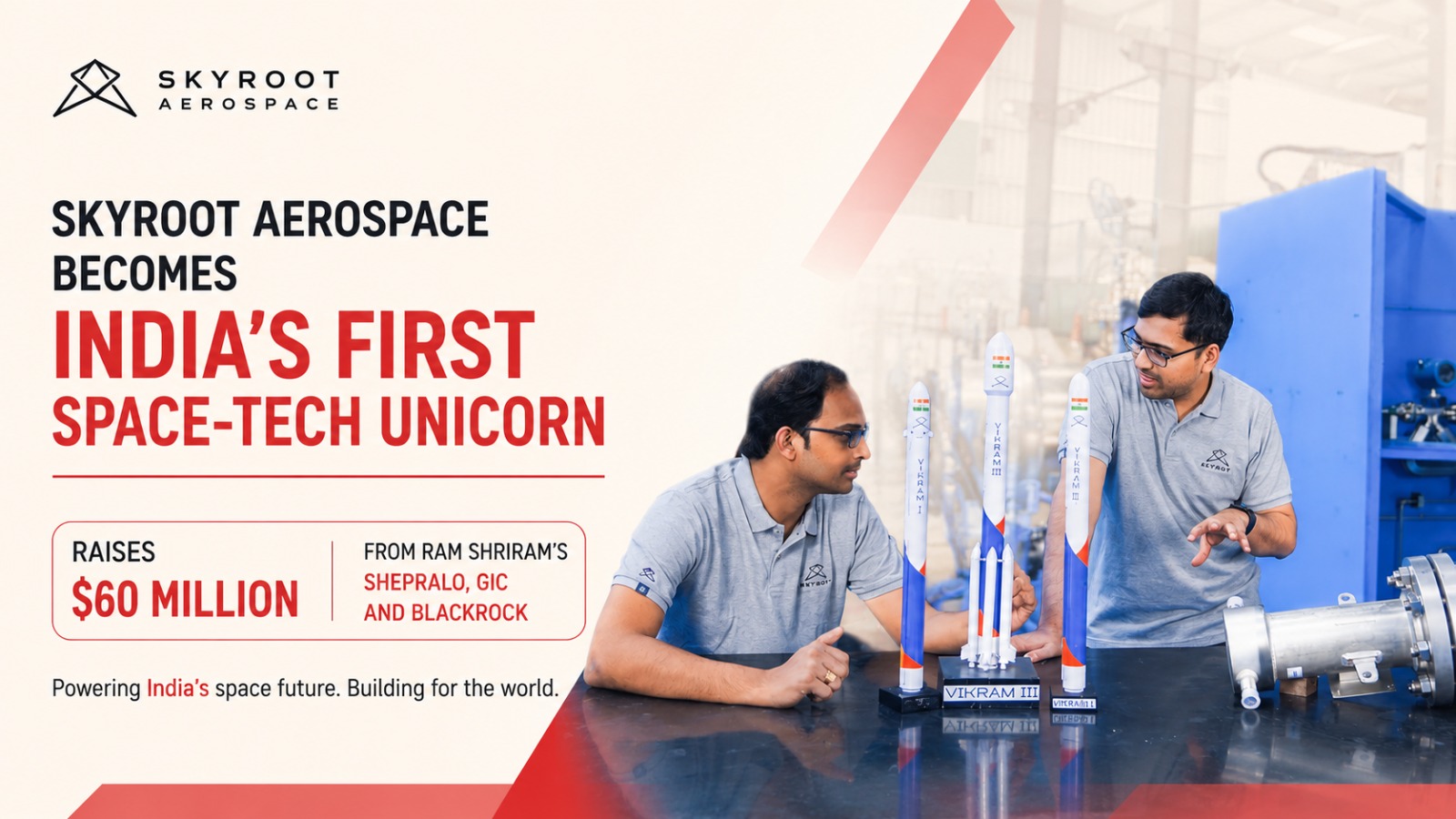
Hyderabad-based Skyroot Aerospace has become India’s first space-tech unicorn after raising $60 million in a fresh funding round backed by Ram Shriram’s Sherpalo, Singapore’s sovereign wealth fund GIC, BlackRock, Greenko Group founders, Arkam Ventures, Playbook Partners, Shanghvi Family Office and other investors.
The round, co-led by Sherpalo and GIC, has valued Skyroot at $1.1 billion, a sharp rise from its reported valuation of around $519 million in 2023.
With this, the private launch vehicle company has crossed a rare milestone for India’s space startup ecosystem: it is now the country’s first privately held space-tech company to be valued at $1 billion or more.
The funding also brings Skyroot’s total capital raised to more than $160 million, or about Rs 1,500 crore.
For Skyroot, the money arrives at a crucial moment. The company is preparing for the upcoming Vikram-1 launch, described by co-founder and CEO Pawan Kumar Chandana as India’s first private orbital rocket. Chandana said the investment reflects confidence from some of the world’s reputed investors in the company’s mission.
Ram Shriram, founder and managing partner of Sherpalo Ventures, will also join Skyroot’s board. Shriram, a board member of Alphabet Inc and one of Google’s earliest backers, said his belief in the Skyroot team has grown stronger as the company moves closer to the Vikram-1 launchpad.
The new capital will be used to build a higher launch cadence for Vikram-1, scale up manufacturing, and develop Vikram-2, a 1-tonne class launch vehicle powered by an advanced cryogenic stage. The company expects Vikram-2 to help expand the range of missions and customers it can serve.
What makes the moment important is not just the valuation. It is the signal it sends about private space technology in India. For years, India’s space story has been led by public institutions. Skyroot’s unicorn status shows that private launch companies are now beginning to attract deep global capital, serious long-term investors, and boardroom attention from some of the biggest names in technology investing.
The company, founded by Naga Bharath Daka and Pawan Kumar Chandana, now sits among India’s best-funded space-tech startups. Its next test will not be the valuation headline, but execution: launching reliably, scaling manufacturing, and proving that India’s private launch sector can move from promise to repeatable commercial performance.
Also Read: India’s Safest SUVs for 2026: Bharat NCAP Releases Latest Rankings