

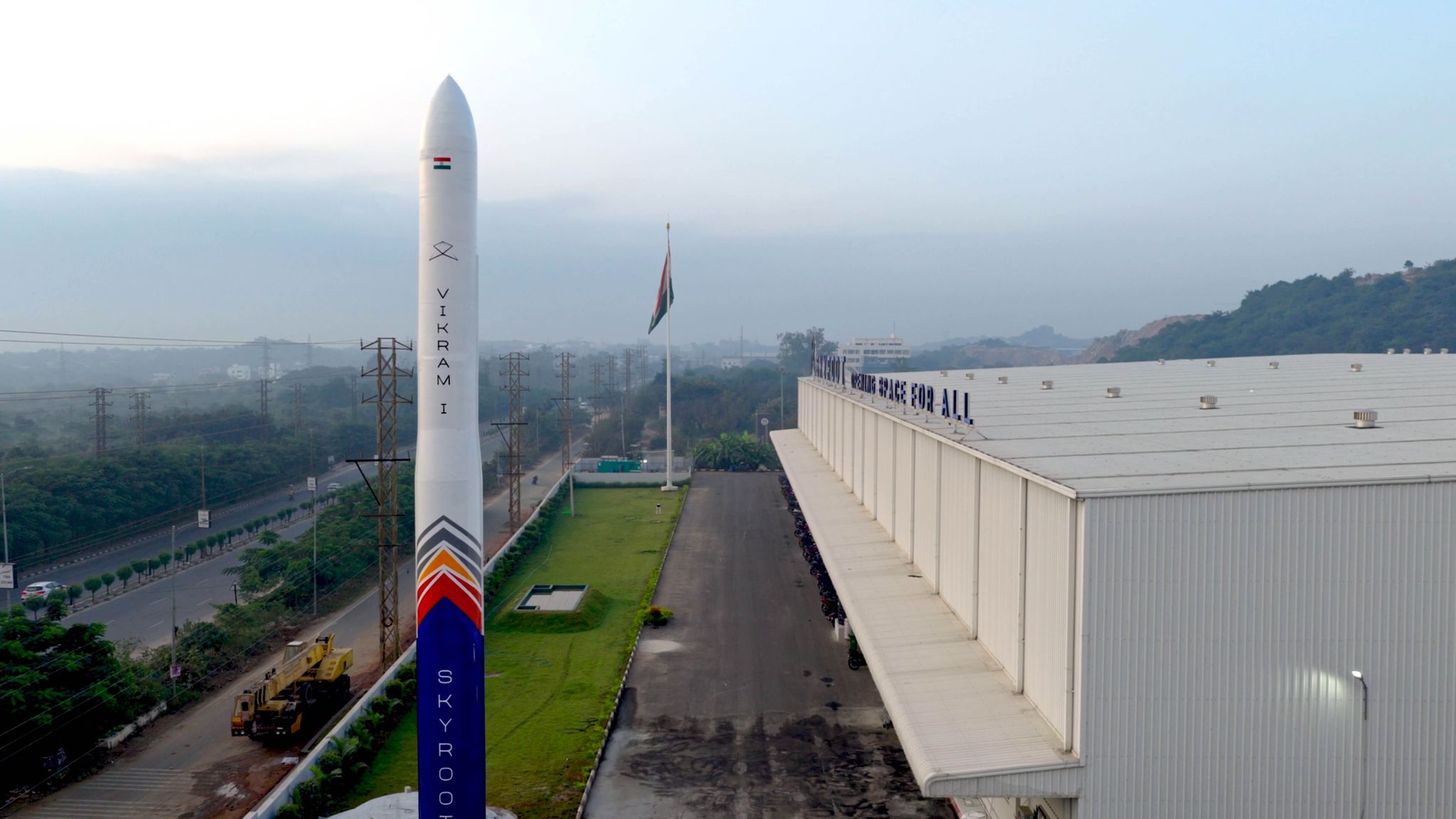
At Skyroot Aerospace’s newly inaugurated Infinity Campus, a 75-foot replica of the Vikram Rocket (Vikram-1) launch vehicle now stands tall, positioned as a permanent reminder of India’s growing private space ecosystem and the audacity of its young entrepreneurs.
Skyroot’s Co-Founder & CEO, Pawan Kumar Chandana, described the structure as “a symbol of India’s rising space aspirations,” sharing an image of the rocket and reflecting on what the moment means for the company and the country.
A Rocket Turned Monument
The Vikram-1 replica is more than a design element on a cutting-edge campus. By placing the rocket at the heart of its Infinity Campus, Skyroot is clearly framing Vikram-1 as the company’s central narrative, the vehicle that carries not just payloads, but the dreams of a new generation of Indian space innovators.
Calling it a “new monument” for Hyderabad, Chandana’s description underlines how space technology is moving from distant launchpads into everyday urban imagination. Where Indian cities once celebrated industrial plants, IT parks and statues, a full-scale rocket now claims its place as an emblem of modern aspiration.
Prime Minister’s Spotlight on Skyroot
The significance of the moment was amplified by the presence of the country’s top political leadership.
Chandana noted that Prime Minister Narendra Modi inaugurated the Infinity Campus and unveiled the Vikram-1 rocket replica, effectively placing Skyroot “in the national spotlight as an inspiration to the country.”
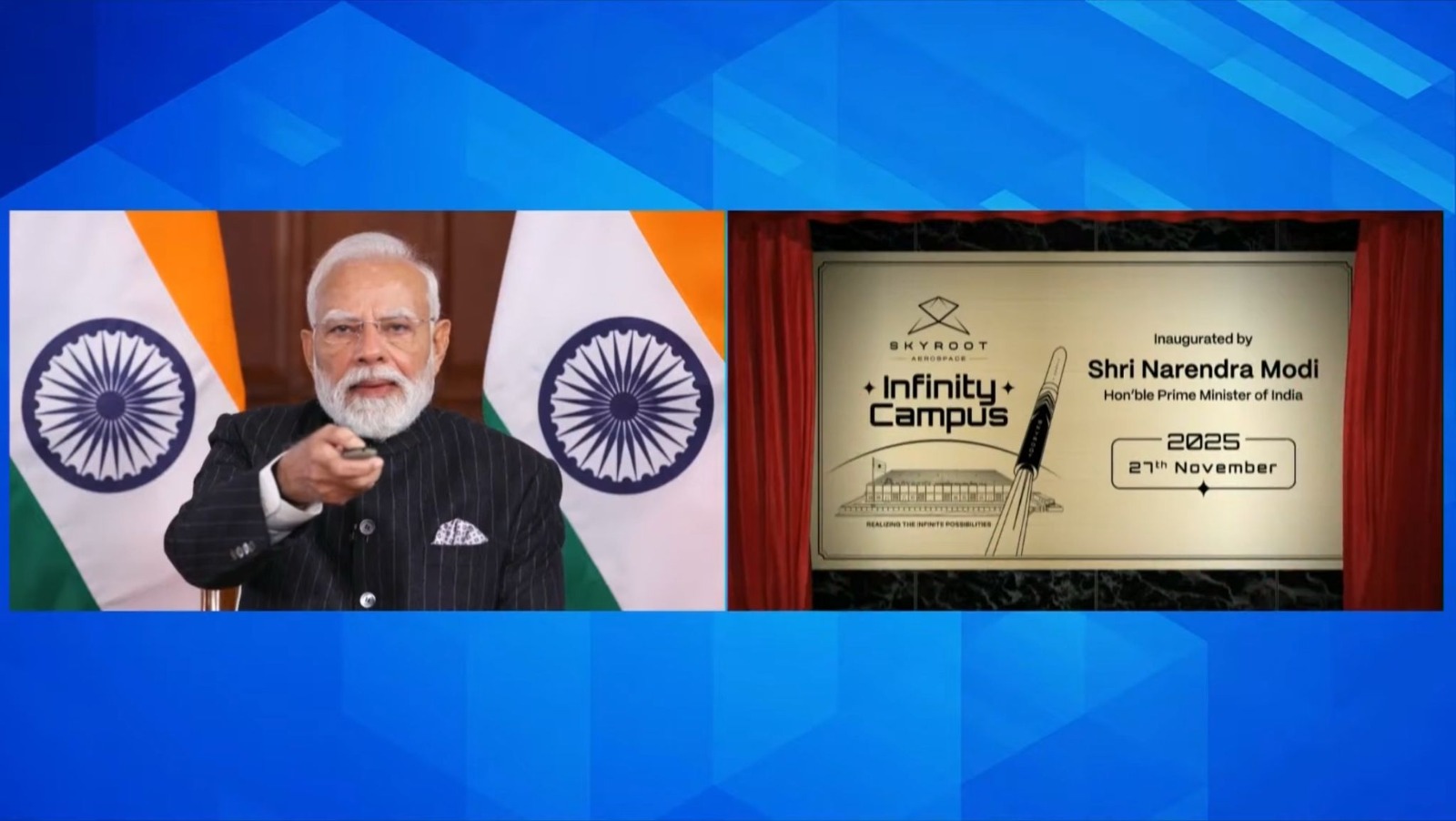
“The head of our nation, the Hon’ble Prime Minister Narendra Modi ji, placed Skyroot in the national spotlight as an inspiration to the country as he inaugurated our Infinity Campus and unveiled Vikram-1 rocket yesterday. It’s unprecedented, and it reflects the importance of the mission we chose and the contribution of every single Skyroot Aerospace member over the years,”
– Pawan Kumar Chandana, Co-Founder & CEO, Skyroot Aerospace
For a private space startup, this is not just ceremonial visibility. It signals political recognition of the role companies like Skyroot are expected to play in India’s next phase of space activity, especially as policy reforms open doors for non-government players in what was once a purely state-driven domain.
A Personal Moment for the Founders
Beyond the optics and symbolism, Chandana framed the event as a deeply personal milestone for him and his fellow Co-Founder Bharath.
He recalled how the Prime Minister appreciated the duo for their risk-taking and belief in their vision:
“When the Prime Minister appreciated Bharath and me for believing in ourselves, taking bold risks, and called us an inspiration to the youth of India, it hits on a whole different level.”
For any founder, especially in a high-risk, capital-intensive field like aerospace, such public acknowledgement from the country’s top leadership is both validation and pressure. Chandana’s words capture that emotional mix, pride, relief, and renewed responsibility.
From Challenges to Responsibility
In his reflection, Chandana connected this recognition to the long, often difficult journey of building a space-tech company in India.
“Moments like these make every challenge along the journey truly worth it,” he wrote, noting that they “remind us of the responsibility we shoulder as a team and inspire us to push boundaries even further.”
The framing is telling. The Vikram-1 monument is not being presented as a capstone achievement, but as a checkpoint, a visible milestone on a much longer road. The emphasis on “responsibility” suggests Skyroot views its work not just as a business, but as part of a national mission in which failure or complacency is not an option.
Vikram Rocket: A Beacon for Young India
While the 75-ft Vikram-1 replica is static, the ideas it represents are anything but.
Through Chandana’s account, Vikram-1 emerges as:
- A symbol of belief in self, in technology, and in India’s ability to compete globally in advanced sectors.
- A signal to the youth that high-risk, high-tech entrepreneurship in India is not just possible, but celebrated at the highest levels.
- A marker of transition from a purely government-led space era to a mixed ecosystem where startups shoulder a portion of the national ambition.
When the Prime Minister called the founders an “inspiration to the youth of India,” it reinforced a narrative that the Vikram-1 structure visually underlines, that the next wave of Indian icons may not be statues of leaders, but machines of the future.
“Our Journey to the Cosmos Has Only Just Begun”
Chandana’s closing line hints at how Skyroot sees the path ahead:
“Deeply grateful to our investors, national and state governments, IN-SPACe and ISRO for empowering our audacious vision. With historic milestones on the horizon, our journey to the cosmos has only just begun.”
The message is deliberately forward-looking. The Infinity Campus, the Vikram-1 monument, and the Prime Minister’s endorsement are framed not as an end in themselves, but as a launchpad, both literally and metaphorically.
For Hyderabad, the new 75-ft Vikram-1 installation adds a distinctive landmark to the city’s tech landscape. For Skyroot, it freezes a historic moment in steel and structure. And for India’s emerging space economy, it stands as a visual declaration: the country’s private rocket dreams are no longer confined to drawings, labs and test stands, they now occupy the skyline too.
Also Read: Poilet’s luxury toilet vans give VIP events a hygiene makeover
















