
The SUTA Story: On a humid evening in Bengaluru’s Indiranagar, two sisters sat at a cafe dreaming out loud. Across the street stood a gorgeous colonial-style building bathed in amber lights. One of them pointed and said, “One day, we’ll open a store right there.”
Months later, that very building became the first physical outlet of their brand, Suta, a startup that began not with a business plan, but with a memory stitched into cotton.
Sujata Biswas and Taniya Biswas did not leave their corporate jobs chasing valuations. They walked away chasing the feel of their grandmother’s sarees, soft, airy, smelling faintly of starch and sunshine drying in the courtyard. From that childhood memory, a bootstrapped ₹6-lakh idea grew into a ₹75 crore handcrafted empire.
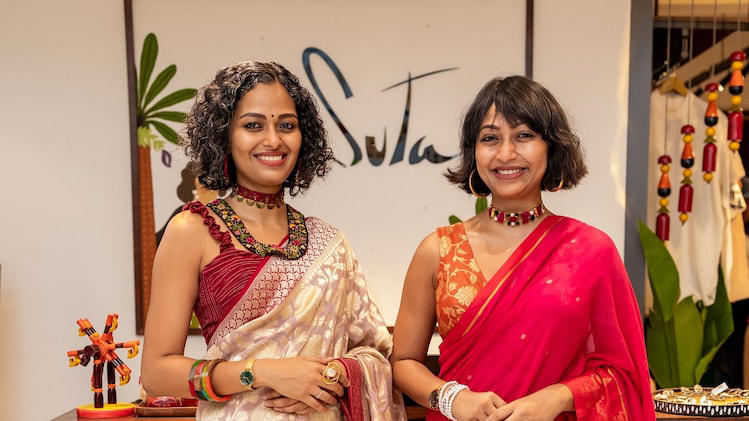
Suta: From Engineering Degrees to the Looms
The Biswas sisters are not products of fashion schools or textile legacies. They are engineers and MBAs who once built corporate strategies and ran production lines. “The Indian craft is already so beautiful. It just needed a little modern touch,” co-founder Sujata said in an interview.
Their first entrepreneurial step wasn’t sarees at all, it was a photography venture, where Sujata posed in clothes they stitched. People ignored the lens and loved the outfits. What the camera captured accidentally became their calling.
The Saree That Changed Everything
In 2016, when sarees were largely boxed into “wedding wear,” the sisters went back to that childhood memory, the gentle texture of mul cotton, light enough to feel like a second skin. It inspired their first big hit: “Made in Heaven Mul”, designed for everyday comfort, priced affordably, and loved by young first-time saree wearers.
It was a simple yet bold contradiction to the market:
- sarees that were minimal, not heavy
- woven by artisans, yet priced accessibly
- meant for daily life, not only ceremonies
Suta didn’t just sell a garment; it taught Gen Z how to feel at home in a saree.
A Brand That Didn’t Chase Funding, Only Fairness
From just two weavers, Suta now collaborates with thousands of artisans across India, providing steady work, fair wages and dignity for a craft that was fading. The sisters insist the relationship is not charity, it’s interdependence. “Brands like us need them more,” Sujata shared during a conversation, speaking of how younger family members of artisans are now returning to weaving because they see hope in the profession again.
Notably, the growth came without a single rupee of external funding. The company has remained profitable, backed directly by paying customers, not by investor cheques. Their revenues crossed ₹75 crore by FY 2025.
The IPO Dream, But Not Yet
Despite rapid store expansion, 15 stores and counting across India, the founders are in no rush to scale at the cost of purpose. They are eyeing an IPO, but only after reaching deeper stability. The goal isn’t explosive speed. It’s longevity.
Their approach echoes the very lesson the handloom industry teaches: true value grows slowly and meaningfully.
Their designs today span pre-stitched sarees, reversible blouses, stretchable fabrics, all created to make sarees effortless without losing their soul. Because, as Sujata puts it: “Fashion is not just about looking good, it’s about feeling good.”
The Legacy They Are Weaving
Suta’s success is not merely commercial. It has resurrected respect for an ancient craft. It has brought sarees back into wardrobes not as nostalgia, but as choice.
A ₹6 lakh risk has today become a brand worn by celebrities, loved by everyday Indians, and celebrated globally. But the legacy is simpler and stronger than the revenue it has earned:
Two sisters trusted memory more than data, artisans more than trends, and softness more than scale.
Like their mul cotton, their journey reminds us that the softest things, when nurtured, can build the strongest empires.
Also Read: Agnikul Cosmos raises ₹150 crore as new investors back India’s small-satellite push