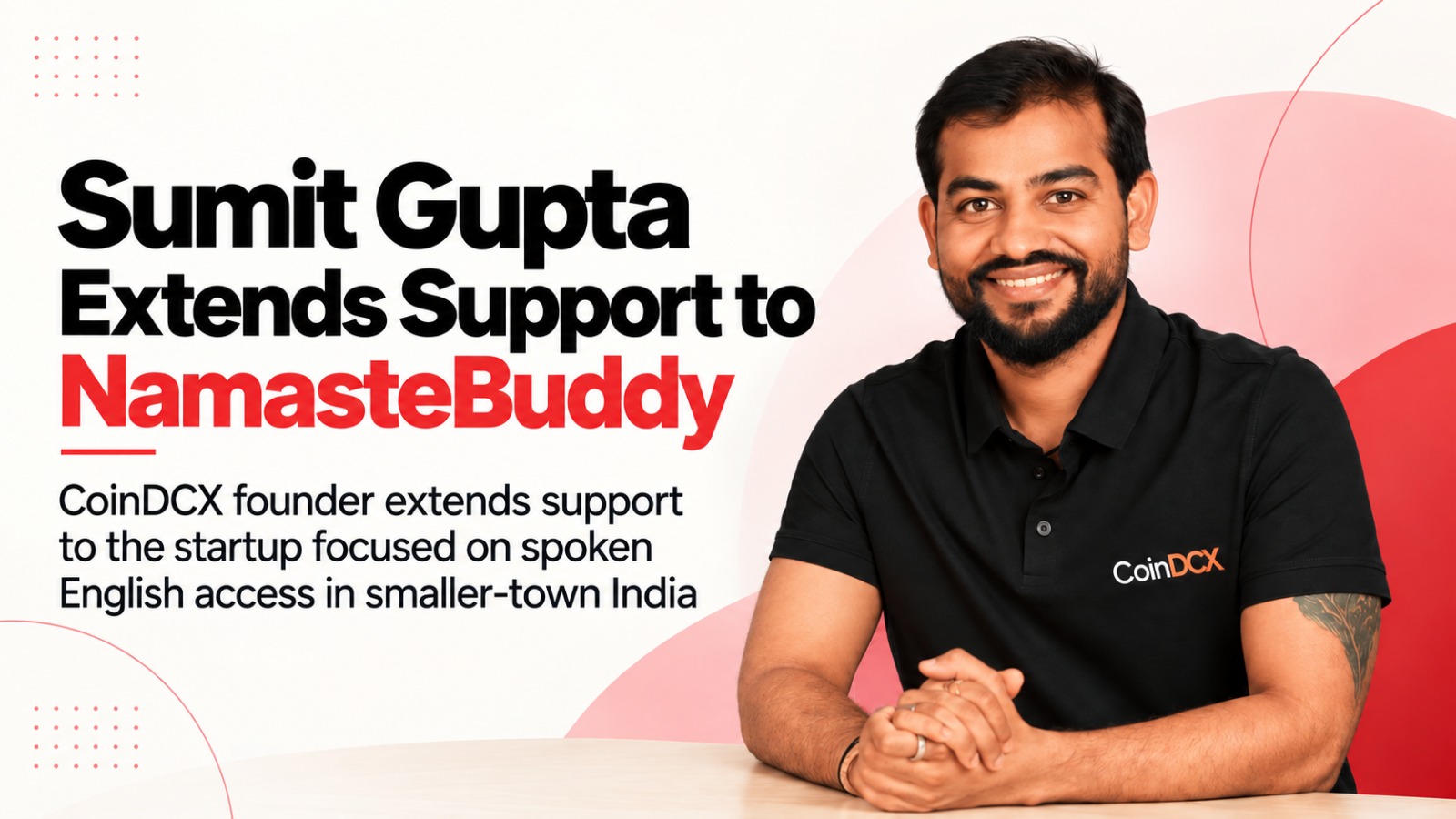
What began as a social media post about a young education startup quickly turned into a founder-to-founder conversation. NamasteBuddy, an AI-led conversational learning platform, drew the attention of CoinDCX founder Sumit Gupta after entrepreneur and social media creator Rohan Das highlighted the startup’s potential in rural India.
Das had pointed to a familiar gap in English education outside major cities. Students may study English in school, he noted, but many get little opportunity to use the language in everyday conversation. In his view, the bigger challenge is often not writing English, but speaking it with confidence.
The potential of a platform like NamasteBuddy is immense, but the hard part is turning it into reality.
Being a founder myself, I believe the primary use case for this platform will be in rural India.
That observation led him to publicly call on people in his network to help connect NamasteBuddy’s founders with those who could guide or support them.
Sumit Gupta responded soon after.
For Gupta, the issue carried a personal connection.
“This one’s quite personal for me. Having grown up in small villages and towns in Madhya Pradesh, I know how the right exposure and confidence can change a child’s journey,” he wrote.
This one's quite personal for me. Having grown up in small villages and towns in Madhya Pradesh, I know how the right exposure and confidence can change a child's journey.
I have asked my team to get in touch with the founders to see how I can help. https://t.co/sJXfavUNFq
He then added that he had asked his team to get in touch with the founders to explore how he could help.
That public exchange did not end on social media.
According to NamasteBuddy founder Nikhil Singh, it eventually led to a one-hour conversation with Gupta about the startup, its journey so far and where the team wants to take the product next.
Singh said one of the most striking parts of the discussion was Gupta’s understanding of the Tier-2 and Tier-3 India opportunity. Having grown up in a small town himself, Gupta brought a perspective shaped by firsthand familiarity with the opportunities and limitations that children in smaller cities and towns can face.
The conversation, Singh wrote, went well beyond the product.
The two discussed the problem NamasteBuddy is trying to solve, the opportunity in smaller cities and towns, areas where the startup could approach things differently, and lessons Gupta had gathered through his own entrepreneurial journey.
For a young startup still building its presence, that kind of conversation can matter.
NamasteBuddy began with a different use case. Its initial idea was to help children in the Indian diaspora speak Hindi with their grandparents through an AI conversation environment.
The company says that model worked, and it is now trying to bring the same approach to spoken-English practice in India.
Its pitch is simple: children should not only read or study a language, they should be able to speak it. The platform is designed around conversation, with AI characters responding to children, correcting them during the interaction and allowing them to rely on their own language when they need support.
The company has said it wants to focus on schoolchildren across Tier-2 and Tier-3 India, with smaller towns first and villages next.
That is also where the connection with Gupta’s response becomes significant.
His own experience of growing up in Madhya Pradesh gives the conversation a regional and personal context. For children in smaller towns across states such as Madhya Pradesh and Uttar Pradesh, where members of NamasteBuddy’s founding team also come from, access to regular spoken-English practice can be different from access to classroom instruction.
Das’s original observation was built around precisely that gap. English may be taught, but not always spoken often enough to build confidence.
NamasteBuddy is trying to position itself around that missing layer of practice.
Gupta has not announced an investment, partnership or formal association with the startup. What is confirmed is that he publicly offered to help, asked his team to connect with the founders and subsequently spent an hour speaking with Singh about the business, its market and the road ahead.
The significance of the episode is not in a funding announcement. It is in the speed with which a small startup’s idea travelled from one founder’s social media post to the attention of another entrepreneur who personally related to the problem.
Singh captured that shift in his own reflection on the day.
“Building a company is a strange journey. You spend months building quietly, and then suddenly something like this happens in a single day,” he wrote.
For NamasteBuddy, the immediate outcome is a conversation and a new connection.
For the larger problem it is trying to solve, the moment also underlines a question that is becoming increasingly relevant in smaller-town India: how do children move from learning English in a classroom to actually feeling comfortable speaking it?
NamasteBuddy believes conversational AI could be one answer.
And with Gupta now taking an interest in the company’s journey, the startup has found an experienced founder willing to engage with that question and help the team think through what comes next.