A young German climatetech company Co-Reactive is betting that one of the world’s most stubborn emissions problems can be tackled not just with cleaner energy, but with chemistry that literally turns CO₂ into a construction input.
Co-reactive, headquartered in Düsseldorf, has raised €6.5 million in seed funding to scale a continuous CO₂ mineralisation process that it says can lock emissions into CO₂-negative supplementary cementitious materials (SCMs), materials used to partially replace traditional cement components in concrete.
The round was led by High-Tech Gründerfonds (HTGF), with participation from NRW.Bank, HBG Ventures, AFI Ventures, Evercurious VC, and “several climate tech angels,” the report said. Co-reactive also secured seven-figure support from the German Federal Ministry for Economic Affairs and Energy (BMWi).
From lab-scale to a 1,000-tonne-per-year demo plant
The company’s next milestone is unapologetically industrial.
With this fresh capital, Co-reactive plans to move from prototype work into a continuous 1,000-tonne-per-year demonstration plant by Q2 2026.
Beyond that, it says it is preparing first-of-a-kind plants at “tens-of-thousands-of-tons” scale, targeting deployments that directly mineralise biogenic or process-related CO₂ streams at cement and steel facilities starting in 2027.
In plain terms: this is a company trying to prove that carbon mineralisation can run continuously, not as a lab trick and then plug into heavy industry where the CO₂ is already concentrated and constant.
Also Read: India Tech Startups Raise $10.5 Billion in 2025, Stay Global No. 3
Why cement is the battleground?
Cement is a decarbonisation headache for two reasons: it’s massive in volume, and emissions are baked into the process.
Cement production accounts for roughly 8% of global CO₂ emissions. It also flags a cost squeeze: rising CO₂ pricing is expected to push production costs upward, “potentially doubling within a decade.”
At the same time, the industry’s most widely used substitutes are becoming harder to source. Traditional SCMs like fly ash and ground granulated blast furnace slag are becoming scarce, due to the coal phase-out and changing steel production methods.
That combination, pressure to cut emissions plus shrinking availability of “easy” cement replacements is where Co-reactive is positioning itself.
What Co-reactive says its process does?
Co-reactive’s pitch is straightforward: take CO₂ that would be emitted, react it with minerals, and end up with a usable cement substitute that also stores carbon.
Its process reacts emissions with natural minerals such as olivine or with metallurgical slags from EAF and BOF steelmaking. The company says the output is a “new class” of CO₂-negative SCMs that can improve compressive strength and durability, while allowing producers to cut clinker content, a major driver of cement’s emissions profile.
Importantly for conservative industrial buyers, the report describes the solution as “drop-in technology”, designed to integrate into current cement and materials production lines without requiring a complete overhaul.
That “drop-in” promise matters because cement plants aren’t startups. They’re capital-heavy, risk-averse operations that move slowly unless the economics and reliability are convincing.
A crowded ecosystem and a deliberate strategy to fit into it
Co-reactive isn’t selling a standalone gadget; it’s attempting to build a network around a material stream.
The company was founded in 2024 by Dr. Andreas Bremen, Orlando Kleineberg, and Willi Peter, and it says it’s building an “end-to-end ecosystem,” collaborating with CO₂ suppliers, raw material providers, cement and concrete manufacturers, and certification bodies.
Longer term, the report says its vision points to 100–300 kilotonne industrial plants to bring CO₂ mineralisation into mainstream production.
What the founders and lead investor are saying
In a statement included in the report, Dr.-Ing. Andreas Bremen, Co-reactive’s co-founder and CEO, framed the challenge as moving beyond research and into industrial execution:
“We are taking CO₂ mineralisation from the lab into continuous industrial operation… [HTGF’s] support… gives us the strength to deliver proof of performance with a 1,000-ton demonstration plant and to prepare large-scale deployment together with industry.”
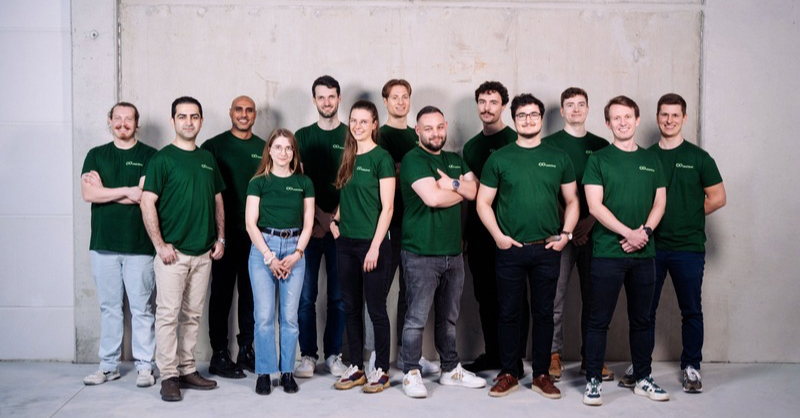
HTGF, the lead investor, highlighted both scarcity and economics. Anna Stetter, Investment Manager at HTGF, said conventional SCMs are becoming more expensive as decarbonisation progresses, adding that fly ash prices have “in some cases quadrupled over the past two years.” She described Co-reactive’s approach as both CO₂-negative and integrable as a drop-in solution, pointing to “strong unit economics” and the team’s plant-engineering expertise.
The real test: proving performance, not just a climate story
For all the climate urgency around cement, the market is unforgiving: materials must meet standards, performance has to be consistent batch after batch, and any new input must be certifiable at scale.
That’s why Co-reactive’s timeline is worth watching. A continuous 1,000-tonne-per-year demonstration plant by Q2 2026 is the kind of milestone that can generate real-world data and, if successful, de-risk the jump to tens-of-thousands-of-tons plants aimed at cement and steel sites from 2027.
If it works as described, the idea is elegant: make CO₂ a feedstock, not a waste product and sell the output into a sector that has to decarbonise but can’t compromise on strength and durability.
Also Read: Memcyco Raises $37M: Israeli Cybersecurity Startup Scales Fraud Defense