IPL Business Model: For nearly two months every year, India does not just watch cricket. It rearranges its evenings around it.
Families eat dinner with the match on. Offices run fantasy leagues. Brands plan campaigns around fixtures. Restaurants screen games. Phones light up with scores, memes, reels and arguments. A six in the final over is not just a sporting moment. It is advertising inventory, digital traffic, food orders, social media content and brand recall, all moving at once.
That is the real business of the Indian Premier League.
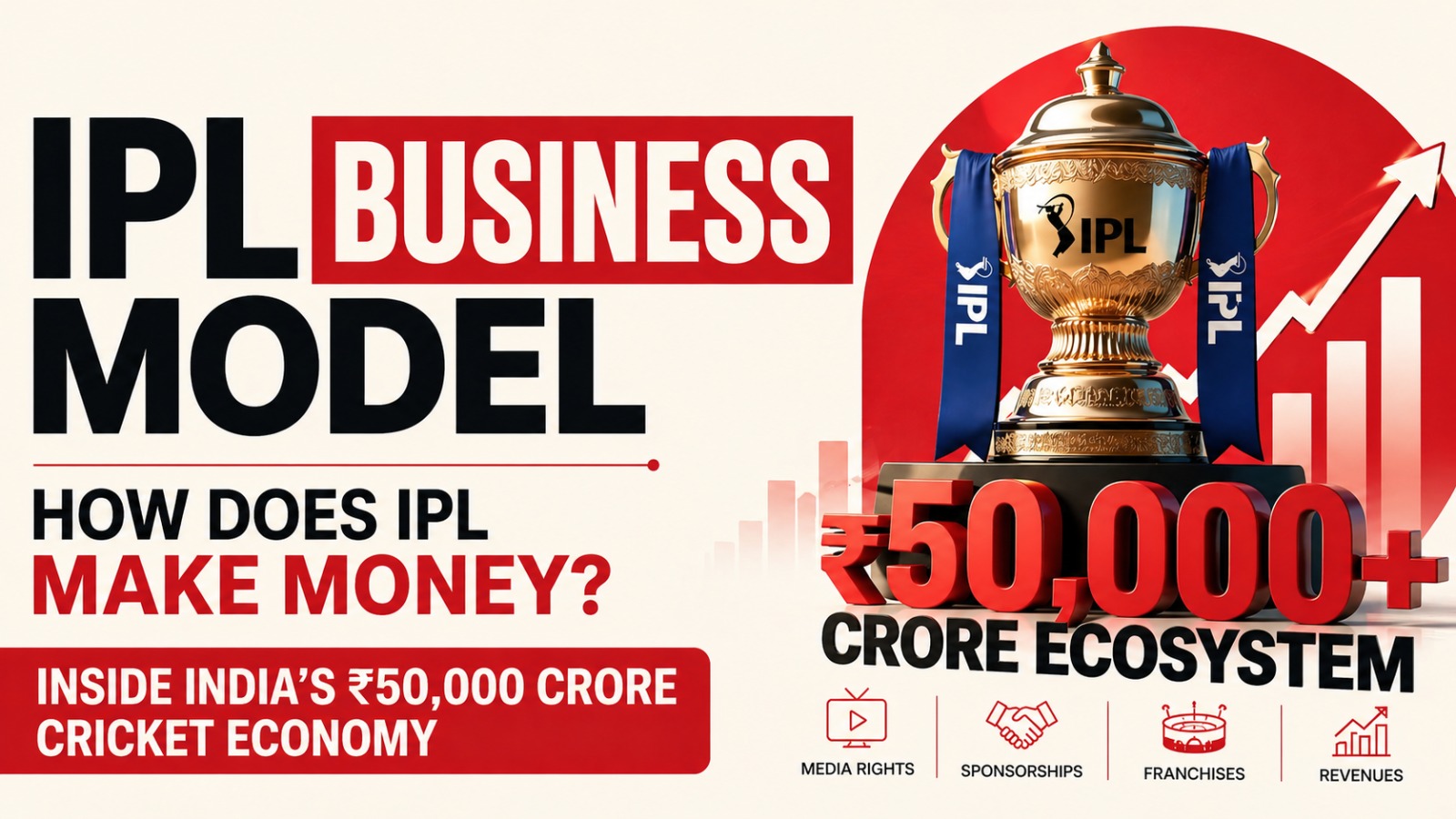
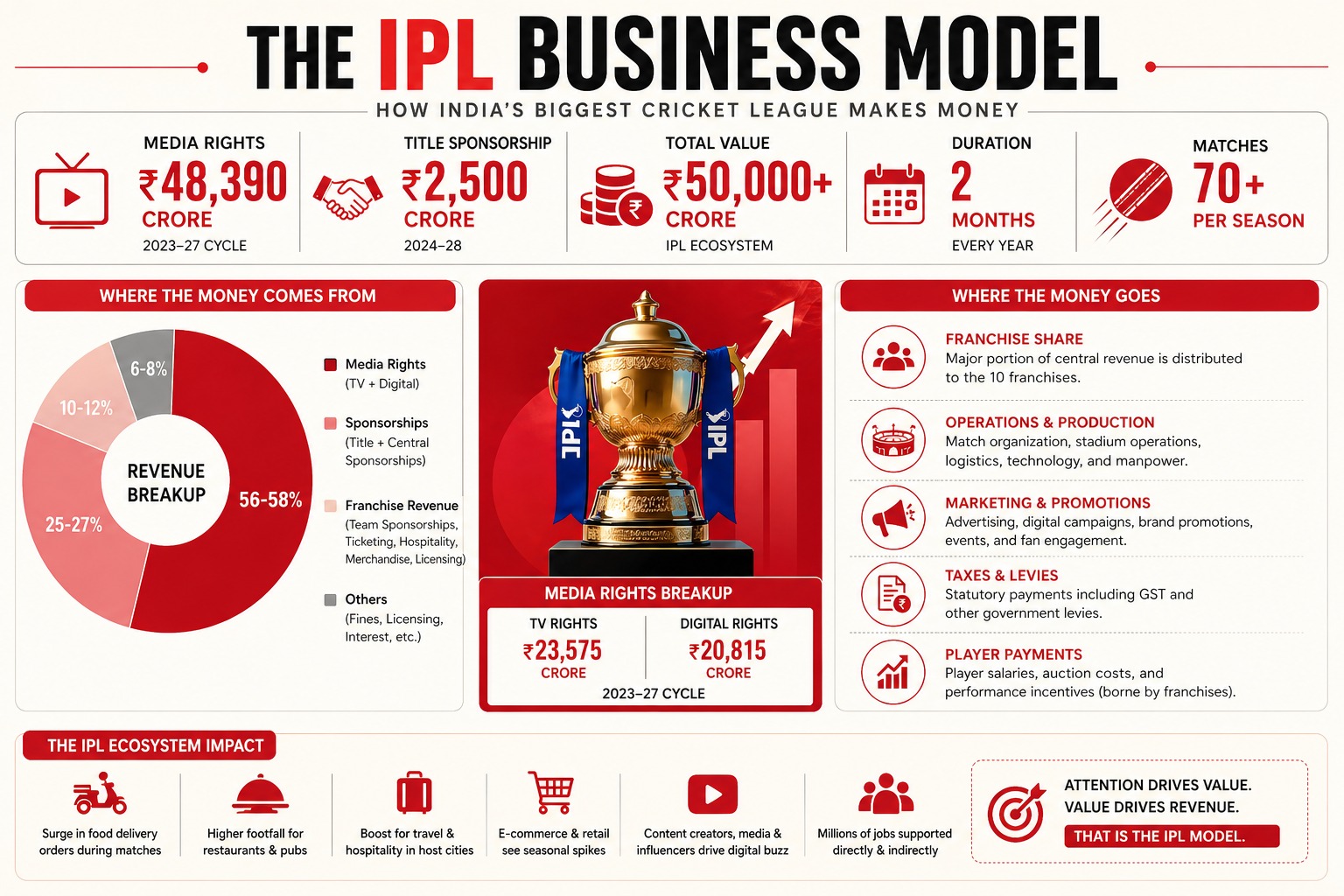
The IPL is often described as a cricket tournament, but that definition is too small now. It is a media property, a franchise economy, a sponsorship marketplace and a seasonal consumer festival. Its commercial foundation alone crossed historic scale when the BCCI sold IPL media rights for the 2023 to 2027 cycle for ₹48,390 crore. Add title sponsorship, central sponsorships, franchise-level deals, ticketing, hospitality and merchandising, and the IPL comfortably sits inside a ₹50,000 crore plus business ecosystem.
Also Read: Who Owns Your Team Now? IPL’s Latest Ownership Breakdown
The biggest product is not cricket. It is attention.
The IPL’s biggest strength is that it sells something every brand wants but few platforms can guarantee: mass Indian attention.
A streaming show can trend for a weekend. A film can dominate for a few days. A political event can capture attention briefly. But IPL delivers repeated prime-time attention across weeks.
That is why advertisers keep returning.
The tournament gives brands reach across cities, languages, income groups and age brackets. It also gives them emotion. A normal ad break is forgettable. An ad during a tense chase, a timeout, or a rivalry match lands inside a moment people are already emotionally invested in.
That is what makes IPL advertising different.
The ₹48,390 crore media rights deal changed everything
The clearest proof of IPL’s commercial power is its media rights value.
For the 2023 to 2027 cycle, IPL media rights were sold for ₹48,390 crore. Disney Star retained television rights for the Indian subcontinent, while Viacom18 secured digital rights for the same territory. The deal placed IPL among the most valuable sports properties in the world by per-match value.
This number is important because it explains the entire IPL economy.
Franchises do not depend only on ticket sales or jersey sponsors. A major portion of their business rests on the central revenue pool created by media rights and sponsorships. This makes IPL teams more stable than many traditional sports businesses because their biggest income stream comes from the league’s collective commercial power.
IPL’s main revenue structure: The IPL Business Model
| Revenue stream | Who benefits |
|---|---|
| Media rights | BCCI and franchises |
| Title sponsorship | BCCI and franchises |
| Central sponsorships | BCCI and franchises |
| Team sponsorships | Individual franchises |
| Ticketing | Franchises and venue stakeholders |
| Hospitality | Franchises and stadium partners |
| Merchandise and licensing | Franchises and partners |
This structure is why IPL works as a business. The league creates central value, then franchises build their own local and national brand value on top of it.
Sponsorship is where cricket becomes commerce
The Tata Group secured IPL title sponsorship rights for 2024 to 2028 in a deal valued at ₹2,500 crore, announced by the BCCI.
That figure tells us something important. Brands are not just buying logo visibility. They are buying cultural presence.
During IPL season, a sponsor can appear on television, streaming platforms, jerseys, stadium boards, highlight packages, social media clips and news discussions. The same brand can reach a viewer on the big screen, then again on a phone, then again through a meme, then again through a post-match video.
That repeated exposure is the reason IPL sponsorship remains so valuable.
Franchises are now serious business assets
In the early years, IPL teams were sometimes seen as glamour purchases. That view has changed.
A franchise today is a media-linked sports asset with recurring revenue, loyal fans and long-term brand value. Teams such as Chennai Super Kings, Mumbai Indians, Royal Challengers Bengaluru and Kolkata Knight Riders are not followed only because of results. They have built identity.
CSK stands for loyalty and continuity. Mumbai Indians built a winning culture. RCB became a fan movement through personality, digital engagement and Virat Kohli’s long association. KKR combined cricket, Kolkata emotion and celebrity appeal.
This is where IPL becomes more than sport. A team becomes a city symbol. A jersey becomes a lifestyle product. A fan base becomes an asset.
Digital streaming expanded the IPL market
Television made IPL a national habit. Digital made it personal.
Streaming changed how the tournament is consumed. Fans no longer need to sit in front of a television for three hours. They can watch on phones, follow scores during travel, catch highlights, switch language feeds and consume short clips throughout the day.
This has expanded the IPL’s value for advertisers.
Digital platforms allow sharper targeting than traditional television. A brand can reach younger viewers, regional language audiences and mobile-first consumers with far more precision. That is why IPL’s digital rights became so valuable in the latest cycle.
The auction is a business show of its own
The IPL auction is one of the league’s smartest inventions.
It turns team-building into public drama. A player’s price becomes a headline. A team’s strategy becomes a debate. A young uncapped cricketer getting a major contract becomes a national story.
The auction creates attention before the tournament even begins.
For franchises, it is not only about buying players. It is also about shaping perception. A bold signing tells fans the team is ambitious. Retaining a senior player signals loyalty. Investing in young Indian talent builds future value.
In the IPL, even recruitment has become content.
The wider economy around IPL
The official IPL economy is large. The unofficial seasonal economy around it is also significant.
Food delivery apps run match-night promotions. Restaurants and pubs host screenings. E-commerce brands launch cricket-led campaigns. Newsrooms create special coverage. YouTubers, podcasters and creators build daily content around teams, players and matches.
The IPL creates a short, intense consumption cycle.
This is why the tournament matters beyond cricket. It influences media planning, advertising budgets, consumer spending and digital engagement across India.
Why the IPL model is difficult to copy?
Many leagues have tried to build franchise-based sports properties in India. Few have matched the IPL’s scale.
The reason is simple. IPL had three advantages at once:
First, cricket was already India’s strongest sports habit.
Second, the league created city-based loyalty without breaking national cricket emotion.
Third, it arrived at the right time, just as television, mobile internet, celebrity culture and consumer brands were expanding rapidly.
That combination is rare.
The IPL did not create India’s love for cricket. It monetised it with extraordinary timing.
The risks are real
The IPL’s success does not mean it has no pressure points.
Media rights are expensive, so broadcasters and streaming platforms must recover large investments. Too much advertising can irritate viewers. Player workload remains a concern in modern cricket. The league must also protect the quality of competition because the business depends on the sport staying credible.
The IPL’s biggest challenge is balance.
It has to remain commercially aggressive without making fans feel that cricket has become secondary.
The Bottomline
The IPL is India’s most successful sports business story.
It has turned cricket into a repeatable commercial season where media companies, sponsors, franchises, players, platforms and fans all participate in the same economy. Its ₹48,390 crore media rights deal is the foundation, but the larger value comes from what happens around the matches.
Every over produces attention. Every attention window creates inventory. Every fan emotion becomes a business opportunity.
That is why IPL is not just a cricket league anymore.
It is India’s biggest annual business carnival built around sport.
And its real lesson is simple: in modern India, attention is money. For two months every year, nobody understands that better than the IPL.
Also Read: Vaibhav Suryavanshi’s Rise Is Bigger Than a Net-Worth Number