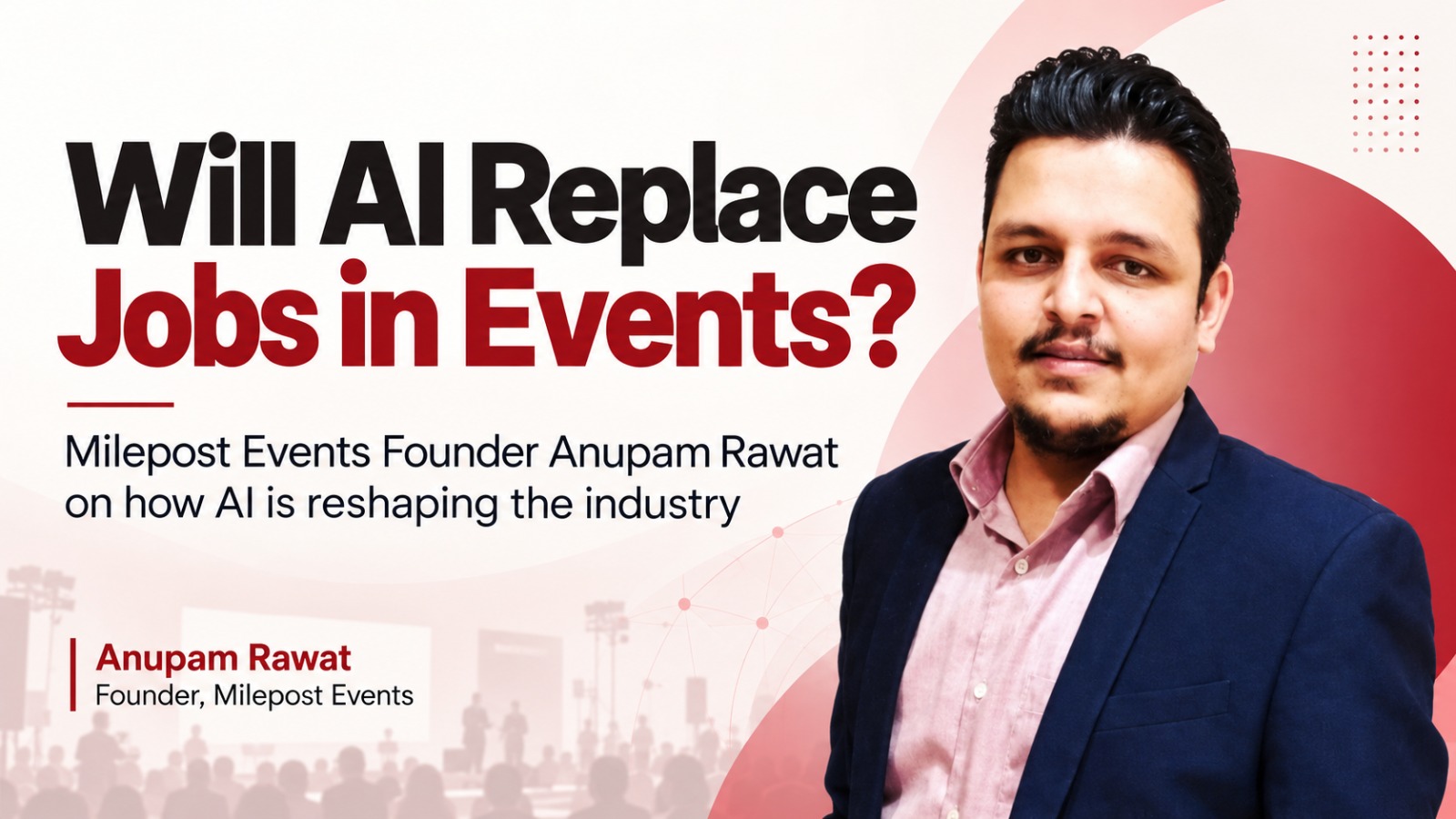
From event conceptualisation and client servicing to experiential marketing, vendor management, logistics and live production, artificial intelligence is beginning to challenge established business models in the events industry. Following Anupam Rawat‘s observations about employment disruption, Ascendants explores a bigger question: Is AI simply making event companies more efficient, or fundamentally changing the future of the profession?
Artificial intelligence could change not only how events are designed and executed but also how agencies generate revenue, build teams, manage clients and deliver experiences.
During a conversation with Ascendants, Anupam Rawat, Founder of Milepost Events, highlighted the impact of emerging technologies on employment within the industry. He estimated that the design and creative segment had already experienced approximately 30% job losses, while pointing out that technological adoption was also affecting production-related work.
His observations open up a much larger discussion.
The events industry is an interconnected ecosystem involving experiential marketing, corporate events, exhibitions, conferences, weddings, entertainment, sponsorships, technical production, hospitality, logistics, creative services and thousands of specialised vendors.
Unlike industries where AI primarily affects digital workflows, event management combines intellectual, creative, commercial and physical responsibilities.
An agency may use artificial intelligence to develop a campaign concept, estimate budgets, prepare a pitch, forecast attendance, personalise invitations, identify vendors and analyse audience engagement. Yet the same project still requires human coordination, physical infrastructure, client relationships, contingency planning and on-ground execution.
This creates a complex employment equation. AI may eliminate certain repetitive responsibilities, strengthen the capabilities of smaller teams and create entirely new service offerings.
However, greater technological efficiency does not automatically guarantee employment growth.
Against this backdrop, Ascendants examines ten defining questions around AI, employment and the changing economics of the events industry, drawing on themes raised during the conversation with Rawat.
1. Is AI merely replacing specific event management jobs, or are we witnessing a fundamental restructuring of the entire events industry?
The conversation around AI-driven job displacement has largely focused on creative designers and content professionals. However, the implications extend considerably further.
An event management company operates through multiple interconnected departments, including business development, client servicing, creative strategy, planning, procurement, production, logistics, marketing and operations.
AI now offers capabilities relevant to several responsibilities traditionally distributed across these departments.
For instance, initial proposals, presentation structures, communication drafts, planning documents and administrative reporting can increasingly be supported by automated systems.
This raises a fundamental business question: Will event management companies continue to recruit employees according to traditional departmental structures, or will they increasingly prefer smaller, multidisciplinary teams supported by technology?
More importantly, how will such restructuring affect professionals whose expertise lies in routine coordination and execution rather than strategic decision-making?
2. You raised concerns about employment losses in creative design. Could AI eventually have a greater impact on event planners, coordinators, client servicing executives and back-office teams?
Event management is often perceived as a predominantly creative and production-oriented profession. In practice, a considerable amount of agency work involves documentation, coordination, communication and repetitive administrative processes.
Consider the responsibilities involved in organising a corporate conference.
Teams must prepare schedules, manage registration databases, send invitations, develop communication material, coordinate speakers, track attendee requirements, maintain budgets and prepare post-event reports.
AI-assisted software can already support several of these activities.
As these tools improve, agencies will face decisions about which functions require dedicated employees and which can be managed through integrated technology platforms.
For entry-level professionals, this could be particularly significant because many begin their careers through coordination, documentation and client servicing responsibilities.
The challenge is determining whether AI will complement these roles or progressively reduce the requirement for dedicated personnel.
3. Pitching and business development are the backbone of event agencies. Could AI transform the traditional pitching ecosystem and create an entirely new competitive landscape?
Winning an event mandate often involves considerable investment before an agency receives confirmation of the project.
Teams spend time studying the brief, developing concepts, researching references, preparing presentations, estimating production requirements and creating preliminary budgets.
AI can potentially compress several stages of this process.
A relatively small agency equipped with sophisticated creative and planning tools may be able to prepare multiple pitch directions without employing an equally large supporting team.
This could alter the competitive dynamics between established agencies and emerging event management firms.
However, it also introduces a commercial dilemma.
If several agencies have access to similar generative tools, will clients begin receiving increasingly comparable creative proposals? Could faster pitch development encourage clients to demand more speculative work at shorter notice?
And if technology makes creating a preliminary pitch easier, will the industry’s differentiation increasingly depend on strategic thinking, execution credibility, proprietary ideas and client relationships rather than presentation capabilities alone?
4. Event production has traditionally depended on technicians, fabricators, audiovisual specialists and large execution teams. How deeply can AI penetrate the physical side of event management?
Rawat’s observation about technology influencing production is particularly relevant because event execution has traditionally involved substantial human intervention.
The production ecosystem includes stage construction, technical drawings, lighting, audiovisual systems, fabrication, equipment deployment, rehearsals and on-site coordination.
Emerging technologies are creating opportunities for automated lighting control, virtual previsualisation, computer-assisted technical planning, equipment monitoring and digital simulations.
These capabilities could reduce manual effort in certain planning and operational functions.
However, physical event execution introduces limitations that purely digital industries do not face.
A live event must account for venue conditions, electrical infrastructure, installation safety, weather, unexpected technical failures and last-minute client requirements.
The question, therefore, is not whether automation will eliminate physical production altogether, but which technical roles may evolve, which tasks can be automated and where experienced professionals will remain indispensable.
A related concern is whether traditional production vendors and technicians will have sufficient access to training and technology to participate in this transition.
5. Could AI disrupt the traditional agency-vendor relationship and allow brands to manage a larger portion of their events internally?
One of the less-discussed implications of artificial intelligence concerns the relationship between brands, event agencies and specialised service providers.
Historically, companies have relied on external agencies for services ranging from creative conceptualisation and event planning to vendor discovery, coordination and reporting.
However, AI-powered platforms can help internal marketing teams manage several aspects of the event planning process.
For instance, a brand’s in-house team could potentially use technology to prepare preliminary concepts, develop event communication, compare supplier quotations, draft schedules and analyse participant feedback.
This raises an important question for the agency business model.
If clients become more technologically self-sufficient, will they continue outsourcing end-to-end event management, or increasingly engage agencies only for specialised strategy, experiential creativity and physical execution?
Such a shift could influence agency retainers, project margins and the commercial value of traditional intermediary services.
It may also encourage event companies to redefine themselves as specialised experience partners rather than conventional project coordinators.
6. Beyond job displacement, could AI fundamentally change how event management agencies make money, price their services and protect their profitability?
Technological transformation is ultimately a commercial issue as much as an employment issue.
Traditional event agency pricing can involve creative fees, management charges, production costs, service fees and project-specific commercial arrangements.
If AI reduces the time required to undertake certain tasks, clients may eventually question the pricing of services previously associated with extensive human effort.
For example, preliminary visual concepts, campaign content, presentation development, administrative reporting and routine communication may become faster to produce.
However, reduced effort in one department does not necessarily translate into lower overall project expenses.
Venue rentals, transportation, catering, equipment, fabrication and physical logistics continue to involve real-world operational costs.
This creates an interesting strategic challenge: Should agencies pass technological efficiencies on to clients, reinvest the savings into better experiences or move towards pricing based on expertise and delivered value rather than manpower?
The answer could influence profitability, hiring decisions and even the survival of certain traditional agency business models.
7. Event technology is expanding beyond automation into audience intelligence. How could AI transform personalisation, sponsorship, experiential marketing and the measurement of event success?
For years, an important challenge for the industry has been demonstrating the measurable business value of experiential marketing.
While attendance figures and participant feedback offer useful indicators, brands increasingly want to understand how an event contributes to engagement, qualified leads, customer relationships and commercial objectives.
AI-powered analytics can potentially help organisers interpret registration patterns, participant preferences, session attendance and feedback data.
At exhibitions and business conferences, intelligent matchmaking tools can help connect delegates with relevant exhibitors, speakers or business opportunities.
For experiential marketing agencies, improved data analysis could support more targeted audience engagement and campaign evaluation.
This also creates opportunities to rethink sponsorship packages.
Rather than relying solely on branding visibility and estimated footfall, organisers could develop more detailed reporting around sponsor interactions and measurable participation, where appropriate data is lawfully available.
However, greater audience intelligence introduces questions concerning participant consent, data privacy, transparency and the responsible use of personal information.
Will the future event agency need professionals who understand data science and audience behaviour as deeply as they understand production and creativity?
8. Could AI-driven hybrid, virtual and immersive experiences eventually reduce demand for traditional physical events?
Artificial intelligence is also influencing how event experiences can be delivered.
Digital presenters, multilingual translation, intelligent networking systems, virtual environments and automated content generation offer possibilities for extending participation beyond a physical venue.
For international conferences and corporate gatherings, such technology could reduce certain communication and accessibility barriers.
Immersive technologies may also offer alternative formats for product demonstrations, exhibitions and brand experiences.
However, technological capability does not automatically translate into a replacement for physical participation.
Live events provide interpersonal interaction, spontaneous networking, sensory experiences and shared environments that remain central to many event objectives.
The larger question is whether the industry will increasingly adopt hybrid experience models in which physical and digital participation serve different purposes.
If that happens, event management companies may need to expand their capabilities beyond traditional venue-based execution and reconsider the composition of their technical and creative teams.
9. With automation entering multiple departments, what happens to young professionals, freelancers and small vendors who form a significant part of the event industry ecosystem?
The employment implications of AI should not be viewed exclusively through the lens of permanent agency employees.
The events industry also relies on freelance designers, technical specialists, content creators, coordinators, photographers, production assistants and independent service providers.
Many professionals develop their careers by working on project-based assignments before establishing their own specialised businesses.
If technology reduces demand for certain entry-level tasks, the industry could face a challenge in developing its future talent pool.
For example, professionals traditionally gain experience through research, documentation, production assistance and coordination before progressing towards creative direction or project leadership.
When technology begins handling portions of this foundational work, agencies may need to introduce more structured training pathways.
Simultaneously, independent professionals who adopt emerging tools could potentially expand their capabilities and compete for projects that previously required larger teams.
This presents two contrasting possibilities: AI could create more capable independent professionals while simultaneously increasing pressure on those unable to access or adapt to new technologies.
10. Looking towards 2030, what will a successful event management company look like? Will it be defined by its workforce, technological capabilities or its ability to create experiences that AI cannot replicate?
Perhaps the most consequential question surrounding AI is how it could redefine the identity of an event management agency.
Historically, the ability to handle large-scale projects has often been associated with extensive teams, established vendor relationships, operational capabilities and accumulated industry experience.
AI introduces another potential model, where technologically equipped teams can manage a wider range of responsibilities with fewer dedicated resources.
But event management is not simply the assembly of individual deliverables.
It involves interpreting client expectations, understanding human behaviour, anticipating operational challenges, negotiating with stakeholders and managing uncertainty in real time.
These responsibilities raise questions about the future value of professional experience.
Could the industry’s next competitive advantage come from combining human judgement with technological efficiency rather than increasing team size?
Will future recruitment prioritise AI literacy alongside creativity, communication, commercial understanding and technical knowledge?
And most importantly, as artificial intelligence becomes more deeply integrated into event management, how should industry leaders balance the pursuit of efficiency with their responsibility to develop and retain skilled professionals?
Beyond Automation: The Larger Question Facing the Events Industry
The concerns raised by Anupam Rawat point towards a transformation that extends beyond individual creative or production departments.
Artificial intelligence has the potential to influence almost every stage of the event management value chain, from the first client brief and commercial pitch to audience acquisition, event execution and post-event measurement.
For agencies, the immediate opportunity lies in understanding how emerging technologies can improve efficiency and expand capabilities.
For professionals, the challenge is identifying which skills will continue to command value as routine responsibilities become increasingly automated.
For the wider industry, however, a more fundamental issue remains.
If technological advancement enables event companies to deliver more work with fewer people, how will the industry ensure that productivity gains also translate into sustainable careers, stronger businesses and better experiences?
That is likely to become one of the defining conversations around the future of event management.
Also Read: iPhone 18 Pro Max Users: If You Face This Cellular Issue, Apple Advises Device Replacement